Culinary Explorer

A cooking platform built around craft, culture, and the stories behind what we eat.
Discover Culinary Explorer
Bombe Odessa

Bombe Odessa

Created by Chef Juliette

Based on No. 2891, Bombe Odessa, from Le Guide Culinaire (1907) by Auguste Escoffier

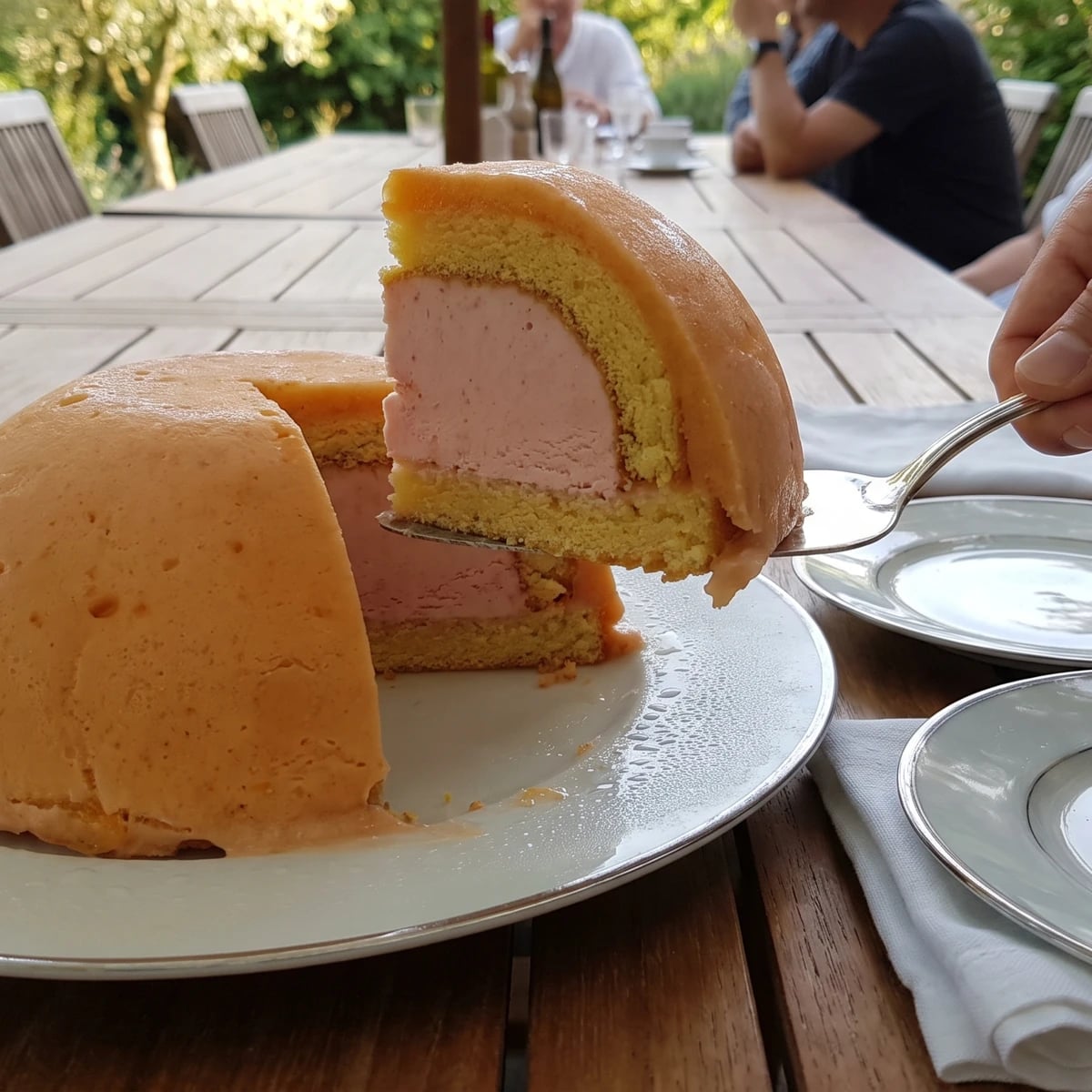
Apricot ice holds a pale strawberry pâte à bombe in a clean two-fruit contrast: bright shell, creamy heart, and no liqueur to blur either perfume. Sweeten boldly, freeze patiently, then turn it out.

Desserts
French
Dinner Party
Outdoor Dining
Make Ahead
50 min
Active Time
10 min cook9 hr total
YieldOne 1½-quart (1.4-liter) bombe, 8 servings

Bombe Odessa (an apricot-lined strawberry frozen bombe) teaches the first law of frozen dessert: cold mutes sweetness and perfume together. Taste both mixtures a shade sweeter and more fragrant than seems polite at room temperature, because the freezer will bring them into balance. The dish is two clear voices, tart-gold apricot around a rose strawberry pâte à bombe, with no liqueur between them.

The original line is a command in brigade shorthand: clothe the mould with apricot ice, then fill it with strawberry Bombe-preparation. It assumes prepared fruit ice, a dedicated freezing station, a mould managed over broken ice, and hands free to build layers during service. At home, a small metal mould, an ice-cream machine, an electric mixer, and an ordinary freezer do the same work for eight. The broken-ice rocking described in Another Method of Preparing Aspics de Filets de Soles (No. 916) is scaffolding for a professional cold station; the even apricot shell and aerated pâte à bombe are the dish, and they stay. One cook, one stove, one evening of active work, then the freezer takes the night watch.

The one step that decides it is clothing the mould: the apricot ice must be soft enough to spread but firm enough to hold an even coat. If it slides, don't fight it. Freeze the mould for ten minutes, patch the bare place, and continue.

Bombe Odessa belongs to the French grand dining-room repertory rather than to a regional household table; bombes took their name from the rounded mould, while individual formulas often borrowed the names of cities. Odessa in the title does not signal a Ukrainian ingredient or a liqueur: the canonical identity here is strictly apricot ice enclosing strawberry Bombe-preparation. Its journey to the home freezer changes the equipment and scale, not that two-part construction.

The technique, the tradition, and the story behind every dish.

Discover Culinary Explorer

Ingredients

unsweetened apricot purée

Quantity

2 cups (475 ml / 500 g)

from ripe or drained canned apricots

granulated sugar for the apricot ice

Quantity

⅔ cup (160 ml / 135 g)

water for the apricot ice

Quantity

¼ cup (60 ml / 60 g)

strawberry purée

Quantity

1 cup (240 ml / 250 g)

from ripe or thawed frozen strawberries, strained

large egg yolks

Quantity

4

granulated sugar for the pâte à bombe

Quantity

⅓ cup plus 1 tablespoon (95 ml / 80 g)

water for the pâte à bombe

Quantity

2 tablespoons (30 ml / 30 g)

cold heavy cream

Quantity

1 cup (240 ml / 240 g)

mould-clothing method reference

Quantity

1 consultation of Another Method of Preparing Aspics de Filets de Soles (No. 916)

technique only; no fish or aspic enters the dessert

Equipment Needed

  • 1½-quart (1.4-liter) metal bombe mould or stainless-steel bowl
  • 1-quart (1-liter) ice-cream machine
  • Electric stand or hand mixer
  • Digital sugar thermometer
  • Small offset spatula
  • Blender and fine-mesh sieve

Instructions

  1. 1

    Chill the equipment

    Set the freezer as cold as it will reasonably go. Chill the clean bombe mould and offset spatula for at least 30 minutes, and prepare the ice-cream machine according to its instructions. A cold mould catches the first layer quickly; a room-temperature one lets the apricot ice slide to the bottom.

  2. 2

    Make the apricot base

    Combine the ⅔ cup (160 ml / 135 g) sugar and ¼ cup (60 ml / 60 g) water in a small saucepan. Warm gently until the sugar dissolves, then take it off the heat and cool completely. Stir it into the apricot purée, cover, and chill until very cold, about 2 hours. Taste it cold. It should seem a shade too sweet and intensely apricot; the freezer will quiet both.

    Don't boil the apricot purée. Heat dulls its perfume, and the dissolved syrup needs no further cooking.
  3. 3

    Churn the apricot ice

    Churn the chilled apricot mixture until it has the dense, spreadable consistency of soft ice cream, usually 20 to 25 minutes. It must hold a ridge from the spatula without becoming hard. If it finishes churning before the mould is ready, hold it in the freezer for no more than 10 minutes and stir once before using.

    Without an ice-cream machine, freeze the mixture in a shallow metal tray, stirring and crushing the ice every 30 minutes, then process it smooth while still pliable. The texture will be slightly firmer, but the construction remains honest.
  4. 4

    Clothe the mould

    Chemiser, to clothe the mould, is the step that makes the bombe. Following the mould-clothing action recorded in Another Method of Preparing Aspics de Filets de Soles (No. 916), set the chilled mould over a tray of ice and turn it as you spread the apricot ice over the bottom and sides. Build an even layer about ½ inch (1.25 cm) thick, leaving a clean hollow in the centre. Freeze for 45 minutes. If the layer slides or exposes a bare patch, freeze it for 10 minutes, soften a spoonful of the remaining ice, and plaster the gap. Ça se rattrape.

  5. 5

    Strain the strawberry

    Pass the strawberry purée through a fine sieve, pressing firmly enough to capture the fruit while leaving most seeds behind. Chill it thoroughly. Keep the flavour plain and direct: no liqueur, vanilla, or citrus belongs between the apricot shell and strawberry centre.

  6. 6

    Whip the pâte à bombe

    Pâte à bombe is a yolk foam cooked with hot sugar syrup. Beat the yolks in a heatproof bowl until thick and pale. Combine the remaining sugar and 2 tablespoons (30 ml / 30 g) water in a small saucepan, dissolve it over gentle heat, then boil without stirring to 244°F (118°C). With the mixer running, pour the syrup in a thin stream between the whisk and the bowl, never directly onto either. Continue beating until the mixture is voluminous, holds a broad ribbon, and feels cool rather than warm, about 8 minutes. If the syrup crystallizes before reaching temperature, add a tablespoon of water, dissolve it gently, and begin the boil again. If a few cooked threads form in the yolks, pass the mixture through a fine sieve while warm, then resume beating.

  7. 7

    Fold and fill

    Whip the cold cream to soft peaks; it should bend, not stand stiffly. Fold the cold strawberry purée into the cooled pâte à bombe, then fold in the cream in three additions, preserving as much air as possible. If the base still feels warm, stop and set the bowl over ice before adding the cream. Warm pâte à bombe collapses it, and waiting five minutes is cheaper than losing the centre. Spoon the strawberry mixture into the frozen apricot shell, pressing gently into the curve so no hollow pockets remain. Level the top, cover closely, and return the mould to the freezer.

  8. 8

    Freeze and unmould

    Freeze until solid through the centre, at least 6 hours and preferably overnight. To unmould, dip the mould in warm water for 5 to 8 seconds, dry it, and invert it onto a chilled platter. If it refuses to release, wrap the mould briefly in a warm towel; don't keep soaking it, or the apricot shell will melt before the centre moves. Return a softened bombe to the freezer for 15 minutes. Let it stand for 5 minutes before cutting with a warmed, thoroughly dried knife. Serve generous wedges while the apricot edge is firm and the strawberry heart has begun to soften. À table!

Chef Tips

  • Ripe apricots are magnificent here, but unsweetened canned apricots are the classical pantry's honest answer outside their season. Drain them well before puréeing. Frozen strawberries picked ripe are better than pale fresh berries with no perfume.
  • Don't reduce the sugar because the unfrozen mixtures taste generous. Sugar carries flavour and controls hardness in a frozen dessert; too little gives you a mute, icy shell and a centre that freezes like a brick.
  • The formula contains no liqueur, and none is missing. Alcohol would soften the freeze and blur the clean boundary between apricot and strawberry.
  • The hot-syrup method cooks the yolk foam, but cooks serving pregnant guests, older guests, young children, or anyone with reduced immunity should begin with pasteurized egg yolks.

Advance Preparation

  • If the ice-cream machine uses a frozen bowl, freeze it for the full time required by its maker, commonly 24 hours. A half-frozen bowl will not give the apricot ice enough body to clothe the mould.
  • The apricot base and strained strawberry purée can be prepared and chilled one day ahead. Keep them covered so their perfumes remain distinct.
  • The completed Bombe Odessa can be frozen for up to 3 days. Wrap the filled mould closely, keep it level, and unmould only shortly before serving.

Frequently Asked Questions

Nutrition Information

1 serving (about 170g)

Calories
280 calories
Total Fat
13 g
Saturated Fat
8 g
Trans Fat
0 g
Unsaturated Fat
5 g
Cholesterol
125 mg
Sodium
15 mg
Total Carbohydrates
37 g
Dietary Fiber
2 g
Sugars
35 g
Protein
3 g

Note: Chef personas and recipes are created with AI assistance. Cook with care: follow safe food-handling practices, check doneness with a thermometer when needed, and adapt for allergies and your kitchen.

Where cooking meets culture.

Culinary guides, cultural storytelling, and the editorial depth that makes cooking meaningful.

Discover Culinary Explorer

More from Ices and Sherbets - Various Bombes

Browse the full collection