Culinary Explorer

A cooking platform built around craft, culture, and the stories behind what we eat.
Discover Culinary Explorer
Bombe Nero

Bombe Nero

Created by Chef Juliette

Based on No. 2887, Bombe Nero, from Le Guide Culinaire (1907) by Auguste Escoffier

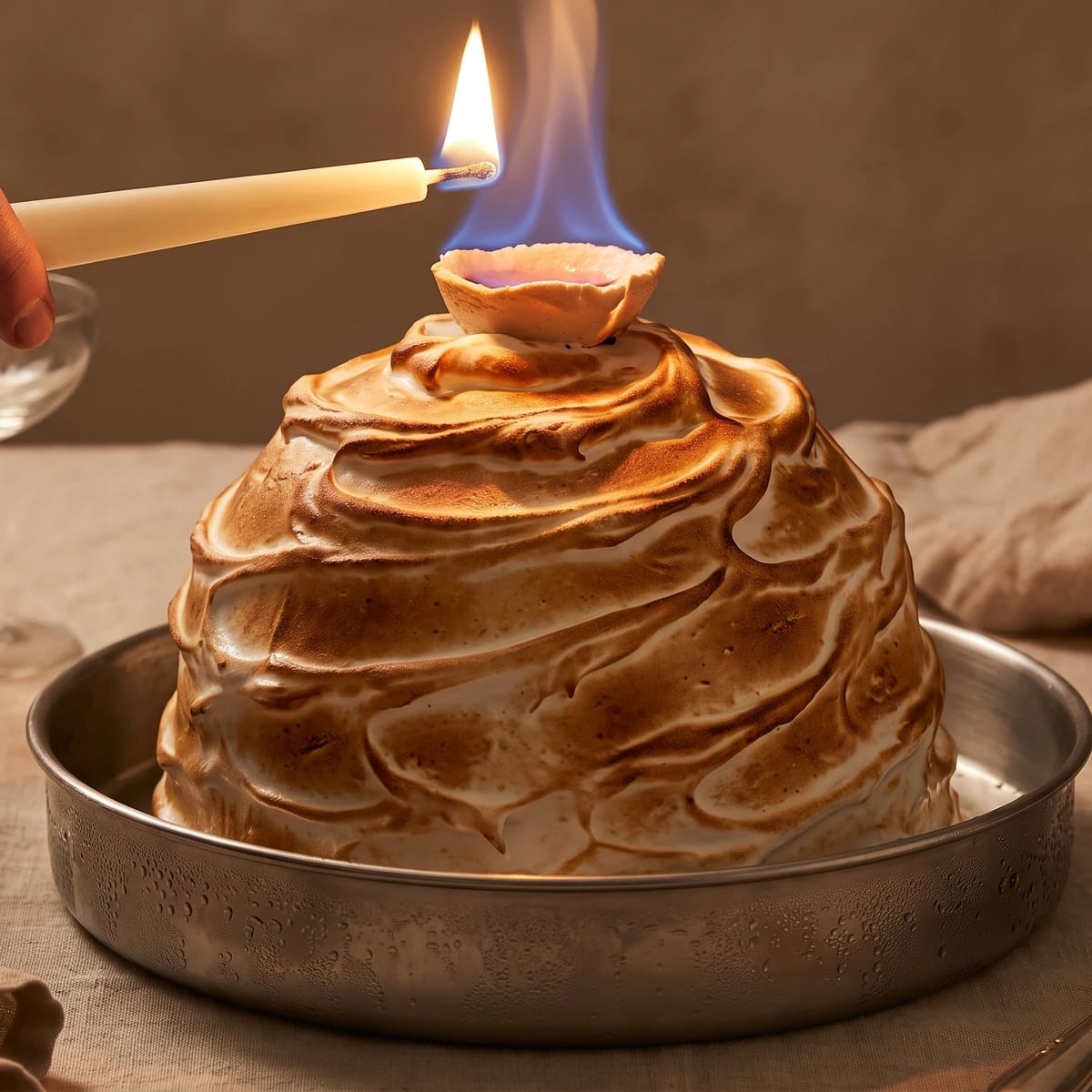
Bombe Nero hides vanilla-caramel ice and a truffle-studded vanilla mousse beneath bronzed Italian meringue, then brings rum fire to the celebration table. Freeze it hard, glaze it fast, and serve while the room is watching.

Desserts
French
Celebration
New Years
Special Occasion
2 hr 15 min
Active Time
1 hr 45 min cook11 hr total
YieldOne 7-inch (18 cm) bombe, 8 servings

Bombe Nero (a vanilla-caramel ice bombe with chocolate truffles and flaming rum) teaches one true thing before all others: temperature is an ingredient. The caramel-ice shell must be hard enough to hold a pale vanilla mousse, and the Meringue à l’Italienne (No. 2383) must bronze before the frozen centre has time to notice the heat. Seconds make the glaze. Minutes ruin it.

The original grand kitchen assumed a pâtissier preparing several finished components, a metal bombe mould, a hard-freezing cabinet, and a salamander fierce enough to colour sugar almost instantly. At home, a chilled stainless steel bowl becomes the mould and a fully heated broiler becomes the salamander. The separate churn of vanilla ice was brigade scaffolding, so a good full-fat vanilla ice cream receives a dark caramel made on your stove; the mousse, chocolate truffles, Punch Biscuit, Italian meringue, layered freezing, and rum flame stay because they are the dish.

The active work fits one cook, one stove, one evening, though the freezer deserves its full shift before the celebration. The deciding step is the last one: freeze the bombe hard, then glaze it under fierce heat for seconds, never minutes.

The bombe belongs to the Parisian pâtissier's repertory, taking its name from the domed metal mould whose shape recalled an artillery shell and moving from grand dining rooms to celebration tables through generations of frozen-dessert service. Bombe Nero's title is theatrical rather than regional: dark chocolate truffles punctuate the vanilla mousse, while the rum flame at its crown supplies the final drama. It is not simply ice cream hidden under meringue; the clothed mould, mousse heart, Punch Biscuit, rapid glaze, and tableside flame are its classical architecture.

The technique, the tradition, and the story behind every dish.

Discover Culinary Explorer

Ingredients

full-fat vanilla ice cream

Quantity

3½ cups (830 ml / 740 g)

softened only until spreadable

granulated sugar, for the caramel ice

Quantity

⅓ cup (80 ml / 70 g)

heavy cream, for the caramel ice

Quantity

3 tablespoons (45 ml / 45 g)

warmed

unsalted butter, for the caramel ice

Quantity

1 tablespoon (15 ml / 14 g)

diced

fine sea salt, for the caramel ice

Quantity

⅛ teaspoon (0.6 ml / 0.8 g)

dark chocolate containing 65 to 70 percent cacao

Quantity

¾ cup (180 ml / 125 g)

finely chopped

heavy cream, for the chocolate truffles

Quantity

¼ cup (60 ml / 60 g)

unsalted butter, for the chocolate truffles

Quantity

1 tablespoon (15 ml / 14 g)

softened

pasteurized large egg yolks

Quantity

4

granulated sugar, for the vanilla mousse

Quantity

½ cup (120 ml / 100 g)

water, for the vanilla mousse

Quantity

3 tablespoons (45 ml / 45 g)

vanilla bean

Quantity

1

heavy cream, for the vanilla mousse

Quantity

1⅔ cups (400 ml / 400 g)

thoroughly chilled

large eggs, for the Punch Biscuit

Quantity

2

separated

granulated sugar, for the Punch Biscuit

Quantity

⅓ cup (80 ml / 65 g)

cake flour

Quantity

½ cup (120 ml / 60 g)

sifted

unsalted butter, for the Punch Biscuit

Quantity

1 tablespoon (15 ml / 14 g)

melted and cooled

water, for the punch syrup

Quantity

2 tablespoons (30 ml / 30 g)

granulated sugar, for the punch syrup

Quantity

2 tablespoons (30 ml / 25 g)

dark rum, for the punch syrup

Quantity

1 tablespoon (15 ml / 14 g)

Meringue à l’Italienne (No. 2383)

Quantity

5½ cups (1.3 L / 650 g)

prepared in two batches from its own entry

dome mould clothed by the technique in Another Method of Preparing Aspics de Filets de Soles (No. 916)

Quantity

1

using caramel ice cream rather than jelly; no fish or aspic enters the dessert

dark rum at 45 to 50 percent alcohol, for flaming

Quantity

¼ cup (60 ml / 56 g)

Equipment Needed

  • 1½-quart (1.5 L) stainless steel dome mould or mixing bowl with a 7-inch (18 cm) opening
  • Electric hand mixer or stand mixer
  • Candy or instant-read thermometer
  • 8-inch (20 cm) cake tin
  • Piping bags with plain and star tips
  • 10-inch (25 cm) flat stainless steel serving platter, freezer-safe and broiler-safe
  • Flexible metal spatula
  • Long taper or fireplace match
  • Small metal lid for extinguishing the rum flame

Instructions

  1. 1

    Dry the meringue cup

    Heat the oven to 200°F (95°C) and line a small tray with parchment. Prepare about 1 cup (240 ml / 120 g) of the Meringue à l’Italienne (No. 2383) from its own entry, leaving the larger finishing batch unmade for now. Pipe a 2½-inch (6 cm) disk, then pipe three rings around its edge to form a shallow receptacle for the rum. Dry it for 75 to 90 minutes, until crisp enough to lift cleanly, then cool and store airtight. If one ring cracks, pipe a little meringue over the gap and return it to the oven for 15 minutes. Ça se rattrape.

  2. 2

    Shape the truffles

    Reserve 1 tablespoon of the measured truffle cream. Warm the remainder until small bubbles appear around the edge, then pour it over the chopped chocolate. Wait one minute, add the softened butter, and stir from the centre outward until the ganache is dark and glossy. If it turns oily, stir in the reserved warm cream a teaspoon at a time until it closes again. Chill until firm enough to handle, then roll 12 to 14 pieces the size of small hazelnuts and freeze them on a lined plate.

  3. 3

    Make caramel ice

    Put the caramel sugar in a light-coloured saucepan and cook it over medium heat without stirring, swirling the pan only after the edges begin to melt. Let it reach a deep amber, then remove the pan from the heat and add the warm cream carefully; it will rise fiercely. Return it to low heat and stir until smooth, then add the butter and salt. If the caramel seizes into a hard lump, keep it over gentle heat and stir patiently. It will melt back. Cool it completely, then work it through the softened vanilla ice cream until the colour is evenly café au lait.

  4. 4

    Clothe the dome

    Chill a 1½-quart (1.5 L) stainless steel dome mould or mixing bowl for 20 minutes. Chemiser, meaning clothing the mould, follows the coating principle in Another Method of Preparing Aspics de Filets de Soles (No. 916), applied here to ice cream rather than jelly. Press the caramel ice evenly over the bottom and sides in a layer about ⅝ inch (1.5 cm) thick, leaving a clean hollow in the centre. If the ice slides toward the bottom, freeze the first thin coating for 10 minutes, then add the rest. Freeze the clothed mould until thoroughly hard, about 2 hours.

    Run the back of a cold spoon over the shell and hold the bowl to the light. Thin patches show clearly and can be reinforced before the mousse goes in.
  5. 5

    Bake Punch Biscuit

    Raise the oven to 375°F (190°C). Line the base of an 8-inch (20 cm) cake tin. Whisk the yolks with half the biscuit sugar until pale and thick. In a clean bowl, whisk the whites until foamy, add the remaining sugar gradually, and continue until they hold a supple peak. Fold the whites into the yolks, sift over the flour, and fold again, adding the cooled butter with the final strokes. Spread the batter thinly in the tin and bake for 10 to 12 minutes, until lightly golden and springy. Cool, then trim it to the exact diameter of the bombe mould. If the edge tears, patch it with a trimmed piece and put that side underneath. Cooking well is not cooking fancy.

  6. 6

    Whip vanilla mousse

    Reserve 2 tablespoons of the cold mousse cream. Split the vanilla bean and scrape its seeds into the yolks. Whisk the yolks in a heatproof mixer bowl while the mousse sugar and water cook to 244°F (118°C). With the mixer running, pour the syrup in a thin stream down the inside of the bowl, never onto the whisk, and beat until the pâte à bombe, the yolks whipped with hot syrup, is thick, pale, and cool. Whip the remaining cream to soft peaks and fold it into the pâte à bombe in three additions. If the base is still warm and loosens the cream, stop, set the bowl over ice, and fold again once cool. If the cream becomes grainy, fold in the reserved liquid cream to smooth it.

  7. 7

    Fill and freeze

    Spoon one-third of the vanilla mousse into the frozen caramel-ice shell and scatter over one-third of the frozen chocolate truffles. Continue in layers so the truffles remain suspended rather than sinking into one dark band. Smooth the final mousse level with the rim, cover the mould, and freeze for at least 6 hours, preferably overnight. The shell and centre must be hard before unmoulding; this waiting is not brigade scaffolding, it is the structure of the Bombe Nero.

  8. 8

    Punch the biscuit

    Bring the punch-syrup water and sugar to a boil and stir only until clear. Cool it, then add the dark rum. Set the Punch Biscuit on a flat, freezer-safe stainless steel serving platter and brush it lightly with the syrup. It should be fragrant and supple, not saturated; too much syrup freezes into an icy layer beneath the mousse.

  9. 9

    Unmould and cover

    Press a towel wrung out in warm water against the mould for 5 seconds, then invert it over the Punch Biscuit. If the bombe refuses to release, repeat with the towel rather than holding it under hot water. Centre the dome on its biscuit cushion. Prepare the remaining Meringue à l’Italienne (No. 2383) from its own entry and spread a thin, complete layer over the bombe. Pipe ridges or shells around the sides, then fix the dried meringue receptacle at the crown with a dab of fresh meringue. Freeze the covered bombe, uncovered, for 30 to 45 minutes.

  10. 10

    Glaze under fierce heat

    Set an oven rack 5 to 6 inches (13 to 15 cm) below the broiler and heat it at maximum for a full 15 minutes. Take the bombe directly from the freezer to the broiler on its metal platter. Glaze it for 30 to 60 seconds, rotating once if necessary, until the ridges are bronzed but the hollows remain ivory. Watch without turning away. A slow oven melts the bombe before it colours. If a small patch begins to slide, pull the platter out immediately, press the meringue back with a cold spatula, and refreeze for 15 minutes. Ça se rattrape.

    Use metal beneath the bombe. A chilled ceramic platter can crack when it meets the broiler's fierce heat.
  11. 11

    Flame and serve

    Place the measured rum in a small heatproof jug and stand it in a bowl of just-boiled water until it reaches about 125°F to 130°F (50°C to 55°C). Never warm rum over an open flame. Carry the bombe to a cleared table, extinguish nearby candles, and keep a small metal lid within reach. Pour the warm rum into the meringue receptacle and ignite it with a long taper, keeping the rum bottle away from the table. Let the blue flame subside, or smother it with the lid if needed, then cut the bombe with a warm, dry knife. À table!

    Never add more rum while any flame remains. The display is brief by design, and the dessert waits for no encore.

Chef Tips

  • Buy a dense, full-fat vanilla ice cream with real cream and vanilla in the ingredient list. A whipped, low-fat ice cream collapses quickly as it softens and freezes back with a coarse texture.
  • The citation to Another Method of Preparing Aspics de Filets de Soles (No. 916) preserves the source's technical cross-reference for clothing and releasing a mould. Only that moulding principle enters Bombe Nero; no fish, forcemeat, jelly, or aspic belongs anywhere near the dessert.
  • Use a shallow stainless steel platter for both freezing and glazing. Metal tolerates the sudden move beneath the broiler and carries the bombe to the table without asking you to transfer a softening dessert.
  • Warm and dry the slicing knife before every cut. Push straight down through the meringue, ice shell, mousse, and biscuit, then wipe the blade clean so each slice shows the layers sharply.
  • The rum flame does not remove all the alcohol. Keep the table clear, use a long taper, and never pour from the bottle near a flame. If fire service isn't suitable for your guests, omit it plainly; don't put rum extract or another substitute in the meringue cup.
  • Serve with black coffee or a small glass of aged rum. A very dry sparkling wine tastes severe after caramel, chocolate, and Italian meringue.

Advance Preparation

  • The chocolate truffles and dried meringue receptacle can be made up to three days ahead. Keep the truffles frozen and the meringue cup airtight at room temperature.
  • The Punch Biscuit can be baked a day ahead, cooled completely, and wrapped. Add the punch syrup only when assembling so the sponge doesn't become wet and fragile.
  • Fill and freeze the bombe one or two days before serving. Keep the mould tightly covered after the mousse is hard so the ice cream doesn't collect freezer odours.
  • Unmould and cover the bombe with fresh Italian meringue 30 to 45 minutes before serving, then return it to the freezer. Glaze and flame only when the table is ready.

Frequently Asked Questions

Nutrition Information

1 serving (about 330g)

Calories
975 calories
Total Fat
47 g
Saturated Fat
29 g
Trans Fat
1 g
Unsaturated Fat
16 g
Cholesterol
260 mg
Sodium
200 mg
Total Carbohydrates
120 g
Dietary Fiber
2 g
Sugars
108 g
Protein
13 g

Note: Chef personas and recipes are created with AI assistance. Cook with care: follow safe food-handling practices, check doneness with a thermometer when needed, and adapt for allergies and your kitchen.

Where cooking meets culture.

Culinary guides, cultural storytelling, and the editorial depth that makes cooking meaningful.

Discover Culinary Explorer

More from Ices and Sherbets - Various Bombes

Browse the full collection