
Chef Juliette
Smelt (Éperlans)
Tiny éperlans, lightly floured and fried until their tails stand crisp, arrive in a generous heap on a napkin with fried parsley and grooved lemon, a weeknight lesson in heat and restraint.
A cooking platform built around craft, culture, and the stories behind what we eat.
Created by Chef Juliette
Based on No. 288, Milt Butter, from Le Guide Culinaire (1907) by Auguste Escoffier
Beurre de laitances turns mild herring milt, lemon, mustard, and its own weight in butter into a pale, silken spread. Gentle poaching preserves tenderness; the fine sieve makes the dish.
Beurre de laitances (milt butter) teaches the discipline of refinement. Soft herring roe needs barely enough heat to set, then its own weight in butter to become supple. The one true thing to know before touching the pan is that browning has no place here: keep the milt pale and tender so the lemon and mustard can lift its mild, milky character.
The original formula assumed a covered buttered sauté pan, a mortar, and a fine tamis always within reach. A small lidded skillet, a sturdy bowl and fork, and a fine-mesh sieve do the same work at home. No brigade reduction is needed because four ounces of milt already makes one generous crock for an appetizer table. What changed is the equipment, not the sequence or proportions. The mortar is scaffolding and may go; the fine sieving is the dish and must stay.
Poach gently, pound the roe while warm, then let it cool enough that it won't melt the softened butter. If the mixture turns oily, ça se rattrape, and the method will show you where to pause. Before you begin, set out the fine sieve: rubbing every spoonful through it is the step that decides whether this becomes a coarse fish paste or true beurre de laitances.
Beurre de laitances belongs to the classical French hors-d'œuvre table and garde-manger, the cold station, where fish roes were treated as delicate ingredients rather than discarded trim. Herring links it most closely to the Channel fish trade of Boulogne-sur-Mer and Dieppe, though the butter entered the national repertoire rather than remaining a named northern specialty. Laitance is soft male roe, not fish eggs; pounding and sieving turn its milky flesh into a spread whose richness is sharpened, not disguised, by lemon and mustard.
Quantity
1/2 cup (120 ml / 113 g)
rinsed and patted dry
Quantity
1 teaspoon (5 ml / 5 g)
Quantity
1 1/2 tablespoons (22 ml / 22 g), from 1/2 medium lemon
Quantity
1/2 cup (120 ml / 113 g)
softened, exactly the same weight as the milt
Quantity
1 teaspoon (5 ml / 5 g)
| Ingredient | Quantity |
|---|---|
| fresh soft herring roe (milt)rinsed and patted dry | 1/2 cup (120 ml / 113 g) |
| unsalted butter for the pan | 1 teaspoon (5 ml / 5 g) |
| fresh lemon juice | 1 1/2 tablespoons (22 ml / 22 g), from 1/2 medium lemon |
| unsalted buttersoftened, exactly the same weight as the milt | 1/2 cup (120 ml / 113 g) |
| smooth Dijon mustard | 1 teaspoon (5 ml / 5 g) |
Rinse the milt briefly under cold water, then pat it thoroughly dry. Trim away any loose blood vessels or ragged membrane without tearing the soft roe sacs apart. Weigh the cleaned milt before measuring the finishing butter, because the ratio is exact: one part milt to one part butter by weight.
Rub the teaspoon of butter over the base of a 20 cm (8-inch) lidded sauté pan. Lay in the milt and pour the lemon juice around it. Pocher à couvert, poach gently under cover, over the lowest heat for 5 to 8 minutes, turning once, until the roe is opaque and tender throughout and reaches 63°C (145°F). The butter must remain pale. If it begins to colour, slide the pan off the heat at once, lower the flame, and finish with the lid on; ça se rattrape as long as the roe hasn't browned or tightened.
Scrape the cooked milt and every drop of the butter-lemon cooking juices into a mortar or sturdy bowl. Pound with a pestle, or crush firmly with a fork, until no large pieces remain and the mixture forms a soft paste. Let it stand for about 5 minutes, until warm rather than hot. Hot roe melts the finishing butter and leaves the mixture greasy.
Add the softened butter in four portions, working each one completely into the roe before adding the next. Beat in the Dijon mustard until the mixture is uniform and satiny. If it turns loose and oily, the bowl was too warm. Refrigerate it for 10 minutes, then beat again until it comes together. If hard flecks of butter remain, let the bowl stand at room temperature for 5 minutes before continuing.
Set a fine-mesh sieve over a clean bowl and press the mixture through with a flexible spatula, working a spoonful at a time. Scrape the smooth butter from the underside of the sieve and discard the tiny membranes left behind. Do not skip this step. Pounding breaks down the roe, but sieving gives beurre de laitances its fine, unified texture. If the mixture becomes too firm to pass, leave it at room temperature for several minutes, then continue.
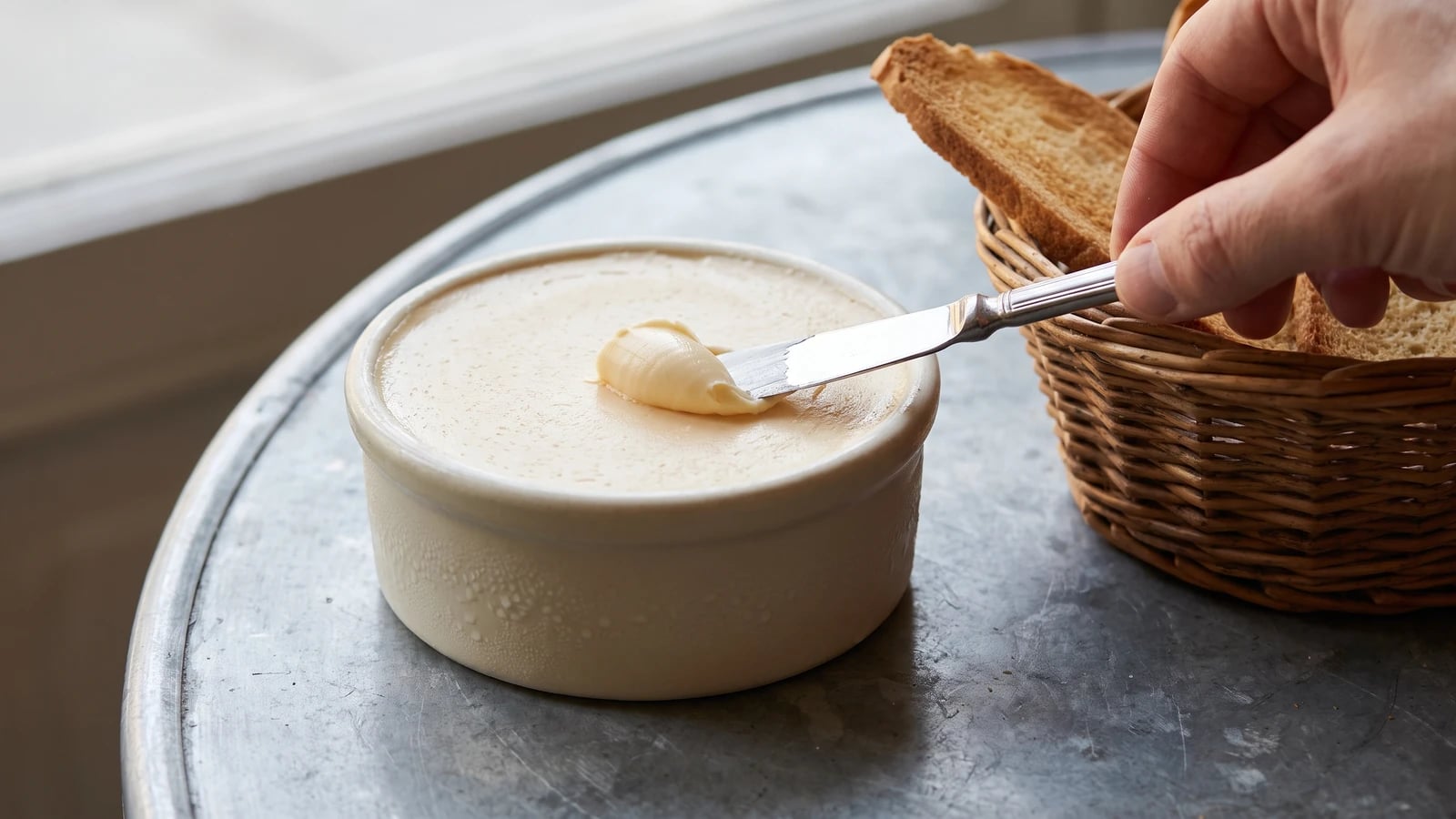
Pack the sieved butter into a small crock, smooth the surface, and cover it closely. Refrigerate for at least 2 hours so it sets and the mustard and lemon settle into the roe. Take it from the refrigerator 15 to 20 minutes before serving; it should yield easily to a spreading knife, not sit waxy and hard. Serve with thin, crisp toast. À table!
1 serving (about 30g)
Culinary guides, cultural storytelling, and the editorial depth that makes cooking meaningful.
Discover Culinary ExplorerChef Juliette
Tiny éperlans, lightly floured and fried until their tails stand crisp, arrive in a generous heap on a napkin with fried parsley and grooved lemon, a weeknight lesson in heat and restraint.

Chef Juliette
Brandade de Morue turns salt cod, warm olive oil, and milk into a pale, silky emulsion: keep everything warm and add the oil slowly, then crown the generous dome with butter-fried bread.

Chef Juliette
Salt cod worked warm with cream, one patient spoonful at a time, until the rough flakes become a glossy Nîmes paste, domed generously and ringed with butter-fried croutons for the table.

Chef Juliette
Wine-poached char packed in its earthenware crock beneath butter gold: a make-ahead first course that turns careful cooling, thorough boning, and one unbroken seal into quiet abundance.