
Chef Juliette
Various Almond Preparations
Five almond preparations, one discipline: remove the skins cleanly, dry every kernel through, then cut, toast, or cloak it in pale caramel without letting its fragrant oils escape.
A cooking platform built around craft, culture, and the stories behind what we eat.
Created by Chef Juliette
Based on No. 2873, Bombe Marquise, from Le Guide Culinaire (1907) by Auguste Escoffier
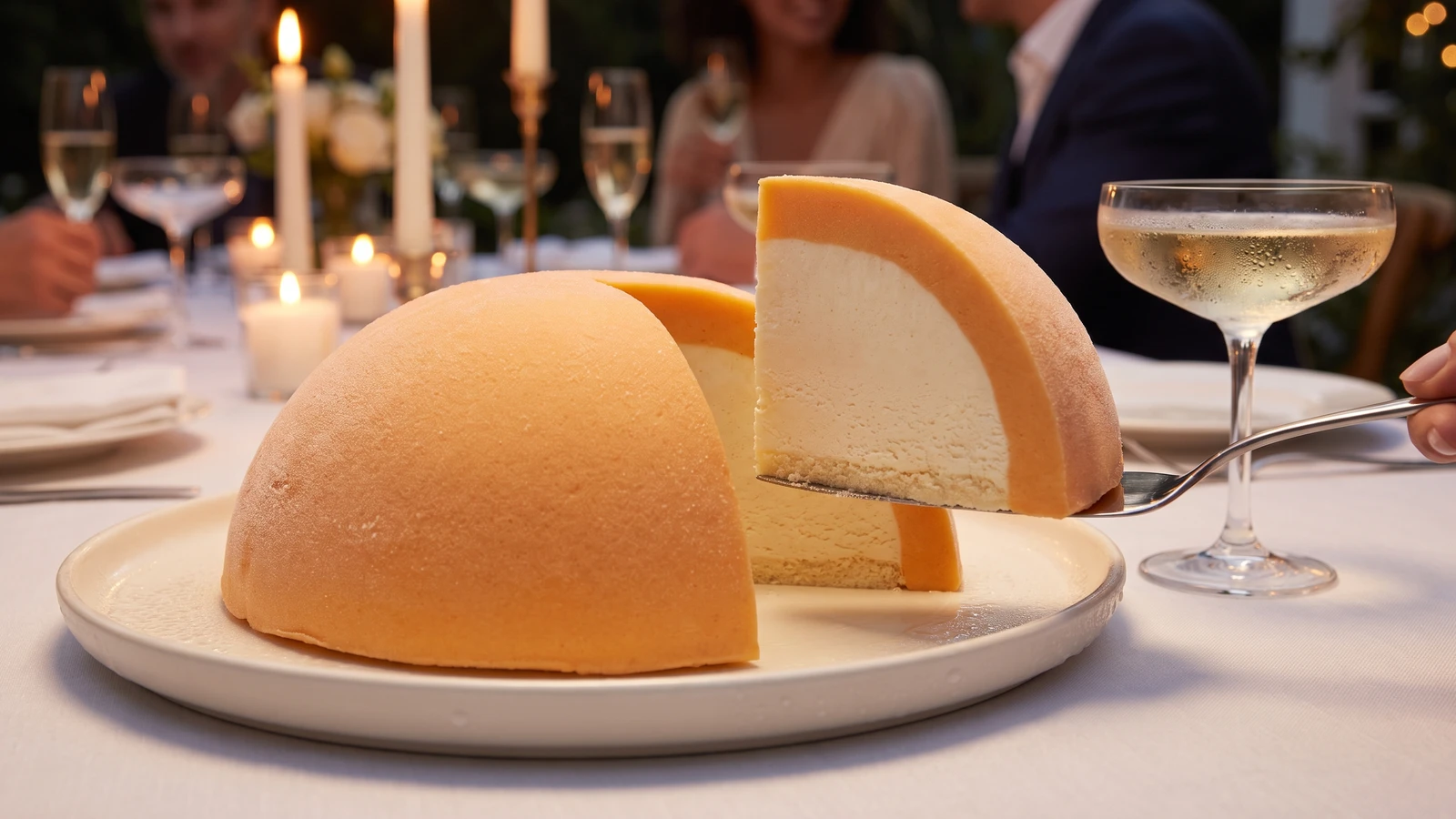
Apricot ice forms a bright, tart shell around silky Champagne pâte à bombe, a celebration dessert whose clean slices depend on a fully frozen mould and patience.
Bombe Marquise (apricot-clad Champagne frozen cream) teaches the architecture of a proper bombe: one ice forms the mould, another preparation fills it, and each must reach the freezer at exactly the right consistency. The centre is a Champagne pâte à bombe, the cooked-yolk foam that gives the filling its satin body. The one true thing to know before touching the pan is this: the apricot shell must be frozen hard before the filling enters, or the two layers blur into one.
The original assumed a sorbetière, a metal bombe packed and repacked in salted ice, and enough hands to tend both mixtures. Your honest equivalent is a 1.5-litre metal mould, an ice-cream machine, and the coldest part of a household freezer. The brigade's broken-ice station is scaffolding and can go. Clothing the mould with apricot ice and filling it with Champagne Bombe-preparation are the dish, so they stay. This version makes eight generous slices with one evening of work, then lets the freezer keep watch overnight.
The Champagne goes in cold and last, preserving its perfume while the whipped cream carries its lightness. Do not rush the final freeze; alcohol and sugar make the centre beautifully tender but slower to set. Freeze the apricot shell until it is hard enough to resist the spatula before you fill it. Everything depends on that clean boundary.
Bombe Marquise belongs to the Parisian classical dining-room repertoire, where layered frozen desserts were assembled in domed metal moulds and given ceremonial names suited to a celebration table. The title Marquise follows that naming tradition, but the identity of the dish is practical and precise: tart apricot water ice outside, Champagne Bombe-preparation within. Bombe refers to the rounded mould and its shell-like form, not to a baked cake or a dessert set alight.
Quantity
1⅔ cups (400 ml / 400 g), for the apricot ice used with Another Method of Preparing Aspics de Filets de Soles (No. 916)
thawed and chilled if frozen
Quantity
½ cup (120 ml / 120 g)
for the apricot ice
Quantity
½ cup (120 ml / 100 g)
for the apricot ice
Quantity
1 tablespoon (15 ml / 15 g)
Quantity
1 pinch (about 1/16 teaspoon / 0.3 ml / 0.4 g)
Quantity
5 large (about ⅓ cup / 90 ml / 90 g)
Quantity
½ cup plus 2 tablespoons (150 ml / 125 g)
for the pâte à bombe
Quantity
3 tablespoons (45 ml / 45 g)
for the pâte à bombe
Quantity
1¼ cups (300 ml / 300 g)
well chilled
Quantity
½ cup (120 ml / 120 g)
well chilled
| Ingredient | Quantity |
|---|---|
| unsweetened apricot puréethawed and chilled if frozen | 1⅔ cups (400 ml / 400 g), for the apricot ice used with Another Method of Preparing Aspics de Filets de Soles (No. 916) |
| waterfor the apricot ice | ½ cup (120 ml / 120 g) |
| caster sugarfor the apricot ice | ½ cup (120 ml / 100 g) |
| fresh lemon juice | 1 tablespoon (15 ml / 15 g) |
| fine sea salt | 1 pinch (about 1/16 teaspoon / 0.3 ml / 0.4 g) |
| large egg yolks | 5 large (about ⅓ cup / 90 ml / 90 g) |
| caster sugarfor the pâte à bombe | ½ cup plus 2 tablespoons (150 ml / 125 g) |
| waterfor the pâte à bombe | 3 tablespoons (45 ml / 45 g) |
| heavy creamwell chilled | 1¼ cups (300 ml / 300 g) |
| brut Champagnewell chilled | ½ cup (120 ml / 120 g) |
Put the ½ cup water and ½ cup sugar in a small saucepan. Warm gently until the sugar dissolves, then boil for one minute and remove from the heat. Cool for ten minutes before whisking in the apricot purée, lemon juice, and salt. Do not cook the fruit; its vivid acidity must remain intact against the rich filling. Chill the mixture thoroughly for at least two hours, and place the empty bombe mould in the freezer at the same time.
Churn the apricot mixture until it holds soft ridges and is firm enough to spread. Chemiser, to clothe the mould, by pressing the apricot ice evenly over the bottom and sides of the frozen mould in a layer about ⅜ inch (1 cm) thick. The source borrows this principle from Another Method of Preparing Aspics de Filets de Soles (No. 916), where liquid jelly is rocked over broken ice. Here, a frozen metal mould and a flexible spatula are the honest home equivalents because apricot ice will not flow like jelly. Hold the mould up to the light; if any patch looks thin, ça se rattrape, press on a little more ice and smooth it level. Freeze the clothed mould for at least ninety minutes, until the shell is hard all the way through.
Put the yolks in the bowl of a stand mixer and begin whisking at medium speed. Combine the remaining sugar and water in a clean saucepan, bring them to a boil without stirring, and cook to 244°F (118°C). If the syrup crystallizes before reaching temperature, ça se rattrape: add 1 tablespoon (15 ml / 15 g) water, cover for thirty seconds, and return it to the heat without stirring. With the mixer running, pour the hot syrup down the inside of the bowl in a thin, steady stream, keeping it away from the whisk. Increase the speed and beat until the pâte à bombe is very pale, thick enough to fall in ribbons, and nearly cool, about eight minutes. If a few cooked egg threads appear, pass the mixture through a fine sieve at once and continue whisking in a clean bowl.
Whip the cold cream to soft peaks that bend when the whisk is lifted. Fold one-third into the pâte à bombe to loosen it, then fold in the rest with broad strokes, preserving as much air as you can. Add the cold Champagne last, in three small additions, folding only until evenly incorporated. The wine stays cold so its aroma remains itself, and it goes in last because heat would flatten it. If the mixture becomes very fluid, the pâte à bombe was still too warm; set the bowl over ice for ten minutes and fold gently until it mounds softly again. Do not beat it.
Check that the apricot shell is completely hard before filling. Spoon in the Champagne Bombe-preparation, easing it into the curve without scraping through the apricot layer, then smooth the surface level with the rim. Cover directly with parchment, fit the lid or wrap the mould closely, and freeze in the coldest part of the freezer at 0°F (-18°C) or below for at least ten hours, preferably overnight. The sugar and Champagne keep the centre tender, which is desirable, but they also slow the freeze. A home freezer simply needs longer than the old salted-ice station. If the centre still yields deeply when pressed through the parchment, give it another two hours.
Chill the serving platter for twenty minutes. Uncover the bombe and pass a warm, damp towel around the mould for five to eight seconds, then invert it firmly onto the platter. If it does not release, ça se rattrape: warm the mould for another three seconds and try again rather than pulling at the dessert. Return a softening bombe to the freezer for twenty minutes before cutting. Slice with a knife dipped in warm water and wiped dry between cuts, revealing the apricot-orange shell around the pale Champagne centre. À table!
1 serving (about 160g)
Culinary guides, cultural storytelling, and the editorial depth that makes cooking meaningful.
Discover Culinary ExplorerChef Juliette
Five almond preparations, one discipline: remove the skins cleanly, dry every kernel through, then cut, toast, or cloak it in pale caramel without letting its fragrant oils escape.

Chef Juliette
A pastry pantry lesson in one tray: filberts warmed only until their red skins release, rubbed clean, cooled, and chopped into a fragrant mise-en-place for cakes, creams, pralines, and petits fours.

Chef Juliette
The smallest pâtisserie discipline decides whether a cake leaves its mould intact: clarified butter in every corner, followed by the lightest veil of dry flour or fécule.

Chef Juliette
Four whites, one spotless bowl, and a patient change of speed: whisk gently until loosened, then briskly to glossy stiffness, with powdered sugar waiting if the foam begins to granulate.