Culinary Explorer

A cooking platform built around craft, culture, and the stories behind what we eat.
Discover Culinary Explorer
Bombe à la Maréchale

Bombe à la Maréchale

Created by Chef Juliette

Based on No. 2870, Bombe à la Maréchale, from Le Guide Culinaire (1907) by Auguste Escoffier

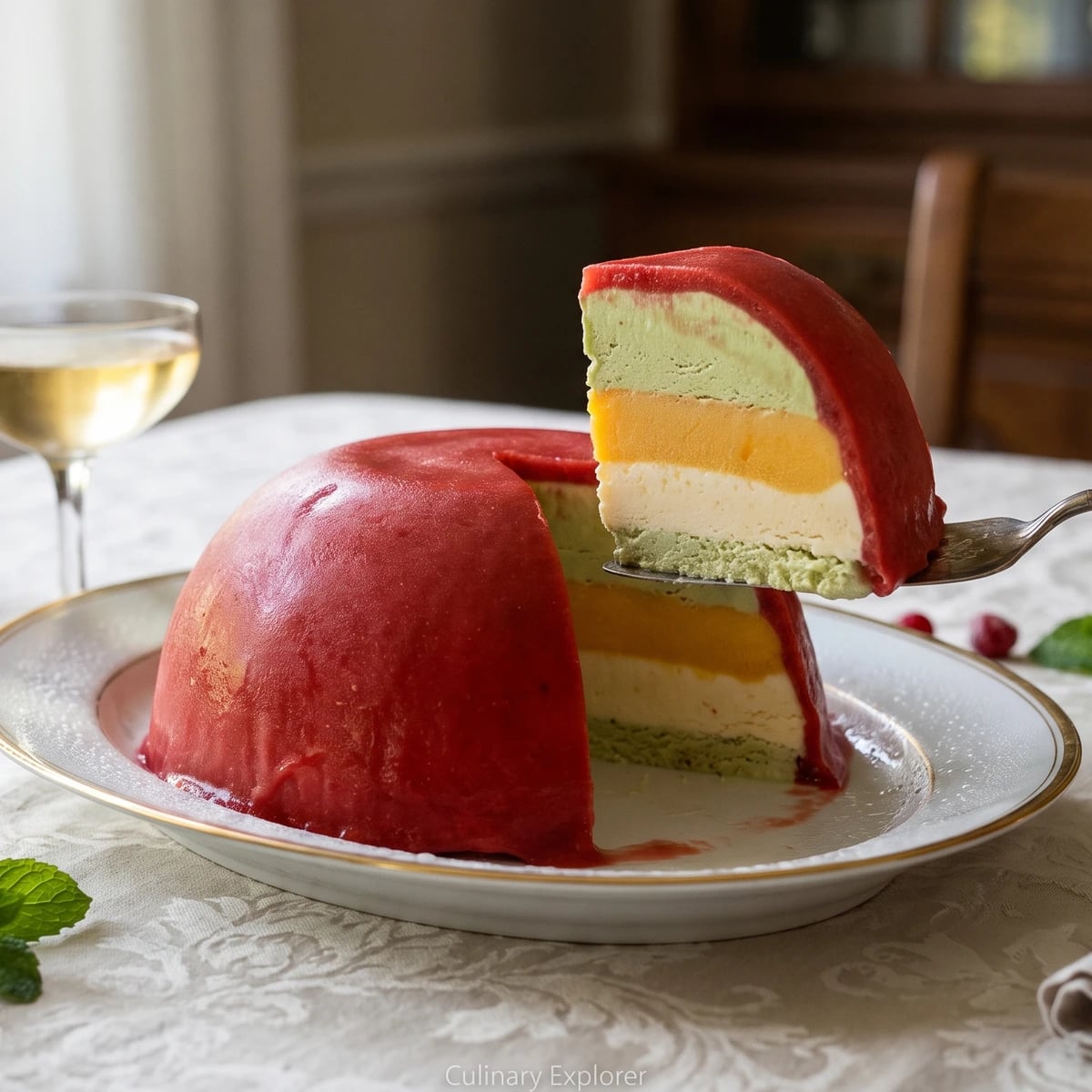
Bombe à la Maréchale teaches the discipline of cold layers: a scarlet strawberry shell around pistachio, orange, and vanilla pâte à bombe, frozen one clear band at a time for a splendid cut.

Desserts
French
Special Occasion
Celebration
Dinner Party
1 hr 10 min
Active Time
20 min cook10 hr total
YieldOne 1.5-liter bombe (8 servings)

Bombe à la Maréchale (a strawberry-lined layered frozen bombe) teaches one discipline: cold must finish its work before the next layer arrives. If one band is merely chilled rather than firm, the following one pushes through it, and the cut shows mud instead of pistachio green, orange gold, and vanilla ivory.

The classical entry assumed a pâtisserie brigade with strawberry ice and three finished Bombe-preparations waiting in separate tubs, plus a lidded metal mould packed in salted ice. Your honest equivalent is a 1.5-liter metal mould and a household freezer. Make one pâte à bombe, yolks expanded with hot sugar syrup, divide it into three, and flavor each portion separately. This changes the organization, not the prescribed flavors or their order. One cook, one stove, one evening.

Separate crews and four waiting tubs were brigade scaffolding, so they can go. The strawberry clothing and the individually frozen bands are the dish, and they stay. Freeze every band until it feels firm beneath a fingertip before adding the next; that pause is what makes the bombe magnificent when the first wedge comes away.

The bombe glacée belongs to the formal Parisian repertoire of frozen entremets, where pâtissiers assembled contrasting ices in deep metal moulds and hardened them in salted ice. Its name comes from that rounded mould and its dramatic shape, not from cake, and the method traveled readily from grand dining rooms to celebration tables once home freezers could supply the necessary cold. The title à la Maréchale is an honorific menu name rather than a regional designation; in this entry, the identity lies precisely in its strawberry shell and pistachio, orange, and vanilla filling.

The technique, the tradition, and the story behind every dish.

Discover Culinary Explorer

Ingredients

ripe strawberries

Quantity

4 cups (950 ml / 600 g)

hulled and halved

granulated sugar for the strawberry ice

Quantity

3/4 cup (180 ml / 150 g)

water for the strawberry ice

Quantity

1/2 cup (120 ml / 120 g)

fresh lemon juice

Quantity

2 tablespoons (30 ml / 30 g)

strained fresh orange juice

Quantity

1/2 cup (120 ml / 120 g)

orange zest

Quantity

2 teaspoons (10 ml / 4 g)

finely grated

orange liqueur

Quantity

1 tablespoon (15 ml / 14 g)

pasteurized egg yolks

Quantity

6 large (about 1/2 cup / 120 ml / 110 g)

granulated sugar for the pâte à bombe

Quantity

3/4 cup (180 ml / 150 g)

water for the pâte à bombe

Quantity

1/3 cup (80 ml / 80 g)

cold heavy cream

Quantity

1 1/2 cups (360 ml / 360 g)

unsweetened pistachio paste

Quantity

1/4 cup (60 ml / 60 g)

vanilla bean

Quantity

1

Another Method of Preparing Aspics de Filets de Soles

Quantity

1 cited preparation (No. 916)

consulted for the mould-clothing technique only; no savory component is added

Equipment Needed

  • 1.5-liter metal bombe mould or deep stainless-steel bowl
  • Sugar thermometer
  • Electric hand mixer or stand mixer
  • Fine-mesh sieve
  • Small offset spatula
  • Ice-cream machine, optional
  • Long slicing knife

Instructions

  1. 1

    Chill the mould

    Clear a level place in the freezer and chill the empty 1.5-liter metal bombe mould or deep stainless-steel bowl for at least 30 minutes. Chill a small offset spatula as well. Metal takes the cold quickly and releases cleanly later; thick glass is slow to freeze and liable to resent the warm-water unmoulding.

    Measure the mould with water before starting. A vessel much larger than 1.5 liters produces thin, mean layers; a smaller one leaves filling behind.
  2. 2

    Make strawberry ice

    Bring the strawberry sugar and water to a boil, stirring only until the sugar dissolves, then simmer for 1 minute and cool completely. Purée the strawberries with the lemon juice and cooled syrup, then pass the mixture through a fine sieve. Churn it until thick and spoonable. Without a machine, freeze it in a shallow metal pan and stir vigorously every 30 minutes until it holds soft ridges, usually 2 to 3 hours. It must be pliable enough to spread but cold enough to cling.

  3. 3

    Clothe the mould

    Reach for the mould-clothing procedure preserved in Another Method of Preparing Aspics de Filets de Soles (No. 916): spoon strawberry ice into the chilled mould, turn and rock the mould to distribute it, then press it into an even 8 to 10 mm shell with the cold spatula. The cited savory preparation supplies the technique only; none of its ingredients enters this dessert. Reserve about 1 cup of strawberry ice for the closing layer. Freeze the clothed mould for 45 minutes, until the shell is hard.

    Hold the mould against a bright window and look for thin patches. If light shows strongly through one place, press on another spoonful of strawberry ice and freeze again. Ça se rattrape.
  4. 4

    Concentrate the orange

    Boil the orange juice in a small pan until only 2 tablespoons (30 ml / 30 g) remain. Pour it into a cold bowl and chill it completely. Reduction gives the orange band a clear flavor without adding enough water to make the filling icy; warm reduction would flatten the whipped base, so don't hurry it.

  5. 5

    Whip the pâte

    Beat the yolks at medium speed until loosened and slightly pale. Put the pâte à bombe sugar and water in a small, clean saucepan and cook without stirring to 118°C (244°F). With the mixer running at medium-low speed, pour the syrup in a fine stream down the inside of the bowl, never onto the moving beaters. Increase the speed and beat for 8 to 10 minutes, until the mixture has tripled, falls in a broad ribbon, and the bowl no longer feels warm. If the syrup crystallizes in the pan, add 1 tablespoon of water and melt it again over gentle heat. Ça se rattrape.

  6. 6

    Fold in cream

    Reserve 2 tablespoons of the cold cream, then whip the rest to soft peaks that bend at their tips. Fold one-third of the cream into the cooled yolk base to loosen it, then fold in the remainder with broad strokes, turning the bowl as you work. Stop as soon as no white streaks remain. If the cream has gone slightly grainy from overwhipping, fold in the reserved liquid cream before combining it with the yolks; it will smooth again.

  7. 7

    Flavor three portions

    Divide the pâte à bombe equally by weight among three chilled bowls. Loosen the pistachio paste with a spoonful of the first portion, then fold that mixture back into the bowl. Fold the cold orange reduction, zest, and orange liqueur into the second. Split the vanilla bean, scrape its seeds into the third, and fold them through. Keep all three portions cold while you assemble the bombe.

  8. 8

    Set pistachio layer

    Spoon the pistachio pâte à bombe into the strawberry shell and spread it level without scraping the red sides. Freeze for 45 to 60 minutes, until the surface feels firm and leaves no filling on a fingertip. This is the pause that decides the stripes. A softer layer will buckle beneath the next one.

  9. 9

    Set orange layer

    Spread the orange pâte à bombe gently over the firm pistachio layer, working from the centre outward so you don't gouge the surface. Freeze for another 45 to 60 minutes. If the pistachio layer dents or streaks, scrape the orange mixture back into its bowl while it remains soft and freeze the mould for 20 minutes longer. Then begin again. Ça se rattrape.

  10. 10

    Seal and freeze

    Add the vanilla pâte à bombe, smooth it level, and freeze for 45 minutes. Soften the reserved strawberry ice just until spreadable, then cover the vanilla with an even 1 cm layer, sealing it to the strawberry shell around the edge. Cover the mould and freeze on a level shelf for at least 6 hours, preferably overnight, until the bombe is solid through the centre.

  11. 11

    Unmould and slice

    Chill the serving platter. Dip the outside of the mould into warm water for 5 to 8 seconds, keeping the water below the rim, then dry it and invert it onto the platter. If the bombe doesn't release, repeat for 3 seconds rather than forcing it. If the surface softens or smears, return the unmoulded bombe to the freezer for 15 minutes. Cut with a long knife dipped in hot water and wiped dry between slices, revealing the red shell and three clean bands. À table!

Chef Tips

  • A metal bombe mould is useful, but a deep 1.5-liter stainless-steel bowl is its honest home equivalent. Choose one with a smooth interior and a rounded bottom; ridges and seams make unmoulding needlessly theatrical.
  • Use pure, unsweetened pistachio paste. A sugary confectionery spread throws the pâte à bombe out of balance and gives the green layer no proper pistachio backbone.
  • The orange reduction must be cold before it touches the filling. Warm liquid melts the whipped cream's structure, and the layer freezes hard instead of creamy.
  • Cold mutes flavor, so taste each portion before layering. The pistachio, orange, and vanilla should seem a shade more pronounced than you want at the table.
  • Serve with demi-sec Champagne if you want wine. Its gentle sweetness meets the strawberry and orange without bullying the pistachio.

Advance Preparation

  • The strawberry ice can be made up to 3 days ahead. Freeze it covered, then soften it in the refrigerator until pliable before clothing the mould.
  • The completed bombe can be frozen for up to 2 days before serving. Keep it tightly covered so the strawberry shell doesn't collect freezer odors.
  • Unmould the bombe up to 30 minutes before serving and return it to the freezer on its chilled platter. This gives you a calm table and a clean first slice.

Frequently Asked Questions

Nutrition Information

1 serving (about 200g)

Calories
420 calories
Total Fat
24 g
Saturated Fat
12 g
Trans Fat
1 g
Unsaturated Fat
11 g
Cholesterol
200 mg
Sodium
20 mg
Total Carbohydrates
49 g
Dietary Fiber
2 g
Sugars
45 g
Protein
6 g

Note: Chef personas and recipes are created with AI assistance. Cook with care: follow safe food-handling practices, check doneness with a thermometer when needed, and adapt for allergies and your kitchen.

Where cooking meets culture.

Culinary guides, cultural storytelling, and the editorial depth that makes cooking meaningful.

Discover Culinary Explorer

More from Ices and Sherbets - Various Bombes

Browse the full collection