
Chef Juliette
Smelt (Éperlans)
Tiny éperlans, lightly floured and fried until their tails stand crisp, arrive in a generous heap on a napkin with fried parsley and grooved lemon, a weeknight lesson in heat and restraint.
A cooking platform built around craft, culture, and the stories behind what we eat.
Created by Chef Juliette
Based on No. 287, Lobster Butter, from Le Guide Culinaire (1907) by Auguste Escoffier
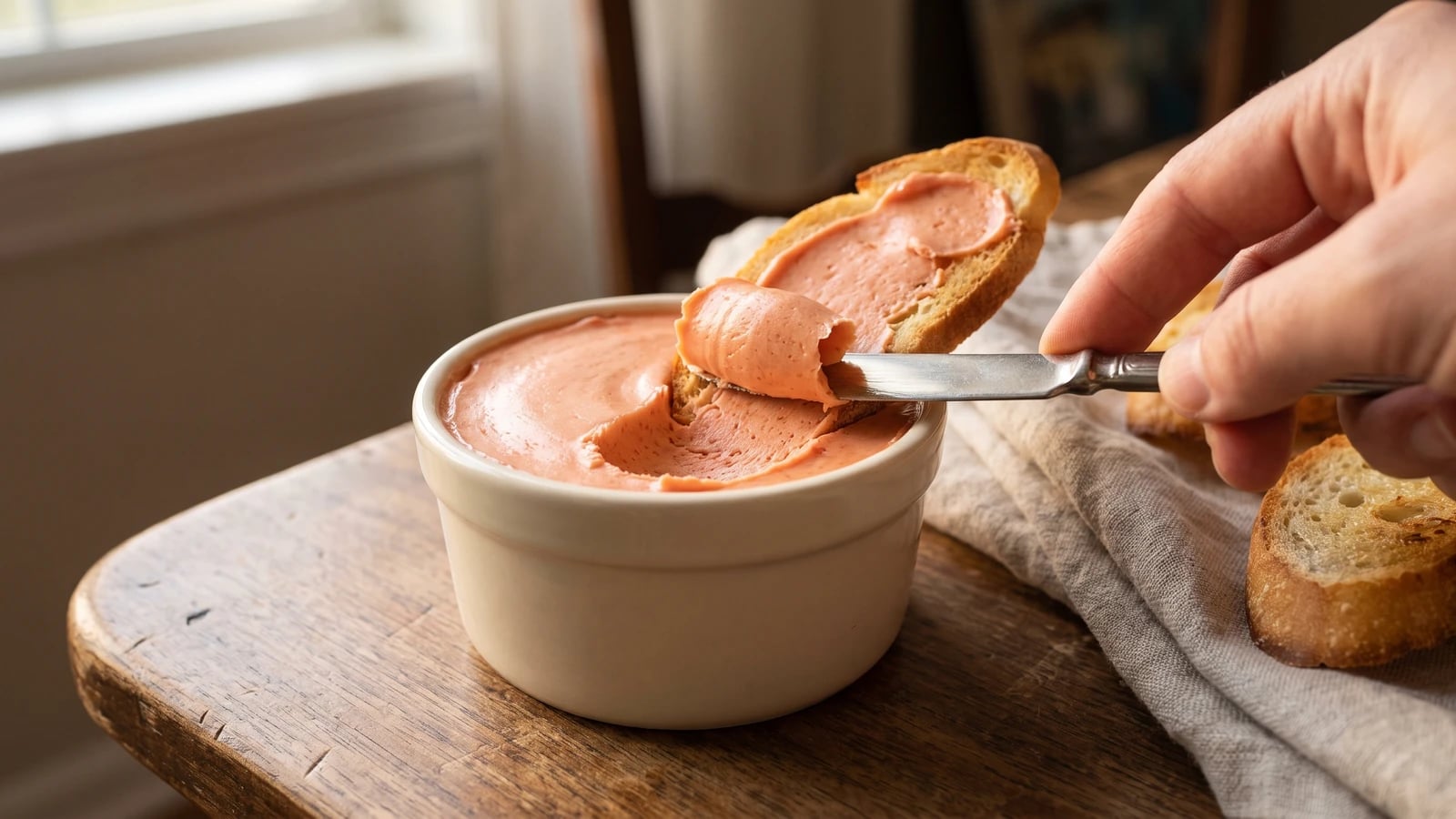
Beurre de Homard turns useful lobster scraps into a satin, coral-pink butter, proving that careful pounding and a fine sieve, not expensive claw meat, make this classical spread.
Beurre de Homard (lobster butter) teaches the classical economy of concentration: take cooked trimmings, spawn, and a little coral, pound them into good butter, then refine the paste until it is smooth as satin. The one true thing to know before touching the bowl is that coral provides the coral-pink colour; expensive claw meat does not. Save the claws for the table.
The original entry assumed a fish station with lobster remnants always at hand, a heavy mortar, a fine tamis, and strong arms to keep pounding. A home kitchen needs trimmings saved from one or two cooked lobsters, a mini food processor, and an ordinary fine-mesh sieve. Hand-pounding is brigade scaffolding and can go; the equal weights of lobster and butter, followed by rubbing through the sieve, are the dish and must stay. The formula is already a civilized home quantity, so its four ounces to four ounces are preserved, not inflated into a saucepot. One cook, one stove, one evening.
Keep the butter cool enough to hold its body but soft enough to take the lobster. If processing warms it until it looks oily, stop and chill the bowl for ten minutes; ça se rattrape. The decisive step is the last one: force every useful bit through the fine sieve and scrape the coral-pink butter from underneath.
Beurre de homard belongs to the classical Parisian sauce kitchen, where shellfish trimmings were pounded into compound butters that could enrich sauces, soups, and fish dishes without wasting the animal's most flavorful remnants. From the professional sauce station it passed naturally to the bourgeois table as a canapé spread and practical finishing butter. Its coral-pink colour comes chiefly from the lobster's coral, not its white claw meat, so sacrificing the claws is expense without purpose.
Quantity
½ cup lightly packed (120 ml / 115 g)
picked free of shell, dried, and roughly chopped
Quantity
1 teaspoon (5 ml / 5 g)
reserved for colour
Quantity
½ cup (120 ml / 115 g)
softened but still cool
| Ingredient | Quantity |
|---|---|
| cooked lobster trimmings and spawnpicked free of shell, dried, and roughly chopped | ½ cup lightly packed (120 ml / 115 g) |
| cooked lobster coralreserved for colour | 1 teaspoon (5 ml / 5 g) |
| unsalted buttersoftened but still cool | ½ cup (120 ml / 115 g) |
Use fully cooked, thoroughly chilled lobster trimmings, spawn, and coral. Pick through them meticulously with your fingers, removing every splinter of shell and tough membrane, then blot them dry. Water loosens the butter and shortens its keeping time, so the remnants must be cold and dry before they are weighed.
Let the butter soften only until a finger leaves a clean impression and a spatula can bend it without effort. It should remain cool, opaque, and able to hold its shape. If it becomes glossy around the edges, return it to the refrigerator for five minutes; melted butter cannot carry the lobster into a fine, even paste.
Put the lobster trimmings, spawn, coral, and butter into a mortar and pound until no distinct pieces remain. For the honest home equivalent, use a small food processor and work in short pulses, scraping the bowl frequently, until the mixture is uniformly coral-pink. Do not let the motor warm the butter. If the paste turns loose or oily, stop and chill the bowl for ten minutes, then continue. Ça se rattrape.
Set a fine-mesh sieve over a clean bowl and add the paste in small portions. Press and rub it firmly through the mesh with a sturdy spoon or flexible scraper, then scrape the smooth butter from the underside of the sieve. This is not ordinary straining: the rubbing refines the lobster into the butter and removes the last fibers and shell fragments. If the paste becomes too firm to pass, leave it for two minutes; if it grows shiny, chill it briefly. Discard the dry residue.
Pack the Beurre de Homard into a small ramekin, pressing out air pockets and leaving the surface naturally swept rather than piped. Cover tightly and chill for at least thirty minutes. For spreading, set it out for ten to fifteen minutes before serving with thin warm toasts; for finishing fish or a sauce, add cold pieces away from direct heat so the butter keeps its body and gloss. À table!
1 serving (about 23g)
Culinary guides, cultural storytelling, and the editorial depth that makes cooking meaningful.
Discover Culinary ExplorerChef Juliette
Tiny éperlans, lightly floured and fried until their tails stand crisp, arrive in a generous heap on a napkin with fried parsley and grooved lemon, a weeknight lesson in heat and restraint.

Chef Juliette
Brandade de Morue turns salt cod, warm olive oil, and milk into a pale, silky emulsion: keep everything warm and add the oil slowly, then crown the generous dome with butter-fried bread.

Chef Juliette
Salt cod worked warm with cream, one patient spoonful at a time, until the rough flakes become a glossy Nîmes paste, domed generously and ringed with butter-fried croutons for the table.

Chef Juliette
Wine-poached char packed in its earthenware crock beneath butter gold: a make-ahead first course that turns careful cooling, thorough boning, and one unbroken seal into quiet abundance.