
Chef Juliette
Bombe Aboukir
Bombe Aboukir sets a pale pistachio ice shell around pralined pâte à bombe, cool, nutty, and cleanly sliceable, with chopped pistachios held in a centre as light as frozen mousse.
A cooking platform built around craft, culture, and the stories behind what we eat.
Created by Chef Juliette
Based on No. 2868, Bombe Madeleine, from Le Guide Culinaire (1907) by Auguste Escoffier
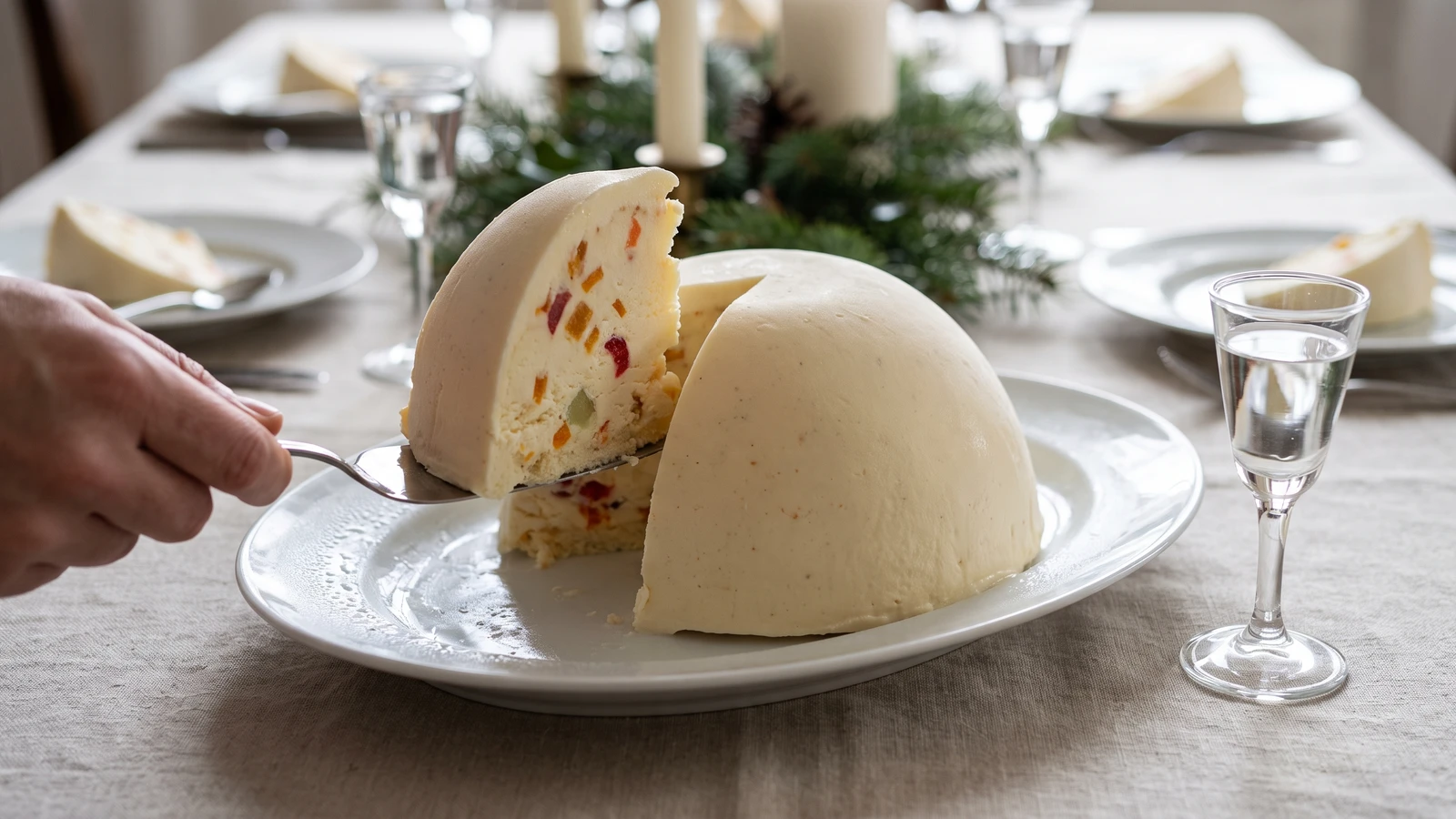
An ivory almond-ice shell gives way to vanilla and Kirsch pâte à bombe jeweled with candied fruit, a make-ahead lesson in freezing each layer before the next one touches it.
Bombe Madeleine (an almond-ice dome with vanilla, Kirsch, and candied fruit) teaches one true thing: freeze the shell hard before the filling touches it. Its centre is pâte à bombe (an egg-yolk foam cooked with hot sugar syrup and lightened with whipped cream), rich but airy against the denser almond ice. If both mixtures are soft, they marble together and the bombe loses the clean surprise of its first slice.
The original instruction is only a sentence because it assumed a pastry station where almond ice and bombe preparation waited as finished mise en place, a pâtissier worked beside a tub of salted ice, and the batch served a dining room. At home, a 1½-quart metal mould, an ice cream machine or shallow freezing tray, and an ordinary freezer do the same work. The salted-ice tub and brigade quantity are scaffolding and can go. The almond shell, vanilla and Kirsch pâte à bombe, candied fruit, and separate freezes are the dish and must stay. One cook, one stove, one evening of active work, then the freezer keeps watch overnight.
When it is right, the bombe turns out as a pale ivory dome with a firm almond coat and a creamy centre bright with little pieces of candied fruit. If the shell smears while you fill it, stop and freeze it again. Ça se rattrape. The step that decides everything is simple: the almond ice must be hard enough that a fingertip leaves no mark.
Bombe glacée belongs to the Parisian grand-cuisine pastry room, where moulded ices passed from working confectionery preparations to formal dining-room centrepieces. The Madeleine formula is not a dessert made from madeleine cakes: its identity is the contrast of almond ice outside with vanilla and Kirsch bombe preparation and candied fruit within. Its cross-reference to Another Method of Preparing Aspics de Filets de Soles (No. 916) shows that chemiser, lining or clothing a mould, was shared grammar between chilled savoury aspics and frozen desserts.
Quantity
¾ cup (180 ml / 85 g)
Quantity
1¼ cups (300 ml / 306 g)
Quantity
½ cup (120 ml / 120 g)
Quantity
⅓ cup (80 ml / 67 g)
Quantity
3 large
Quantity
⅛ teaspoon (0.6 ml / 0.8 g)
Quantity
¾ cup (180 ml / 120 g)
cut into ¼-inch pieces
Quantity
2 tablespoons (30 ml / 28 g)
Quantity
½ cup (120 ml / 100 g)
Quantity
3 tablespoons (45 ml / 45 g)
Quantity
4 large
Quantity
1
split and scraped
Quantity
1¼ cups (300 ml / 300 g)
Quantity
1 application of Another Method of Preparing Aspics de Filets de Soles (No. 916)
used with almond ice in place of jelly
| Ingredient | Quantity |
|---|---|
| blanched almonds | ¾ cup (180 ml / 85 g) |
| whole milk | 1¼ cups (300 ml / 306 g) |
| heavy cream for the almond ice | ½ cup (120 ml / 120 g) |
| granulated sugar for the almond ice | ⅓ cup (80 ml / 67 g) |
| egg yolks for the almond ice | 3 large |
| fine salt | ⅛ teaspoon (0.6 ml / 0.8 g) |
| mixed candied fruitcut into ¼-inch pieces | ¾ cup (180 ml / 120 g) |
| Kirsch | 2 tablespoons (30 ml / 28 g) |
| granulated sugar for the pâte à bombe | ½ cup (120 ml / 100 g) |
| cold water | 3 tablespoons (45 ml / 45 g) |
| egg yolks for the pâte à bombe | 4 large |
| vanilla beansplit and scraped | 1 |
| cold heavy cream for the filling | 1¼ cups (300 ml / 300 g) |
| mould-clothing procedureused with almond ice in place of jelly | 1 application of Another Method of Preparing Aspics de Filets de Soles (No. 916) |
Set the metal bombe mould in the freezer. Put the candied fruit in a small bowl with 1 tablespoon (15 ml / 14 g) of the Kirsch, turn it well, and leave it covered while you prepare the two ices. Chill the mixer bowl and whisk for the cream. Cold equipment is not ceremony here; it keeps the shell distinct and the filling light.
Process the almonds with half the milk until very finely ground. Scrape this into a saucepan with the remaining milk and the ½ cup (120 ml / 120 g) cream, warm it until small bubbles gather at the edge, then cover and infuse off the heat for 30 minutes. Strain through a fine sieve, pressing firmly. Whisk the 3 yolks with the ⅓ cup (80 ml / 67 g) sugar and salt until pale, temper with the warm almond milk, then return everything to gentle heat. Stir continuously until the crème anglaise coats the spoon and reaches 180°F (82°C). Do not boil it. If it turns slightly grainy, take it off the heat at once, strain and blend it while warm, then set the bowl over ice. Ça se rattrape. Chill completely.
Churn the cold almond custard until dense and softly frozen, firm enough to hold a ridge but still spreadable. Without an ice cream machine, pour it into a shallow metal tray and freeze it, beating thoroughly every 30 minutes for 2 to 3 hours until the crystals are fine. Do not freeze it solid yet; chemiser le moule, clothing the mould with a frozen lining, requires almond ice soft enough to spread without gaps.
Follow the mould-clothing procedure in Another Method of Preparing Aspics de Filets de Soles (No. 916), applying its lining principle with softly churned almond ice in place of jelly. This citation supplies the technique only; none of the savoury components enters the dessert. Coat the chilled mould in two thin layers, freezing the first for 20 minutes before adding the second, until the base and sides have an even shell about ⅜ inch (1 cm) thick. Reserve about ½ cup (120 ml) almond ice for the cap. The reference uses broken ice to hold the lining during service; the domestic freezer is the honest equivalent. Freeze the clothed mould for at least 1 hour, until a fingertip leaves no dent.
Put the ½ cup (120 ml / 100 g) sugar and 2 tablespoons (30 ml / 30 g) of the water in a small saucepan, reserving the final tablespoon of water for rescue. Cook without stirring until the syrup reaches 244°F (118°C). While it cooks, beat the 4 yolks with the vanilla seeds until thick and pale. With the mixer running at medium speed, pour the hot syrup in a thin stream down the inside of the bowl, never onto the whisk, then beat at high speed until the mixture holds a broad ribbon and the bowl feels cool. If the syrup crystallizes before pouring, add the reserved water, cover for 30 seconds, and dissolve it again over gentle heat. If a few syrup threads harden against the mixing bowl, warm the bowl briefly over lukewarm water while whisking, then continue off the heat.
Whip the 1¼ cups (300 ml / 300 g) cold cream to soft peaks. Fold one-third into the pâte à bombe to loosen it, then fold in the rest with broad strokes, stopping as soon as no white streaks remain. Fold in the candied fruit with its absorbed Kirsch and the remaining 1 tablespoon (15 ml / 14 g) Kirsch. Keep the filling over a bowl of ice if the kitchen is warm. It should be airy and cool, not loose.
Test the almond shell before filling. If your finger marks it, return it to the freezer for 30 minutes; filling a soft shell is how the two mixtures marble. Spoon in the pâte à bombe, pressing gently enough to remove large air pockets without crushing its volume, and leave a ⅜-inch (1 cm) space at the rim. Soften the reserved almond ice just until spreadable and use it to close the base in an even cap. Cover tightly and freeze for at least 6 hours, preferably overnight.
Chill the serving platter. Dip the mould to just below its rim in warm water for 5 to 8 seconds, dry it, invert it onto the platter, and lift straight upward. If it holds, repeat with a 2-second dip rather than forcing it. If the surface softens too much, return the unmoulded bombe to the freezer for 10 minutes. Let it stand for 5 minutes before slicing with a knife warmed in hot water and wiped dry between cuts. The first wedge should show an ivory almond shell around a pale vanilla centre jeweled with fruit. À table!
1 serving (about 160g)
Culinary guides, cultural storytelling, and the editorial depth that makes cooking meaningful.
Discover Culinary ExplorerChef Juliette
Bombe Aboukir sets a pale pistachio ice shell around pralined pâte à bombe, cool, nutty, and cleanly sliceable, with chopped pistachios held in a centre as light as frozen mousse.

Chef Juliette
A thin dark chocolate chemise gives way to golden apricot pâte à bombe, a frozen dinner-party dessert whose elegance depends on spreading the shell evenly before it firms.

Chef Juliette
Apricot ice holds a Kirsch-scented pâte à bombe and ribbons of stewed fruit, frozen into a gleaming dome whose clean layers depend on cold components and thoroughly drained apricots.

Chef Juliette
Strawberry ice forms a bright, clean shell around a satin Kirsch pâte à bombe, a frozen dessert that teaches precise layering, restrained alcohol, and the patience to let each layer set.