Culinary Explorer

A cooking platform built around craft, culture, and the stories behind what we eat.
Discover Culinary Explorer
Bombe Japonaise

Bombe Japonaise

Created by Chef Juliette

Based on No. 2865, Bombe Japonaise, from Le Guide Culinaire (1907) by Auguste Escoffier

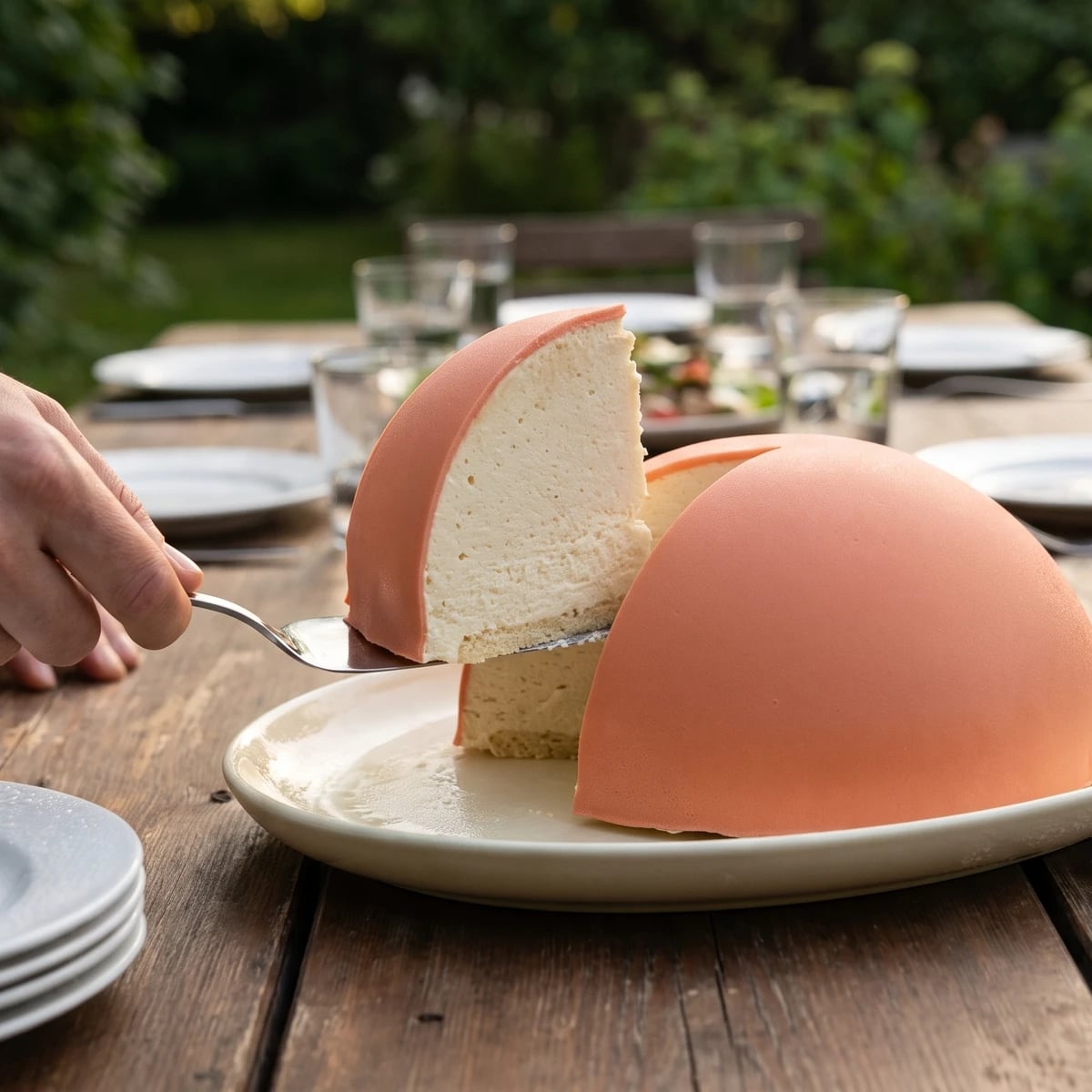
Peach ice clothes the mould around a feather-light iced tea mousse, a French frozen bombe whose success rests on an even shell, a brief infusion, and a patient freeze.

Desserts
French
Dinner Party
Special Occasion
Outdoor Dining
1 hr
Active Time
15 min cook8 hr total
YieldOne 1-quart (1-liter) bombe, 8 servings

Bombe Japonaise (peach ice with iced tea mousse) teaches that cold desserts are built by temperature as surely as sauces are built by heat. The peach ice must be supple enough to clothe the mould, then frozen firm enough to receive a pale, aerated tea mousse without the two blurring together. Cut it and you should see the whole argument at once: a coral-peach shell surrounding an ivory centre, each flavor distinct and neither too sweet.

The original formula assumed the pâtisserie equivalent of a saucier with stock never off the fire: a frozen-dessert station with peach ice ready in the sorbetière, the hand-cranked churn, a deep mould packed in salted ice, and spare hands to manage both layers. A salamander is useless here. Your honest equivalents are a small ice-cream machine, a 1-liter metal mould, and a reliable freezer. That equipment is scaffolding and may change; the even peach shell and light tea centre are the dish and must stay. One cook, one stove, one evening.

Tea is an infusion, not a seasoning you can abandon in the pot. Give the leaves four minutes, strain without squeezing, and stop. A long steep extracts tannin, which tastes drying once frozen, so this first quiet step decides the character of the entire Bombe Japonaise.

Bombe Japonaise belongs not to Japan but to the French repertoire of entremets glacés served from the grand dining rooms of Paris. In classical menu language, tea supplied the Japonaise association while peach ice furnished perfume and bright acidity; the domed mould and layered slice later passed into domestic kitchens as household freezing made the same architecture practical. The source's unexpected link to a sole aspic reflects shared technique, not flavor: both savory cold work and pâtisserie clothed a mould with a setting outer layer before filling it.

The technique, the tradition, and the story behind every dish.

Discover Culinary Explorer

Ingredients

sliced frozen ripe peaches

Quantity

3 cups (710 ml / 450 g)

thawed but cold

granulated sugar

Quantity

1/2 cup (120 ml / 100 g)

for the peach ice

water

Quantity

1/4 cup (60 ml / 60 g)

for the peach ice

fresh lemon juice

Quantity

1 1/2 tablespoons (22 ml / 22 g)

fine sea salt

Quantity

1/8 teaspoon (0.6 ml / 0.7 g)

divided

heavy cream

Quantity

1 cup (240 ml / 240 g)

divided and very cold

loose-leaf black tea

Quantity

2 tablespoons (30 ml / 8 g)

without added perfume

pasteurized egg whites

Quantity

2 large (about 4 tablespoons / 60 ml / 60 g)

granulated sugar

Quantity

1/2 cup (120 ml / 100 g)

for the Italian meringue

water

Quantity

3 tablespoons (45 ml / 45 g)

for the Italian meringue

Another Method of Preparing Aspics de Filets de Soles

Quantity

1 technique reference, Another Method of Preparing Aspics de Filets de Soles (No. 916)

used only for clothing the mould; not added to the dessert

Equipment Needed

  • 1-quart (1-liter) smooth metal bombe mould or 6 1/2-inch (16-cm) stainless-steel bowl
  • Countertop ice-cream machine
  • Electric mixer
  • Blender
  • Fine-mesh sieve
  • Instant-read or sugar thermometer
  • Digital kitchen scale

Instructions

  1. 1

    Infuse the cream

    Place the empty bombe mould in the freezer. Warm 3/4 cup plus 1 tablespoon (200 ml / 200 g) of the cream to 175°F (80°C), when it is hot and fluid but nowhere near boiling. Remove it from the heat, add the tea, cover, and steep for exactly four minutes. Strain through a fine sieve without squeezing the leaves, then restore the strained cream to 200 g with some of the reserved cold cream. Set the bowl over ice and stir until thoroughly cold, then refrigerate. If the tea ran long and tastes drying, whisk in reserved cream a spoonful at a time until fragrance returns, then measure out 200 g. Sugar cannot erase tannin, but dilution can rescue a slightly overstrong infusion.

    Choose a fragrant, unperfumed black tea such as Ceylon or Keemun. Earl Grey's bergamot overwhelms the peach and changes the source's clean tea flavor.
  2. 2

    Build the peach base

    Combine the peach-ice sugar and water in a small saucepan. Bring them just to a simmer, stirring until the sugar dissolves completely, then cool for five minutes. Blend the peaches with the syrup, lemon juice, and half the salt until perfectly smooth. Pass the purée through a fine sieve, pressing firmly, then chill it over an ice bath until it feels as cold as the refrigerator. A warm base churns slowly and forms coarse crystals; cold before churning is the principle.

  3. 3

    Churn the peach ice

    Churn the peach mixture according to your machine's directions until it becomes thick, matte, and softly mounded, usually twenty to twenty-five minutes. It should hold the track of a spoon but remain supple enough to spread. If it is still pouring after the machine has done its work, place it in a shallow metal pan for ten minutes, stir, and test again. If it has hardened, temper it briefly in the refrigerator rather than melting it.

  4. 4

    Clothe the mould

    Reserve about 1/2 cup (120 ml) of peach ice for the closing layer. Following the mould-coating principle in Another Method of Preparing Aspics de Filets de Soles (No. 916), press the remaining peach ice over the bottom and sides of the frozen mould in an even 3/8-inch (1-cm) coat. The savory preparation itself comes nowhere near this dessert; its referenced technique is the useful part. Turn the mould as you work and check the rim for thin patches. Freeze for forty-five minutes. If the lining slides or exposes metal, chill it for ten minutes, patch it with more peach ice, and freeze again. It can be rescued.

  5. 5

    Make Italian meringue

    Combine the meringue sugar and water in a small clean saucepan. Cook without stirring to 244°F (118°C). If sugar crystals appear around the sides, cover the pan for thirty seconds so condensation washes them down, then continue. Meanwhile, whisk the egg whites with the remaining salt to soft peaks. Pour the hot syrup into the whites in a thin stream down the side of the bowl while whisking, taking care not to pour it onto the beaters. Continue until the meringue is glossy, firm, and no longer warm, about five minutes.

    With a hand mixer, whip the whites to soft peaks before cooking the syrup. When the syrup is ready, refresh the whites for a few seconds and begin pouring. One cook does not need three hands.
  6. 6

    Fold the tea mousse

    Whip the cold tea-infused cream to soft peaks that curl rather than stand rigid. Fold one-third into the Italian meringue to loosen it, then fold in the remainder with broad strokes until no white streaks remain. This is the tea mousse-preparation, part of the classical family of Mousses: air gives the filling its lightness, and cold fixes it. If the cream turns grainy from overwhipping, stop and fold in a tablespoon of the reserved liquid cream by hand. Ça se rattrape. The finished mousse should fall from the spatula in a wide, slow ribbon.

  7. 7

    Fill and seal

    Check that the peach shell is hard and dry to the touch. If it has softened while you made the mousse, return it to the freezer for fifteen minutes. Spoon in the tea mousse, pressing it gently into the curve so no hollow pockets remain, and stop 3/8 inch (1 cm) below the rim. Freeze for twenty minutes. Temper the reserved peach ice in the refrigerator until spreadable, then smooth it over the mousse to close the bombe. Cover the surface tightly and return the mould to the freezer.

  8. 8

    Freeze and unmould

    Freeze the Bombe Japonaise for at least six hours, until solid through the centre. Chill the serving platter. Dip the mould in lukewarm water for five seconds, dry it, invert it onto the platter, and lift straight upward. If it refuses, wrap the mould briefly in a warm towel or repeat the dip for two seconds; too much warmth erases the peach shell's clean edge. Let the bombe stand for five minutes, then slice with a knife warmed in hot water and wiped dry between cuts. À table!

Chef Tips

  • Frozen ripe peach slices are the classical pantry's honest answer when fresh peaches smell of nothing. Thaw them only until a knife passes through; cold fruit protects the texture of the peach ice.
  • Four minutes means four minutes for the tea. Strain without squeezing, because pressure extracts the bitter liquid held in the leaves. The fragrance should be clear before freezing, since cold mutes aroma.
  • A smooth stainless-steel bowl makes a fine home bombe mould. Avoid glass, which responds slowly during unmoulding, and deeply ridged moulds, which trap the frozen shell.
  • No ice-cream machine is possible, though more laborious: freeze the peach base in a shallow metal pan, whisk it thoroughly every thirty minutes, then process it smooth before clothing the mould. Churning gives the finer result.
  • For outdoor dining, unmould onto a thoroughly chilled platter and keep the bombe frozen until the table is ready. It needs no fruit fan, sauce, or sugared decoration; the two-colored slice is its own finish.

Advance Preparation

  • Freeze a removable ice-cream-machine canister for at least twenty-four hours before churning, unless your machine has its own compressor.
  • The peach base and tea-infused cream can be prepared one day ahead and kept separately chilled. Churn the peach ice only when you are ready to clothe the mould.
  • The completed bombe can be frozen up to three days ahead. Once firm, wrap the mould closely to protect it from freezer aromas and unmould only before serving.

Frequently Asked Questions

Nutrition Information

1 serving (about 130g)

Calories
225 calories
Total Fat
11 g
Saturated Fat
7 g
Trans Fat
0 g
Unsaturated Fat
4 g
Cholesterol
35 mg
Sodium
55 mg
Total Carbohydrates
31 g
Dietary Fiber
1 g
Sugars
31 g
Protein
1 g

Note: Chef personas and recipes are created with AI assistance. Cook with care: follow safe food-handling practices, check doneness with a thermometer when needed, and adapt for allergies and your kitchen.

Where cooking meets culture.

Culinary guides, cultural storytelling, and the editorial depth that makes cooking meaningful.

Discover Culinary Explorer

More from Ices and Sherbets - Various Bombes

Browse the full collection