
Chef Juliette
Bombe Aboukir
Bombe Aboukir sets a pale pistachio ice shell around pralined pâte à bombe, cool, nutty, and cleanly sliceable, with chopped pistachios held in a centre as light as frozen mousse.
A cooking platform built around craft, culture, and the stories behind what we eat.
Created by Chef Juliette
Based on No. 2853, Bombe Fanchon, from Le Guide Culinaire (1907) by Auguste Escoffier
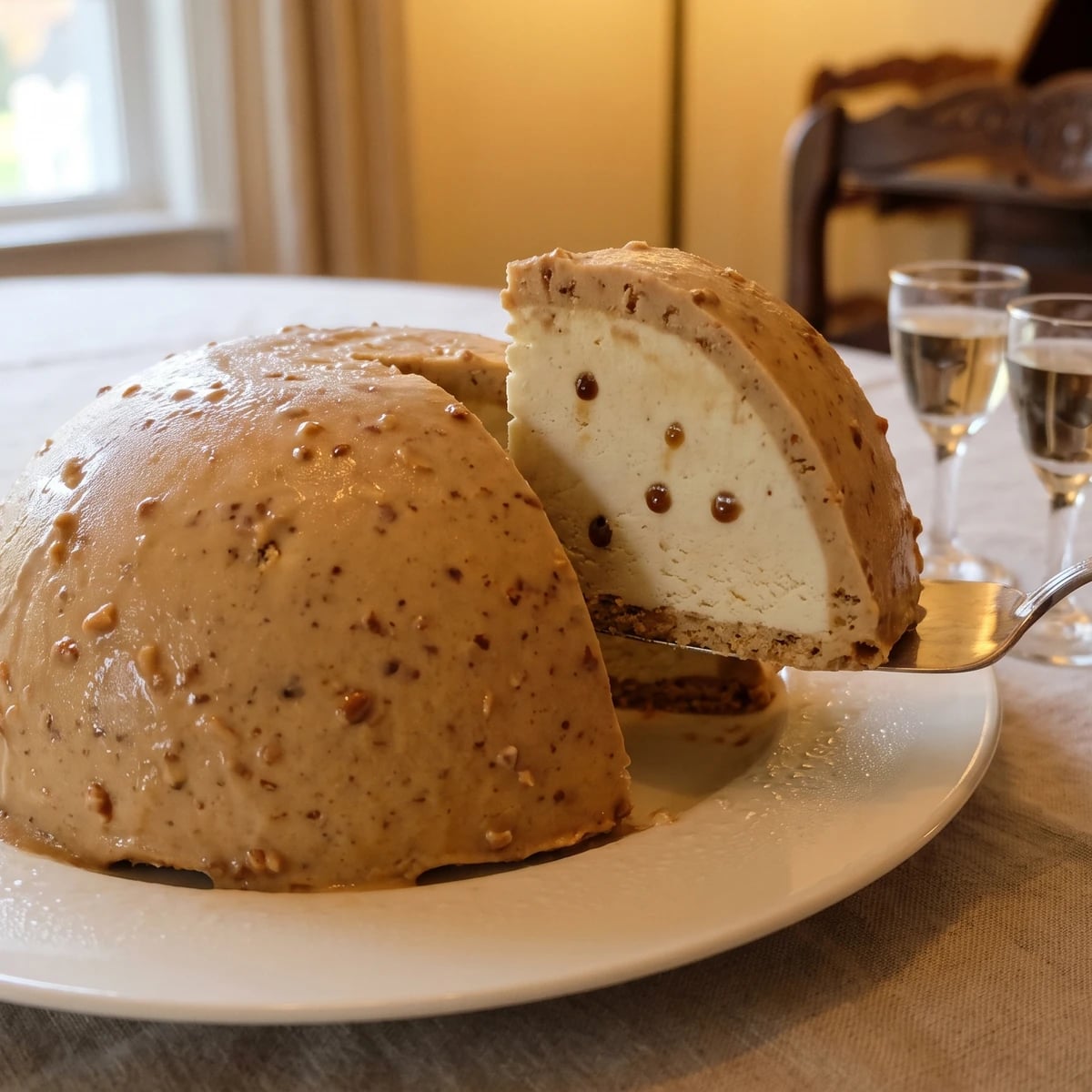
Bombe Fanchon teaches the architecture of a frozen entremets: praline ice pressed into a neat shell, Kirsch pâte à bombe folded light, and coffee drops added last so every bite keeps its crisp surprise.
Bombe Fanchon (a praline-lined Kirsch ice bombe) teaches one discipline above all: every part must be properly cold before it meets the next. The mould wears a shell of glace pralinée (pralined ice), while the centre stays pale and light with Kirsch pâte à bombe, a cooked yolk foam folded with cream. Small coffee drops interrupt all that softness with a dark, crisp little snap.
The original formula assumed a pastry brigade with finished ices waiting, a metal bombe mould packed in freezing salt and ice, and separate hands making the filling. At home, a 1.5-litre metal bowl replaces the specialized mould, an ordinary freezer replaces the ice packing, and two small preparations make eight generous servings. Those stores of ready components were brigade scaffolding and may go. The praline shell, Kirsch filling, and last-minute addition of the coffee drops are the dish itself and must stay.
Keep the shell hard and the pâte à bombe cool before you fold in the cream. Then add the coffee drops on the final turn of the spatula, no sooner. That one restrained fold keeps them whole, crisp, and scattered rather than crushed into the filling.
Bombe Fanchon belongs to the Parisian pâtisserie and formal dining-room repertoire of moulded ices, where bombe names both the domed mould and the practice of enclosing one frozen preparation inside another. Its terse formula reflects a kitchen that kept pralined ice and pâte à bombe ready as parts of a larger system, while the combination of nut caramel, Kirsch, and coffee sweets supplied the Fanchon character. Its cross-reference to a sole aspic is a lesson in technique, not flavour: the same motion used to coat a savoury jelly mould also clothes this frozen dessert.
Quantity
1 cup (240 ml / 240 g)
Quantity
1 cup (240 ml / 240 g)
Quantity
4
Quantity
1/3 cup (80 ml / 67 g)
Quantity
1/2 cup (120 ml / 140 g)
Quantity
1/8 teaspoon (0.6 ml / 0.7 g)
Quantity
5
Quantity
1/2 cup (120 ml / 100 g)
Quantity
1/4 cup (60 ml / 60 g)
Quantity
1 1/2 cups (360 ml / 360 g)
Quantity
3 tablespoons (45 ml / 42 g)
Quantity
1/2 cup (120 ml / 85 g)
thoroughly chilled
| Ingredient | Quantity |
|---|---|
| whole milk, for the glace pralinée | 1 cup (240 ml / 240 g) |
| heavy cream, for the glace pralinée | 1 cup (240 ml / 240 g) |
| large egg yolks, for the glace pralinée | 4 |
| granulated sugar, for the glace pralinée | 1/3 cup (80 ml / 67 g) |
| smooth almond-hazelnut pralin paste | 1/2 cup (120 ml / 140 g) |
| fine sea salt | 1/8 teaspoon (0.6 ml / 0.7 g) |
| large egg yolks, for the Kirsch pâte à bombe | 5 |
| granulated sugar, for the Kirsch pâte à bombe | 1/2 cup (120 ml / 100 g) |
| water | 1/4 cup (60 ml / 60 g) |
| cold heavy cream, for the Kirsch pâte à bombe | 1 1/2 cups (360 ml / 360 g) |
| dry Kirsch eau-de-vie | 3 tablespoons (45 ml / 42 g) |
| small hard coffee dropsthoroughly chilled | 1/2 cup (120 ml / 85 g) |
Put a clean 1.5-litre metal bombe mould or deep stainless-steel bowl in the freezer. Chill the coffee drops in a covered container, along with the bowl and beaters you will use for the cream. Cold equipment buys you working time, and this dessert rewards every minute of it.
Heat the milk and cream until small bubbles gather at the edge. Whisk the four yolks with the sugar and salt until smooth, then pour in the hot dairy gradually while whisking. Return everything to the saucepan and stir over gentle heat until the crème anglaise coats the spoon and reaches 82 to 84°C (180 to 183°F). Do not boil it. If tiny grains appear, pull the pan from the heat, strain immediately into a cold bowl, and whisk hard until smooth. Ça se rattrape. Whisk in the pralin paste, set the bowl over ice, and stir until thoroughly cold.
Churn the cold praline custard until it has the dense, spreadable body of soft ice cream. Working quickly, press it over the bottom and sides of the frozen mould in an even layer about 1.5 cm (5/8 inch) thick. This is chemiser, to clothe the mould, the same coating motion the source directs through Another Method of Preparing Aspics de Filets de Soles (No. 916); the home freezer now does the work once performed over broken ice. Check for thin patches against the light, repair them with more ice, and freeze the shell until solid, 45 to 60 minutes. If any section slumps, refreeze it for 10 minutes and patch it. Nothing is lost.
Put the five yolks in the mixer bowl and begin beating at medium speed. Heat the sugar and water in a small saucepan, stirring only until the sugar dissolves, then boil without stirring to 118°C (244°F). If the syrup crystallizes before reaching temperature, add 1 tablespoon (15 ml / 15 g) water and melt it again gently. Ça se rattrape. With the mixer running, pour the syrup in a fine stream between the whisk and the side of the bowl. Beat until the mixture is thick, pale, and cool enough that the bowl no longer feels warm, then beat in the Kirsch. Leave any hard sugar threads stuck to the bowl behind rather than scraping them into the filling.
Whip the cold cream to soft peaks that fold over rather than stand upright. If the pâte à bombe still feels warm, whisk it over an ice bath until cool before proceeding, or it will melt the cream. Fold in one-third of the cream firmly to loosen the yolk base, then fold in the remainder with broad turns. Add the chilled coffee drops on the final turn only. Stop as soon as they are distributed; repeated folding crushes them and gives moisture time to soften their crisp surface.
Make certain the praline shell is completely firm. Spoon the Kirsch filling into its centre, pressing gently enough to close large air pockets without disturbing the shell, and level the surface at the rim. Cover directly with baking parchment, then wrap the mould well. Freeze for at least 6 hours, preferably overnight. Kirsch keeps the filling supple, which is welcome at the table but means the freezing time cannot be hurried.
Remove the wrapping and invert a chilled serving plate over the mould. Turn both together, then press a warm, well-wrung cloth against the metal for 5 seconds at a time until the bombe releases. If it holds, warm the cloth and repeat; do not flood the mould with hot water or the praline shell will run before the centre lets go. Rest the bombe for 8 minutes, then cut with a knife dipped in hot water and wiped dry between slices. The shell should yield cleanly around the pale Kirsch centre, with coffee drops still whole inside. À table!
1 serving (about 185g)
Culinary guides, cultural storytelling, and the editorial depth that makes cooking meaningful.
Discover Culinary Explorer
Chef Juliette
Bombe Aboukir sets a pale pistachio ice shell around pralined pâte à bombe, cool, nutty, and cleanly sliceable, with chopped pistachios held in a centre as light as frozen mousse.

Chef Juliette
A thin dark chocolate chemise gives way to golden apricot pâte à bombe, a frozen dinner-party dessert whose elegance depends on spreading the shell evenly before it firms.

Chef Juliette
Apricot ice holds a Kirsch-scented pâte à bombe and ribbons of stewed fruit, frozen into a gleaming dome whose clean layers depend on cold components and thoroughly drained apricots.

Chef Juliette
Strawberry ice forms a bright, clean shell around a satin Kirsch pâte à bombe, a frozen dessert that teaches precise layering, restrained alcohol, and the patience to let each layer set.