Culinary Explorer

A cooking platform built around craft, culture, and the stories behind what we eat.
Discover Culinary Explorer
Bombe Diable Rose

Bombe Diable Rose

Created by Chef Juliette

Based on No. 2850, Bombe Diable Rose, from Le Guide Culinaire (1907) by Auguste Escoffier

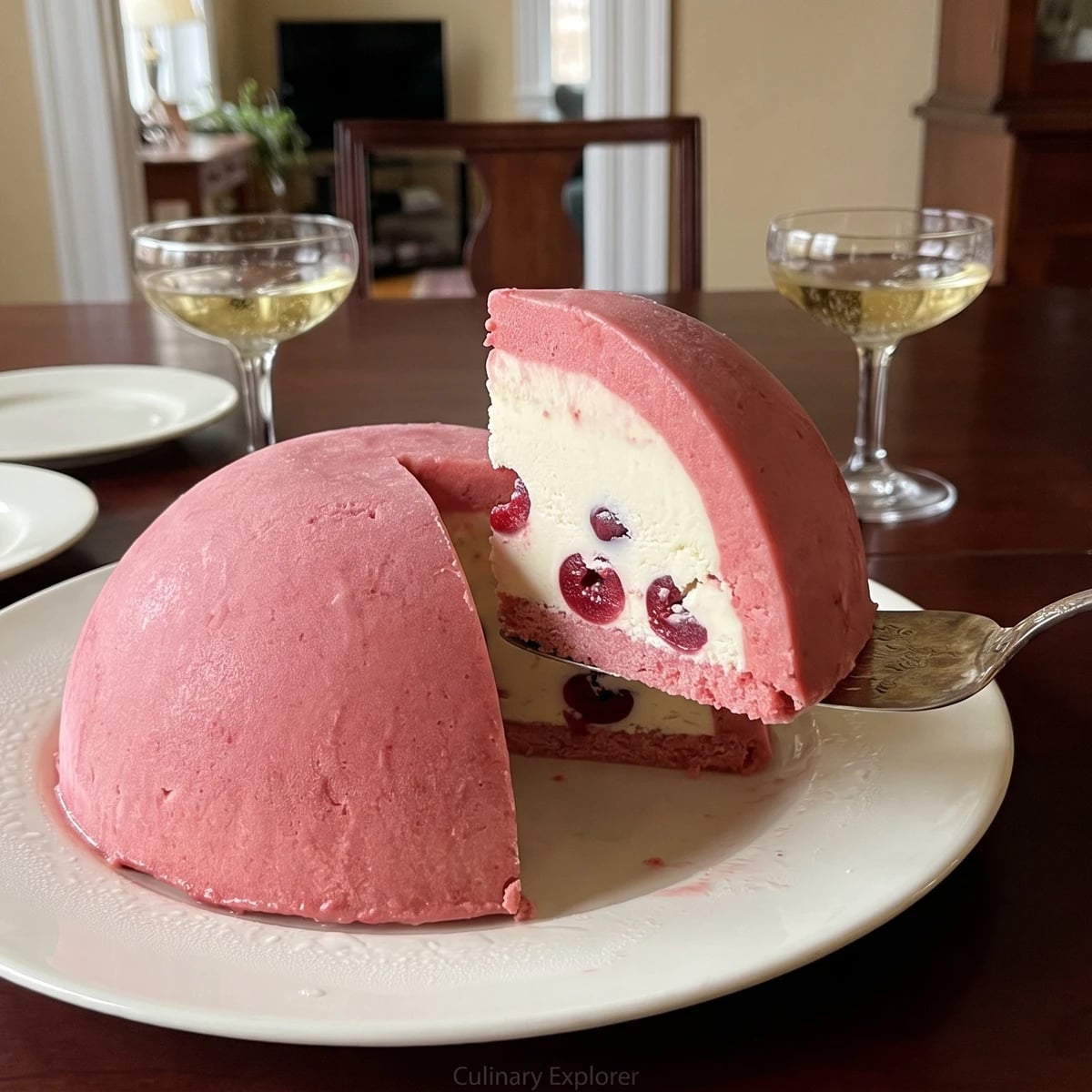
Strawberry ice forms the rose-pink shell, Kirsch pâte à bombe supplies the satin centre, and well-dried candied cherries punctuate each slice: a grand frozen dessert made calmly at home.

Desserts
French
Celebration
Date Night
Special Occasion
1 hr
Active Time
15 min cook9 hr total
YieldOne 1-quart (1-liter) bombe, 6 servings

Bombe Diable Rose (pink devil bombe) teaches the architecture of a bombe glacée: a distinct frozen shell, a softer pâte à bombe filling, and a clean slice that reveals both. The one true thing to know before touching a pan is that water has nowhere to hide in a frozen dessert. Halve the candied cherries and dry them thoroughly, or their surface syrup freezes into hard red pebbles inside the cream.

The original assumed a pastry station with moulds buried in salted ice, several frozen preparations ready at once, and hands available to turn the mould while it was clothed. A one-litre metal bowl, a domestic ice-cream machine, and an ordinary freezer are the honest equivalents. Constantly rocking the mould over broken ice was brigade scaffolding and can go; the even strawberry lining, the Kirsch pâte à bombe, and the dried cherries are the dish and must stay. The work fits one cook, one stove, one evening, then the freezer keeps watch.

When it is cut, the bombe should show a clear rose shell around a pale, creamy centre stippled with cherries. Freeze the clothed mould until it is absolutely firm before filling it. That boundary between shell and centre decides the whole dessert.

Bombe glacée belongs to the Parisian grand-kitchen entremets repertoire, where moulded ices were assembled in contrasting layers and turned out whole for the table. The book's cross-reference to Another Method of Preparing Aspics de Filets de Soles (No. 916) reveals a shared classical grammar: clothing a mould served both clear savory jellies and frozen sweets, though none of that aspic enters this dessert. Diable Rose is a repertory name for the strawberry-pink shell and spirited Kirsch centre, not a regional specialty.

The technique, the tradition, and the story behind every dish.

Discover Culinary Explorer

Ingredients

ripe strawberries

Quantity

2⅔ cups (630 ml / 400 g)

hulled and sliced

granulated sugar, for the strawberry ice

Quantity

½ cup (120 ml / 100 g)

water, for the strawberry ice

Quantity

¼ cup (60 ml / 60 g)

fresh lemon juice

Quantity

1 tablespoon (15 ml / 15 g)

fine sea salt

Quantity

1 pinch (0.3 ml / 0.3 g)

pasteurized egg yolks

Quantity

4 large (about 72 g)

granulated sugar, for the pâte à bombe

Quantity

½ cup (120 ml / 100 g)

water, for the pâte à bombe

Quantity

2 tablespoons (30 ml / 30 g)

cold crème fleurette or heavy cream, at least 35 percent fat

Quantity

1¼ cups (300 ml / 300 g)

clear Kirsch

Quantity

3 tablespoons (45 ml / 43 g)

red candied or glacé cherries

Quantity

½ cup (120 ml / 100 g)

halved and thoroughly dried

Another Method of Preparing Aspics de Filets de Soles

Quantity

1 technique reference (No. 916), not an edible component

consulted only for the mould-clothing method

Equipment Needed

  • 1-quart (1-liter) metal bombe mould or smooth hemispherical stainless-steel bowl
  • Ice-cream machine
  • Stand mixer or electric hand mixer
  • Small heavy saucepan
  • Instant-read or sugar thermometer
  • Fine-mesh sieve
  • Large offset spatula or cold metal spoon

Instructions

  1. 1

    Prepare mould and cherries

    Set a 1-quart (1-liter) metal bombe mould or smooth hemispherical bowl in the freezer for at least 30 minutes. Metal freezes quickly and releases cleanly; glass is slow and risks cracking during unmoulding. Drain the candied cherries if they are packed in syrup, halve them, and press them firmly between clean towels. Spread them out until their cut faces no longer feel wet, then keep them cold. This drying is part of the dish, not decoration: wet cherries freeze hard and bleed syrup through the filling.

    Do not rinse sticky cherries with water. Blot them repeatedly instead, changing the towel when it becomes damp.
  2. 2

    Churn the strawberry ice

    Bring the strawberry-ice sugar and water just to a boil, stirring only until the sugar dissolves. Cool completely, then blend with the strawberries, lemon juice, and salt until smooth. Pass the purée through a fine sieve to remove the seeds and chill it thoroughly. Churn until the strawberry ice is thick, finely textured, and soft enough to spread, with ridges that hold when the paddle turns. Reserve about ½ cup (120 ml) for sealing the bombe.

  3. 3

    Clothe the frozen mould

    Use the clothing principle preserved in Another Method of Preparing Aspics de Filets de Soles (No. 916), replacing the jelly in that preparation with the strawberry ice required here. Press the ice over the bottom and sides of the frozen mould in an even layer about ⅜ inch (1 cm) thick, rotating the mould as you work. Smooth the inner surface with the back of a cold spoon, checking the rim and bottom for thin spots, then freeze for at least 45 minutes, until the shell is hard throughout. If part of it slumps or exposes metal, stop and refreeze for 10 minutes, then patch it with more softened strawberry ice. Ça se rattrape.

    Hold the mould toward a window after clothing it. Light passing through a thin patch will show you exactly where another spoonful of strawberry ice belongs.
  4. 4

    Cook the sugar syrup

    Put the yolks in the mixer bowl and have the whisk ready before beginning the syrup. Combine the pâte à bombe sugar and water in a small heavy saucepan, warm gently until clear, then boil without stirring to 244°F (118°C). If crystals appear around the pan, cover it for 30 seconds so the trapped moisture washes them down, then uncover and continue. Do not scrape crystallized sugar back into the syrup.

  5. 5

    Whip the pâte à bombe

    Whisk the yolks at medium speed until loosened. With the mixer running, pour the hot syrup in a thin, steady stream down the inside of the bowl, avoiding the moving whisk. Increase the speed and beat until the pâte à bombe, a cooked sugar-and-yolk foam, is pale, thick, and cool enough that the bowl no longer feels warm, about 7 minutes. It should fall from the whisk in a broad ribbon. If some syrup hardens against the bowl, leave those threads where they are and use the smooth foam in the centre; scraping them in would seed the filling with hard sugar. Beat in the Kirsch gradually once the mixture is cool.

  6. 6

    Fold in the cream

    Reserve 2 tablespoons (30 ml) of the cold cream, then whip the rest to soft peaks that curl over rather than stand stiffly. Fold one-third into the pâte à bombe to lighten it, then fold in the remaining cream with broad strokes, turning the bowl until no white streaks remain. If the cream becomes slightly too firm, whisk in the reserved liquid cream before folding. If the finished mixture seems loose, chill it for 10 minutes; extra beating would only knock out the air.

  7. 7

    Fill and seal

    Fold the cold, dry cherry halves through the Kirsch pâte à bombe. Spoon the filling into the frozen strawberry shell, pressing gently against the sides to remove large air pockets without crushing the foam, and stop about ⅜ inch (1 cm) below the rim. Freeze for 30 minutes so the surface firms. Soften the reserved strawberry ice just until spreadable, then cover the filling completely and level it with the rim to form the base. Cover the mould tightly.

  8. 8

    Freeze until firm

    Freeze the sealed bombe at 0°F (-18°C) or colder for at least 6 hours, preferably overnight. It must freeze through to the centre or the shell will slide away when the mould is lifted. Once firm, wrap the covered mould well to prevent freezer odors and surface crystals.

  9. 9

    Unmould and slice

    Chill the serving platter. Dip only the outside of the mould in warm water for 5 seconds, dry it, and invert it onto the platter. If it does not release, wrap the mould briefly in a warm towel and try again; do not leave it in water long enough to melt the strawberry shell. Let the bombe stand for 8 minutes, then cut it with a large knife warmed in hot water and wiped dry between slices. The rose shell should remain distinct around the Kirsch centre, with cherries visible through every wedge. À table!

Chef Tips

  • Use clear, dry Kirsch, the cherry eau-de-vie, not a sweet red cherry liqueur. The Kirsch must perfume the cream and leave a little warmth behind without turning the filling syrupy.
  • A plain stainless-steel mixing bowl makes an excellent home bombe mould. Choose one without ridges or a rolled interior seam, since every mark becomes a place where the frozen shell may cling.
  • The strawberry ice should be soft enough to press but not melting. If it shines and runs, return it to the freezer for 10 minutes; a watery coating freezes coarse and separates from the filling.
  • Serve the bombe alone. Its cut face is its decoration, and extra cream or fruit sauce would blur the contrast the whole construction was designed to show.

Advance Preparation

  • The strawberry ice can be churned up to 3 days ahead and kept tightly covered. Let it soften in the refrigerator just until spreadable before clothing the mould.
  • The mould can be clothed in the morning and held frozen until the pâte à bombe is ready. Cover it once the shell is hard so it does not absorb freezer odors.
  • The completed bombe keeps well for 2 days, tightly wrapped in its mould. Longer storage gradually coarsens the strawberry ice and firms the cherries.

Frequently Asked Questions

Nutrition Information

1 serving (about 200g)

Calories
435 calories
Total Fat
21 g
Saturated Fat
13 g
Trans Fat
1 g
Unsaturated Fat
8 g
Cholesterol
185 mg
Sodium
55 mg
Total Carbohydrates
54 g
Dietary Fiber
2 g
Sugars
52 g
Protein
4 g

Note: Chef personas and recipes are created with AI assistance. Cook with care: follow safe food-handling practices, check doneness with a thermometer when needed, and adapt for allergies and your kitchen.

Where cooking meets culture.

Culinary guides, cultural storytelling, and the editorial depth that makes cooking meaningful.

Discover Culinary Explorer

More from Ices and Sherbets - Various Bombes

Browse the full collection