
Chef Juliette
Various Almond Preparations
Five almond preparations, one discipline: remove the skins cleanly, dry every kernel through, then cut, toast, or cloak it in pale caramel without letting its fragrant oils escape.
A cooking platform built around craft, culture, and the stories behind what we eat.
Created by Chef Juliette
Based on No. 2844, Bombe Clarence, from Le Guide Culinaire (1907) by Auguste Escoffier
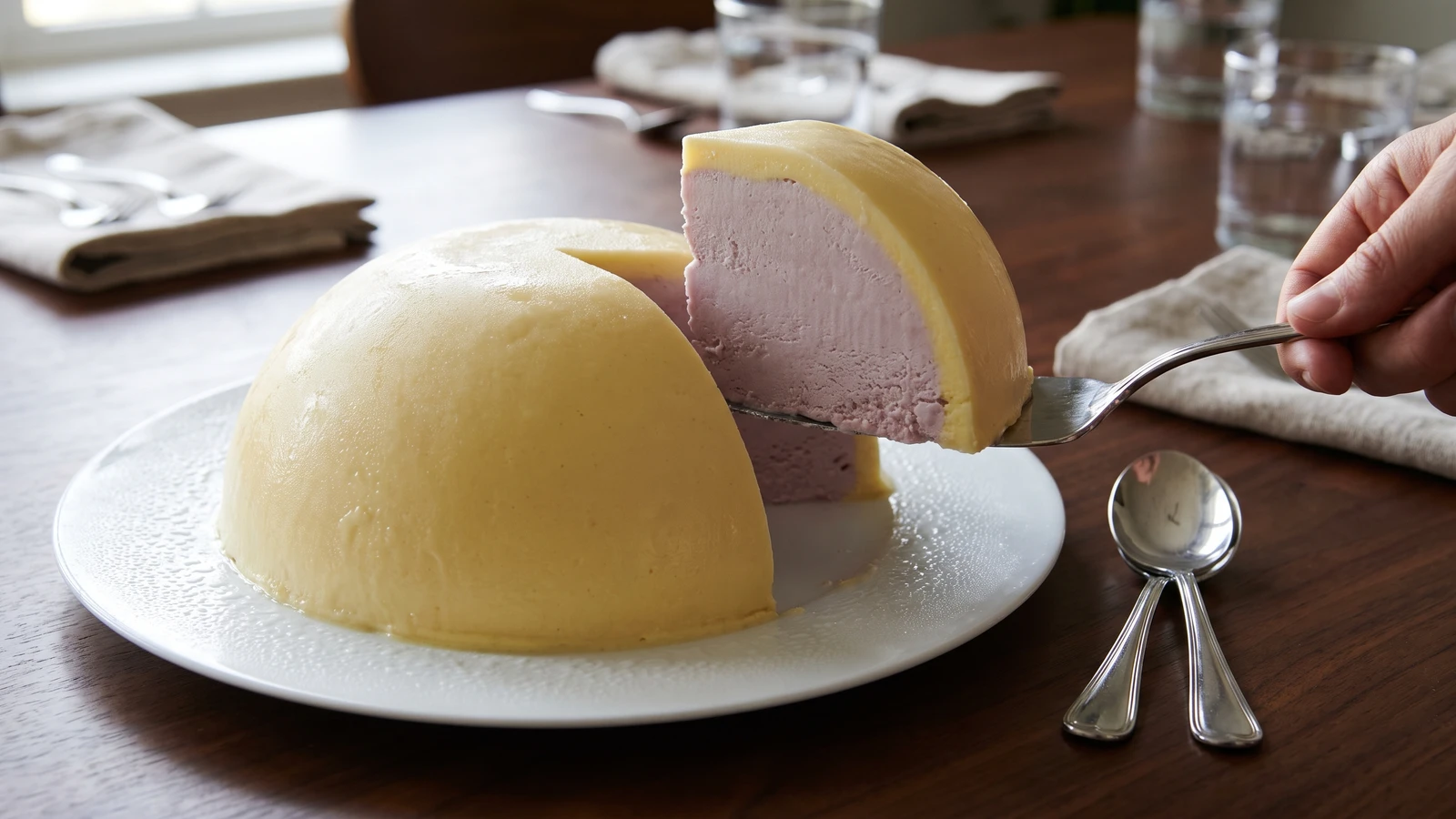
Ripe banana ice around a violet-scented pâte à bombe, moulded into clean, contrasting layers: a floral frozen centrepiece whose success rests on restraint with the violet and patience in the freezer.
Bombe Clarence (a banana-ice shell with a violet cream centre) teaches the most delicate lesson in frozen confectionery: perfume must stop before it announces itself. Violet is lovely at the threshold and soapy one drop later. Before a pan is touched, know this one truth: measure the extract drop by drop, test the mixture cold, and stop while it still smells of flowers rather than sweets.
The source assumes banana ice and violet Bombe preparation already waiting at the entremets station, a metal bombe mould, and a freezing cabinet cold enough to harden one after another for service. A home kitchen needs a 1.25 litre metal bowl, one small ice-cream machine, an electric whisk, and an ordinary freezer. The brigade's separate hands and holding cabinets are scaffolding and can go; clothing the mould evenly and making pâte à bombe, the hot-syrup yolk base that gives the centre its satin body, are the dish and must stay. This version makes eight generous slices. One cook, one stove, one evening of work, then the freezer keeps watch.
When cut, the pale banana shell should hold a clean dome around a faintly lilac centre, fruit first, flowers second, cream finishing the mouthful. The decisive step is scenting the fully cooled base before it is packed into the frozen shell; that is where restraint makes Bombe Clarence.
Bombes glacées belong to the Parisian confectioner's and grand dining table, where contrasting frozen preparations were packed into metal dome moulds and hardened for service. Clarence is a repertoire name, not a regional household pudding; its identity is the pairing of banana ice with violet Bombe preparation, carried from the professional entremets station to formal home dinners. The surprising sole-aspic cross-reference concerns only the shared technique of clothing a mould evenly, not any savoury ingredient.
Quantity
3 medium (about 1½ cups / 340 g peeled)
peeled and sliced
Quantity
½ cup (120 ml / 100 g)
Quantity
½ cup (120 ml / 120 g)
Quantity
1 tablespoon (15 ml / 15 g)
Quantity
4 large (about ¼ cup / 60 ml / 68 g)
Quantity
½ cup (120 ml / 100 g)
Quantity
¼ cup (60 ml / 60 g)
Quantity
1 cup (240 ml / 240 g)
Quantity
4 to 10 drops (about 1/32 to 1/16 teaspoon / 0.15 to 0.3 ml / 0.15 to 0.3 g)
Quantity
¼ cup (60 ml / 60 g)
held for rescuing an over-scented filling
Quantity
1 toothpick-tip
Quantity
1 application from Another Method of Preparing Aspics de Filets de Soles (No. 916)
used only to coat the dessert mould; no fish preparation enters the recipe
| Ingredient | Quantity |
|---|---|
| very ripe bananaspeeled and sliced | 3 medium (about 1½ cups / 340 g peeled) |
| granulated sugar, for the banana ice | ½ cup (120 ml / 100 g) |
| water, for the banana ice | ½ cup (120 ml / 120 g) |
| fresh lemon juice | 1 tablespoon (15 ml / 15 g) |
| large egg yolks | 4 large (about ¼ cup / 60 ml / 68 g) |
| granulated sugar, for the pâte à bombe | ½ cup (120 ml / 100 g) |
| water, for the pâte à bombe | ¼ cup (60 ml / 60 g) |
| cold heavy cream | 1 cup (240 ml / 240 g) |
| food-grade natural violet extract | 4 to 10 drops (about 1/32 to 1/16 teaspoon / 0.15 to 0.3 ml / 0.15 to 0.3 g) |
| additional cold heavy cream (optional)held for rescuing an over-scented filling | ¼ cup (60 ml / 60 g) |
| violet gel food colour (optional) | 1 toothpick-tip |
| mould-clothing technique referenceused only to coat the dessert mould; no fish preparation enters the recipe | 1 application from Another Method of Preparing Aspics de Filets de Soles (No. 916) |
Set the freezer to its coldest normal setting. Chill a 1.25 litre metal bombe mould or stainless steel bowl for at least 30 minutes, along with the platter on which the dessert will be served. If the ice-cream machine uses a frozen bowl, make certain it is fully frozen before beginning; a half-frozen machine bowl gives coarse, soupy ice.
Combine the ½ cup sugar and ½ cup water in a small saucepan. Warm gently until the sugar dissolves, then simmer for one minute and cool completely. Blend the bananas, lemon juice, and cooled syrup until perfectly smooth. Cover the surface directly and chill for about 30 minutes, until thoroughly cold. A warm base churns into large ice crystals; if it still feels warm, return it to the refrigerator and wait.
Churn the banana mixture according to the machine's directions until it is thick, finely frozen, and able to hold a soft mound, usually 20 to 25 minutes. If it remains loose because the machine bowl has warmed, ça se rattrape: spread the mixture in a shallow metal pan and freeze it for 20 minutes, stirring once, until it is firm enough to shape but not hard.
Reserve about ¾ cup (180 ml / 170 g) banana ice for the closing layer. Use the mould-clothing principle referenced in Another Method of Preparing Aspics de Filets de Soles (No. 916), here applied only to frozen dessert: spoon the remaining banana ice into the chilled mould and work it across the bottom and up the sides with a small offset spatula, making an even shell about 1 cm thick. Hold the mould up to the light and look for thin or bare patches. Patch them with soft banana ice, then freeze the shell for 45 minutes. Uneven clothing gives a weak dome; any gaps can be repaired before filling. Ça se rattrape.
Put the egg yolks in the mixer bowl and whisk until fluid and slightly pale. Combine the remaining ½ cup sugar and ¼ cup water in a clean saucepan, dissolve the sugar over gentle heat, then boil without stirring until the syrup reaches 118°C. With the mixer running at medium speed, pour the syrup in a thin stream down the inside of the bowl, never directly onto the whisk. Increase the speed and beat for 6 to 8 minutes, until the pâte à bombe is thick, pale, voluminous, and cool to the touch. If the syrup spins into hard threads against the bowl, set the bowl briefly over warm water and keep whisking until they dissolve.
Whip the 1 cup cold cream to soft peaks. The pâte à bombe must be completely cool before the cream meets it, or the mixture loses its air. Fold in one-third of the cream to loosen the base, then fold in the remainder with broad, gentle turns. Add four drops of violet extract and fold. Chill a teaspoonful on a saucer for two minutes, then smell and taste it cold; add further extract one drop at a time, stopping while the violet still suggests fresh flowers. If it has crossed into soapiness, whip the optional ¼ cup cream to soft peaks and fold it in by spoonfuls. Ça se rattrape. Add only a toothpick-tip of violet colour if using; the centre should be faintly lilac, not purple.
Check that the banana shell is hard and dry to the touch. If it yields under a fingertip, freeze it for another 15 minutes. Spoon in the violet pâte à bombe, pressing gently so no hollow pockets remain, and leave about 1 cm clear at the rim. Let the reserved banana ice soften just until spreadable, then smooth it over the filling to close the dome completely. Cover directly with baking parchment and wrap the mould well. Freeze for at least 6 hours, preferably overnight, until solid through the centre.
Remove the covering and invert the chilled platter over the mould. Wrap the mould for five seconds in a kitchen towel wrung out in hot water, then turn both together and lift carefully. If the bombe refuses to release, repeat for three seconds; don't keep warming it, or the banana shell will soften before the centre lets go. If that happens, return the mould to the freezer for 15 minutes and begin again. Cut generous wedges with a long knife dipped in hot water and wiped dry between slices. Serve at once. À table!
1 serving (about 125g)
Culinary guides, cultural storytelling, and the editorial depth that makes cooking meaningful.
Discover Culinary ExplorerChef Juliette
Five almond preparations, one discipline: remove the skins cleanly, dry every kernel through, then cut, toast, or cloak it in pale caramel without letting its fragrant oils escape.

Chef Juliette
A pastry pantry lesson in one tray: filberts warmed only until their red skins release, rubbed clean, cooled, and chopped into a fragrant mise-en-place for cakes, creams, pralines, and petits fours.

Chef Juliette
The smallest pâtisserie discipline decides whether a cake leaves its mould intact: clarified butter in every corner, followed by the lightest veil of dry flour or fécule.

Chef Juliette
Four whites, one spotless bowl, and a patient change of speed: whisk gently until loosened, then briskly to glossy stiffness, with powdered sugar waiting if the foam begins to granulate.