
Chef Juliette
Various Almond Preparations
Five almond preparations, one discipline: remove the skins cleanly, dry every kernel through, then cut, toast, or cloak it in pale caramel without letting its fragrant oils escape.
A cooking platform built around craft, culture, and the stories behind what we eat.
Created by Chef Juliette
Based on No. 2839, Bombe Brésilienne, from Le Guide Culinaire (1907) by Auguste Escoffier
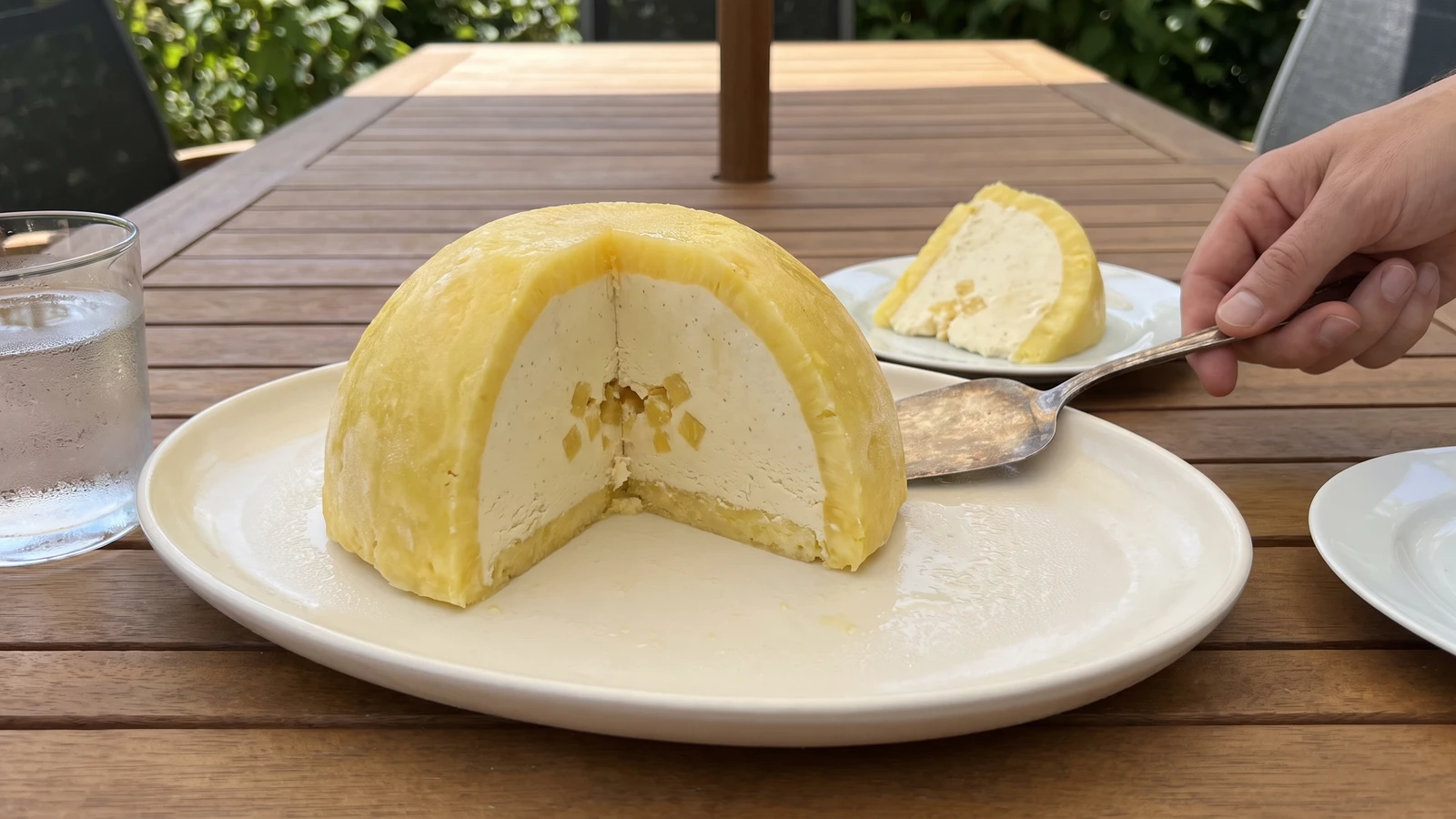
A pineapple-gold shell around vanilla pâte à bombe, softly set with cream, one spoonful of rum, and bright fruit dice. The lesson is control: freeze the shell hard before the center goes in.
Bombe Brésilienne (pineapple ice dome with vanilla-rum cream) teaches the architecture of a frozen dessert: a bright, firm shell around a softer heart. The one true thing is this: the pineapple ice must be frozen solid before the filling touches it. Rush that boundary and the two preparations blur into one; hold it firm and every slice shows the dish exactly as intended.
The original sends the cook to Another Method of Preparing Aspics de Filets de Soles (No. 916) for the operation called clothing the mould, and assumes a brigade rocking that mould over broken ice while another hand manages the filling. At home, a countertop ice-cream machine, a frozen metal mould, and an offset spatula do the work. The aspic construction itself is scaffolding and goes; its lesson, an even coat fitted closely to the mould, is the part that stays. One cook, one stove, one evening of work, then the freezer finishes the job.
Inside goes pâte à bombe, egg yolks expanded with hot sugar syrup, folded with real cream, vanilla, one measured spoonful of rum, and dry pineapple dice. The finished bombe should cut into a pineapple-gold crescent around a pale, softly frozen center. Freeze that shell completely before you make the filling. That is the step that decides the dish.
Frozen bombes belong to Parisian pâtisserie and the grand dining-room table, where rounded metal moulds allowed one frozen preparation to conceal another until the ceremonial unmoulding. Brésilienne is a menu name rather than proof of Brazilian origin; pineapple and rum provide the tropical association, while vanilla keeps the filling within the French frozen-dessert canon. The borrowed vocabulary of clothing a mould shows how freely classical kitchens moved a sound technique between savory aspics and sweet ices.
Quantity
4 cups (950 ml / 600 g)
cut into chunks
Quantity
¾ cup (180 ml / 150 g)
Quantity
½ cup (120 ml / 120 g)
Quantity
2 tablespoons (30 ml / 30 g)
Quantity
⅛ teaspoon (0.6 ml / 0.7 g)
Quantity
1 application (No. 916)
use its clothing-the-mould operation with pineapple ice
Quantity
5
Quantity
⅔ cup (160 ml / 135 g)
Quantity
3 tablespoons (45 ml / 45 g)
Quantity
1
split and seeds scraped
Quantity
1½ cups (360 ml / 355 g)
Quantity
1 tablespoon (15 ml / 14 g)
Quantity
1 cup (240 ml / 165 g)
cut 6 mm thick and thoroughly dried
| Ingredient | Quantity |
|---|---|
| ripe pineapple fleshcut into chunks | 4 cups (950 ml / 600 g) |
| granulated sugar for the pineapple ice | ¾ cup (180 ml / 150 g) |
| water for the pineapple ice | ½ cup (120 ml / 120 g) |
| fresh lemon juice | 2 tablespoons (30 ml / 30 g) |
| fine sea salt | ⅛ teaspoon (0.6 ml / 0.7 g) |
| Another Method of Preparing Aspics de Filets de Solesuse its clothing-the-mould operation with pineapple ice | 1 application (No. 916) |
| large egg yolks | 5 |
| granulated sugar for the pâte à bombe | ⅔ cup (160 ml / 135 g) |
| water for the pâte à bombe | 3 tablespoons (45 ml / 45 g) |
| vanilla beansplit and seeds scraped | 1 |
| cold heavy cream | 1½ cups (360 ml / 355 g) |
| dark rum | 1 tablespoon (15 ml / 14 g) |
| pineapple dicecut 6 mm thick and thoroughly dried | 1 cup (240 ml / 165 g) |
Combine the ¾ cup sugar and ½ cup water in a small saucepan. Warm gently, stirring only until the sugar dissolves, then simmer for one minute and cool completely. Purée the pineapple chunks with the lemon juice and salt until very smooth, then pass the purée through a fine sieve to remove stubborn fibers. Stir in the cooled syrup, cover, and chill for at least two hours, until thoroughly cold.
Churn the cold pineapple mixture until it is dense and spoonable, like firm soft ice cream. Transfer it to the freezer for ten minutes if it still flows; it must cling to the mould rather than slide down its walls. Without a machine, freeze the mixture in a shallow metal pan and beat it thoroughly every thirty minutes until fine-textured and spreadable.
Freeze the metal bombe mould for twenty minutes. Apply the clothing-the-mould operation from Another Method of Preparing Aspics de Filets de Soles (No. 916): press pineapple ice over the bottom and sides in an even layer about 10 mm thick, using a cold offset spatula and working from the base toward the rim. Freeze for thirty minutes, inspect for thin or translucent patches, and cover them with a second coat. Reserve at least ¾ cup of pineapple ice for sealing the base. If the coating slides, return both mould and ice to the freezer for ten minutes and continue; the shape has not been lost.
Put the ⅔ cup sugar and 3 tablespoons water in a clean small saucepan and cook without stirring to 118°C. When the syrup reaches about 110°C, begin beating the yolks until pale and thick. With the mixer running, pour the hot syrup in a thin stream down the inside of the bowl, away from the beaters, then beat until the mixture holds a broad ribbon and the bowl no longer feels warm. If the syrup crystallizes before reaching temperature, add 2 tablespoons of water and dissolve it again over gentle heat; nothing is lost.
Beat the vanilla seeds and the single tablespoon of rum into the cooled pâte à bombe. In a separate cold bowl, whip the cream to soft peaks that bend rather than stand rigid. Fold one-third of the cream into the yolk mixture to loosen it, then fold in the remainder with broad strokes. Add the thoroughly dried pineapple dice last. If the filling becomes loose because the pâte à bombe was still warm, set the bowl over ice for five to ten minutes and fold gently until it regains body.
Take the frozen shell from the freezer and spoon in the filling immediately, pressing it gently against the pineapple ice so no large air pockets remain. Stop about 1 cm below the rim and level the surface. Soften the reserved pineapple ice in the refrigerator just until spreadable, then cover the filling completely and smooth it level with the rim. Do not force ice that is frozen hard, or the shell may crack.
Cover the mould closely and freeze it level for at least six hours, preferably overnight. Rum fights the freeze, which is why the measured spoonful matters: it perfumes the center without leaving it slack. If the middle still yields deeply when pressed through the cover, give it another two hours. Patience, not more cold flavoring.
Chill the serving platter. Dip the mould in lukewarm water for five seconds, dry it, invert it onto the platter, and lift straight upward. If it holds, repeat for two seconds rather than tugging. If the surface softens before release, return the whole arrangement to the freezer for fifteen minutes. Ça se rattrape. Cut with a knife warmed in water and wiped dry between every slice, then serve at once, especially outdoors. À table!
1 serving (about 210g)
Culinary guides, cultural storytelling, and the editorial depth that makes cooking meaningful.
Discover Culinary ExplorerChef Juliette
Five almond preparations, one discipline: remove the skins cleanly, dry every kernel through, then cut, toast, or cloak it in pale caramel without letting its fragrant oils escape.

Chef Juliette
A pastry pantry lesson in one tray: filberts warmed only until their red skins release, rubbed clean, cooled, and chopped into a fragrant mise-en-place for cakes, creams, pralines, and petits fours.

Chef Juliette
The smallest pâtisserie discipline decides whether a cake leaves its mould intact: clarified butter in every corner, followed by the lightest veil of dry flour or fécule.

Chef Juliette
Four whites, one spotless bowl, and a patient change of speed: whisk gently until loosened, then briskly to glossy stiffness, with powdered sugar waiting if the foam begins to granulate.