
Chef Juliette
Various Almond Preparations
Five almond preparations, one discipline: remove the skins cleanly, dry every kernel through, then cut, toast, or cloak it in pale caramel without letting its fragrant oils escape.
A cooking platform built around craft, culture, and the stories behind what we eat.
Created by Chef Juliette
Based on No. 2835, Bombe Américaine, from Le Guide Culinaire (1907) by Auguste Escoffier
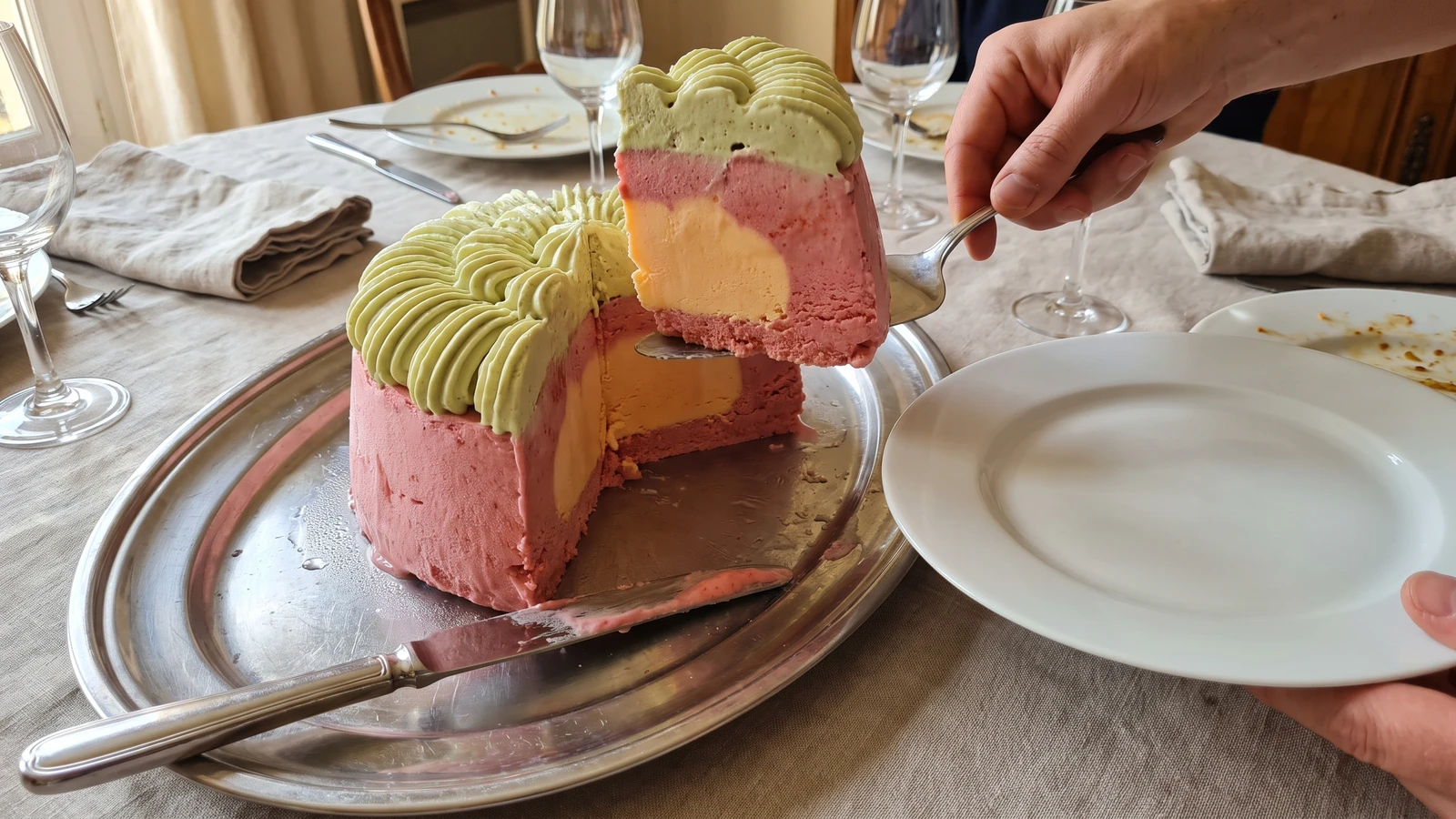
A strawberry shell, a tangerine pâte à bombe heart, and pistachio ice piped over the crown: three temperatures, three colours, and one clean lesson in frozen architecture.
Bombe Américaine (a strawberry-lined frozen bombe with a tangerine pâte à bombe centre and pistachio ice) teaches one cold truth: temperature is architecture. The strawberry must spread without melting, the tangerine filling must be cool and airy, and the pistachio ice must pipe without slumping. Miss the window and nothing is ruined. Back to the freezer it goes.
The original assumed a pastry brigade with strawberry and pistachio ices already prepared, ice and salt for setting, and several hands to coat, fill, turn out, and decorate in sequence. Here the architecture is scaled to one 1.5-litre mould, a home freezer replaces the freezing chest, and two excellent smooth finished ices replace separate rounds of churning. Those ices are brigade scaffolding and the source treats them as finished components; the tangerine pâte à bombe, a yolk foam stabilized with hot syrup, is the dish's centre and stays entirely in your hands. One cook, one stove, one evening.
Cut it and the reward appears at once: a clear strawberry-pink wall around a pale tangerine heart, with cool pistachio green piped across the crown. Put the finely grated zest into the syrup, because the peel carries the tangerine's fragrant oils and juice alone freezes thin in flavour. The step that decides the Bombe Américaine is clothing the mould evenly, so keep that strawberry wall a consistent 1.2 centimetres from base to rim.
Bombe glacée belongs to the Parisian grand-kitchen and pâtisserie repertoire, where contrasting frozen preparations were layered in a domed metal mould for the sweet course of a formal meal. The word bombe names both the mould and the construction, while individual titles identify the sequence of ices and the central bombe preparation. Américaine is the repertory name for this precise arrangement of strawberry, tangerine, and pistachio, not a claim that the dessert arose from an American regional table.
Quantity
3 cups (710 ml / 700 g)
choose a high-fruit strawberry sorbet without fruit pieces
Quantity
4, yielding 1/2 cup (120 ml / 120 g) juice
finely zested, then juiced
Quantity
1/2 cup (120 ml / 100 g)
Quantity
3 tablespoons (45 ml / 45 g)
Quantity
5 (about 90 g)
preferably pasteurized
Quantity
1/8 teaspoon (0.6 ml / 0.7 g)
Quantity
1 1/4 cups (300 ml / 300 g)
Quantity
2 cups (475 ml / 450 g)
choose dense pistachio ice cream without nut pieces
Quantity
1 application of Another Method of Preparing Aspics de Filets de Soles (No. 916)
use only the coating principle; no aspic or fish enters the dessert
| Ingredient | Quantity |
|---|---|
| smooth strawberry icechoose a high-fruit strawberry sorbet without fruit pieces | 3 cups (710 ml / 700 g) |
| medium tangerinesfinely zested, then juiced | 4, yielding 1/2 cup (120 ml / 120 g) juice |
| granulated sugar | 1/2 cup (120 ml / 100 g) |
| water | 3 tablespoons (45 ml / 45 g) |
| large egg yolkspreferably pasteurized | 5 (about 90 g) |
| fine salt | 1/8 teaspoon (0.6 ml / 0.7 g) |
| cold heavy cream | 1 1/4 cups (300 ml / 300 g) |
| smooth pistachio icechoose dense pistachio ice cream without nut pieces | 2 cups (475 ml / 450 g) |
| mould-clothing technique reference, not a food ingredientuse only the coating principle; no aspic or fish enters the dessert | 1 application of Another Method of Preparing Aspics de Filets de Soles (No. 916) |
Clear a level freezer shelf. Chill the 1.5-litre metal bombe mould, serving platter, mixer bowl, and beaters for 30 minutes. Keep the strawberry and pistachio ices frozen for now. Cold tools buy you working time, which is more useful here than hurried hands.
Put the sugar and water in a small saucepan, then grate all the coloured tangerine zest directly into it, stopping before the bitter white pith. In a second small pan, boil the 1/2 cup of juice until reduced to 3 tablespoons (45 ml / 45 g), about 5 minutes. Pour the concentrate into a shallow cup and cool it completely. The juice supplies acidity and body, but the zest in the syrup supplies the perfume; juice alone freezes thin.
Begin whipping the yolks and salt at medium speed until pale. Cook the zested syrup without stirring until it reaches 118°C (244°F), then pour it in a thin stream down the inside of the mixer bowl while whisking continuously. If crystals form before the syrup reaches temperature, stop, add 1 tablespoon (15 ml / 15 g) water, and warm gently until clear before continuing. Once all the syrup is incorporated, the yolk mixture should reach at least 71°C (160°F); if it does not, whisk it briefly over a barely simmering bain-marie until it does, then return it to the mixer. Whip until thick, ribbony, and cool to the touch, about 7 minutes.
Fold the cold tangerine concentrate into the pâte à bombe. Reserve 2 tablespoons (30 ml / 30 g) of the cream, then whip the remainder to soft peaks that bend rather than stand rigid. Fold one-third into the tangerine mixture to loosen it, then fold in the rest without beating out the air. If the cream becomes grainy from overwhipping, work in the reserved liquid cream a spoonful at a time until it relaxes. Cover and refrigerate while you line the mould.
Let the strawberry ice stand just until a spoon can cut through it, usually 8 to 12 minutes. Reserve about 1/2 cup (120 ml / 115 g) for the base. Pack the rest against the bottom and sides of the chilled mould, smoothing it into an even 1.2-centimetre shell with the back of a cold spoon. Another Method of Preparing Aspics de Filets de Soles (No. 916) calls this clothing the mould: only its even-coating principle travels from the savoury reference into this dessert. Freeze for 45 minutes. If the strawberry layer slides or exposes metal, stop and freeze it for 10 minutes, then patch the gap with more ice. Ça se rattrape.
Spoon the tangerine pâte à bombe into the frozen strawberry shell, pressing gently so no large air pockets remain. Leave 1 centimetre below the rim and freeze until the surface is firm enough to support a spoonful of sorbet, about 45 minutes. Soften the reserved strawberry ice and spread it across the opening to seal the centre completely. Cover and freeze on the level shelf for at least 6 hours, preferably overnight.
Chill the serving platter. Dip only the outside of the mould in lukewarm water for 5 seconds, dry it, place the platter over it, and invert decisively. Lift the mould. If the bombe holds fast, repeat with another 3-second dip; prolonged warmth blurs the strawberry shell. If a small patch tears, return the bombe to the freezer for 15 minutes, fill the mark with softened strawberry ice, and smooth it before decorating.
Let the pistachio ice soften until pliable but still cold and dense. Fit a piping bag with a large star tip, fill it only halfway, and pipe generous fluted ropes or overlapping shells from the base toward the crown, decorating the Bombe Américaine only after it has been turned out, exactly as the source directs. If the ridges slump, put the bombe and piping bag back in the freezer for 10 minutes before continuing. Freeze the decorated bombe for at least 30 minutes.
Let the bombe stand at room temperature for 8 to 10 minutes, just until a knife enters without force. Dip a long sharp knife in hot water, wipe it dry, and cut clean wedges, warming and drying the blade between each one. The slice should show three distinct colours with no melted seam between them. À table!
1 serving (about 215g)
Culinary guides, cultural storytelling, and the editorial depth that makes cooking meaningful.
Discover Culinary ExplorerChef Juliette
Five almond preparations, one discipline: remove the skins cleanly, dry every kernel through, then cut, toast, or cloak it in pale caramel without letting its fragrant oils escape.

Chef Juliette
A pastry pantry lesson in one tray: filberts warmed only until their red skins release, rubbed clean, cooled, and chopped into a fragrant mise-en-place for cakes, creams, pralines, and petits fours.

Chef Juliette
The smallest pâtisserie discipline decides whether a cake leaves its mould intact: clarified butter in every corner, followed by the lightest veil of dry flour or fécule.

Chef Juliette
Four whites, one spotless bowl, and a patient change of speed: whisk gently until loosened, then briskly to glossy stiffness, with powdered sugar waiting if the foam begins to granulate.