
Chef Juliette
Various Almond Preparations
Five almond preparations, one discipline: remove the skins cleanly, dry every kernel through, then cut, toast, or cloak it in pale caramel without letting its fragrant oils escape.
A cooking platform built around craft, culture, and the stories behind what we eat.
Created by Chef Juliette
Based on No. 2830, Bombe Africaine, from Le Guide Culinaire (1907) by Auguste Escoffier
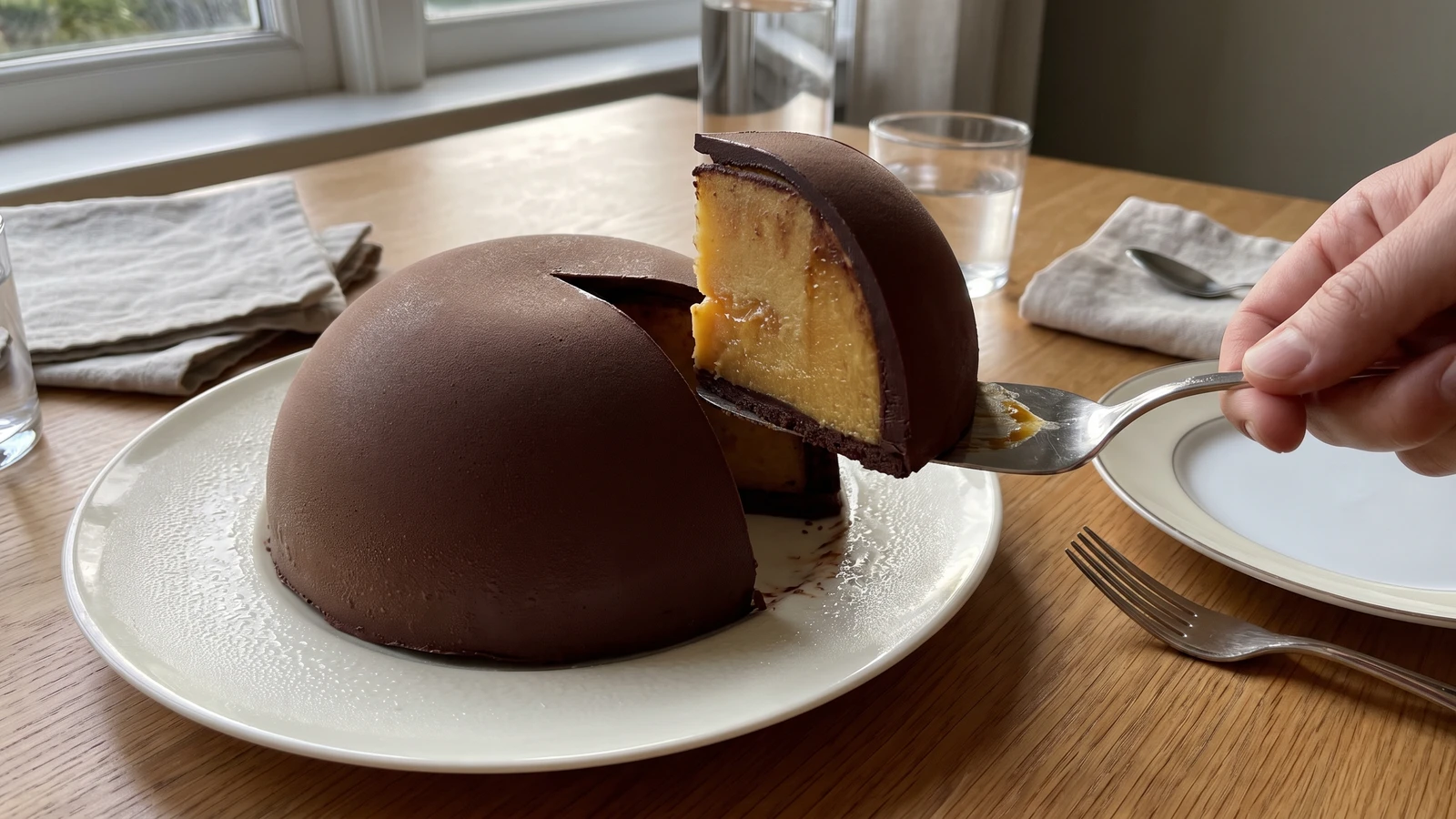
A thin dark chocolate chemise gives way to golden apricot pâte à bombe, a frozen dinner-party dessert whose elegance depends on spreading the shell evenly before it firms.
Bombe Africaine (a dark chocolate and apricot frozen bombe) teaches the discipline of the chemise, the thin frozen lining used to clothe a mould. One truth decides the dessert: the chocolate shell must be thin and even. Make it thick and chocolate buries the apricot; leave gaps and the golden centre breaks through the dark dome. The pleasure lies in that clean contrast, bitter cocoa first, bright fruit immediately behind it.
The original assumed chocolate ice and apricot Bombe-preparation waiting in a professional freezing room, extra hands to manage them, and a metal bombe packed in salt and ice. Your honest equivalents are dense dark chocolate ice cream, an ordinary metal mould in a home freezer, and an electric mixer for the pâte à bombe, a yolk foam stabilized with hot sugar syrup. What changed is the scale and the cold equipment, not the composition. The brigade quantities and packed-ice cabinet are scaffolding; the thin chemise and apricot centre are the dish and must stay.
One cook, one stove, one evening of work, then the freezer keeps watch. Spread the chocolate while it bends without melting, and if it begins sliding down the mould, stop and chill everything for ten minutes. Ça se rattrape. Before you heat the sugar, make certain the chemise is thin, complete, and frozen firm.
Bombe Africaine belongs to the Parisian grand-kitchen repertoire of moulded ices, where contrasting frozen preparations were packed into metal bombes for formal tables. Its name does not place the dessert in an African regional tradition; it comes from the French menu habit of attaching distant place-names to dramatic combinations, here dark chocolate surrounding warm-coloured apricot. The source's surprising reference to Another Method of Preparing Aspics de Filets de Soles (No. 916) is technical: sweet bombes and savoury aspics share the same rocking and spreading motion for clothing a cold mould evenly.
Quantity
2½ cups (600 ml / 500 g)
softened until spreadable but not melted
Quantity
1 cup (240 ml / 250 g)
thoroughly chilled
Quantity
4 (about 72 g)
preferably pasteurized
Quantity
½ cup (120 ml / 100 g)
Quantity
¼ cup (60 ml / 60 g)
Quantity
1¼ cups (300 ml / 300 g)
thoroughly chilled
Quantity
Another Method of Preparing Aspics de Filets de Soles (No. 916); no food component used
| Ingredient | Quantity |
|---|---|
| dense dark chocolate ice creamsoftened until spreadable but not melted | 2½ cups (600 ml / 500 g) |
| smooth unsweetened apricot puréethoroughly chilled | 1 cup (240 ml / 250 g) |
| large egg yolkspreferably pasteurized | 4 (about 72 g) |
| granulated sugar | ½ cup (120 ml / 100 g) |
| water | ¼ cup (60 ml / 60 g) |
| heavy cream, at least 35 percent fatthoroughly chilled | 1¼ cups (300 ml / 300 g) |
| technique reference for clothing the mould | Another Method of Preparing Aspics de Filets de Soles (No. 916); no food component used |
Set a clean 5-cup (1.2 litre) metal bombe mould or smoothly rounded stainless-steel bowl in the freezer for 30 minutes. Soften the chocolate ice cream only until a spoon passes through it with firm resistance, about 8 to 12 minutes at room temperature. Reserve ½ cup (120 ml / 100 g) for closing the base and keep that portion frozen. The rest must be pliable, never liquid; melted ice cream refreezes coarse and cannot hold an even wall.
Use the motion described in Another Method of Preparing Aspics de Filets de Soles (No. 916): place spoonfuls of softened chocolate ice cream around the frozen mould, then rotate it as you spread the ice upward with the back of a spoon or a small offset spatula. Form a complete chemise 5 to 7 mm thick, with no heavy ridge at the bottom and no bare metal showing. Hold the mould toward the light to find thin patches, smooth them immediately, and freeze for 30 minutes. If the ice cream slides or pools, don't build it thicker. Chill the mould and ice cream separately for 10 minutes, then patch the wall. Ça se rattrape.
Put the sugar and water in a small heavy saucepan. Warm gently, stirring only until the sugar dissolves, then stop stirring and boil to 118°C (244°F), the soft-ball stage. Brush any crystals from the pan wall with a pastry brush dipped in water. If the syrup crystallizes before reaching temperature, add a spoonful of water, return it to low heat until completely clear, and begin the boil again without stirring. Keep your hands clear of the syrup; hot sugar clings and burns.
While the syrup approaches temperature, beat the yolks in a deep heatproof bowl until pale and slightly thickened. With the mixer running at medium speed, pour the 118°C (244°F) syrup into the yolks in a very thin stream down the inside of the bowl, keeping it away from the beaters so it does not spin into hard threads. Increase the speed and beat for 7 to 10 minutes, until the pâte à bombe triples in volume, falls from the beaters in a broad ribbon, and feels barely cool. If a few hard sugar threads form on the bowl, leave them there and transfer the smooth foam to a clean bowl rather than scraping them into the filling.
Reserve 2 tablespoons (30 ml / 30 g) of the liquid cream, then whip the remainder to soft peaks that bend over rather than stand rigid. Fold the cold apricot purée into the pâte à bombe in three additions. Stir the first third of the whipped cream in firmly to lighten the mixture, then fold in the rest with broad turns until no white streaks remain. If the cream has gone grainy from overwhipping, add the reserved liquid cream a teaspoon at a time and fold gently until smooth. Ça se rattrape. The finished apricot Bombe-preparation should be light, thick, and clearly fruity.
Check that the chocolate chemise is frozen hard. Spoon in the apricot Bombe-preparation, pressing it lightly against the shell so no air pockets remain, and stop about 1 cm below the rim. Smooth the surface and freeze for 30 to 45 minutes, until firm enough to touch without lifting any filling. Soften the reserved chocolate ice cream and spread it across the opening to close the bombe, joining it cleanly to the frozen edge of the chemise. Scrape the base level so the unmoulded bombe will stand without rocking.
Cover the mould closely and freeze at minus 18°C (0°F) for at least 8 hours, preferably overnight. This long freeze is part of the method, not idle waiting: the apricot pâte à bombe must set through its centre before the chocolate shell is asked to release. Keep the mould level and away from strongly scented freezer foods.
Chill the serving platter. Dip only the outside of the mould in warm water for 5 seconds, dry it, invert the platter over it, and turn both together. Cover the mould with a warm towel and lift gently. If it holds, repeat the warm-water dip for 2 seconds rather than forcing it. If the surface softens during release, return the unmoulded bombe to the freezer for 15 minutes. Let it stand for 5 to 8 minutes before cutting, then use a knife dipped in hot water and wiped dry between slices. The dark shell should part cleanly around the golden centre. À table!
1 serving (about 160g)
Culinary guides, cultural storytelling, and the editorial depth that makes cooking meaningful.
Discover Culinary ExplorerChef Juliette
Five almond preparations, one discipline: remove the skins cleanly, dry every kernel through, then cut, toast, or cloak it in pale caramel without letting its fragrant oils escape.

Chef Juliette
A pastry pantry lesson in one tray: filberts warmed only until their red skins release, rubbed clean, cooled, and chopped into a fragrant mise-en-place for cakes, creams, pralines, and petits fours.

Chef Juliette
The smallest pâtisserie discipline decides whether a cake leaves its mould intact: clarified butter in every corner, followed by the lightest veil of dry flour or fécule.

Chef Juliette
Four whites, one spotless bowl, and a patient change of speed: whisk gently until loosened, then briskly to glossy stiffness, with powdered sugar waiting if the foam begins to granulate.