
Chef Juliette
Various Almond Preparations
Five almond preparations, one discipline: remove the skins cleanly, dry every kernel through, then cut, toast, or cloak it in pale caramel without letting its fragrant oils escape.
A cooking platform built around craft, culture, and the stories behind what we eat.
Created by Chef Juliette
Based on No. 2792, Mandarines Glacées aux Perles des Alpes, from Le Guide Culinaire (1907) by Auguste Escoffier
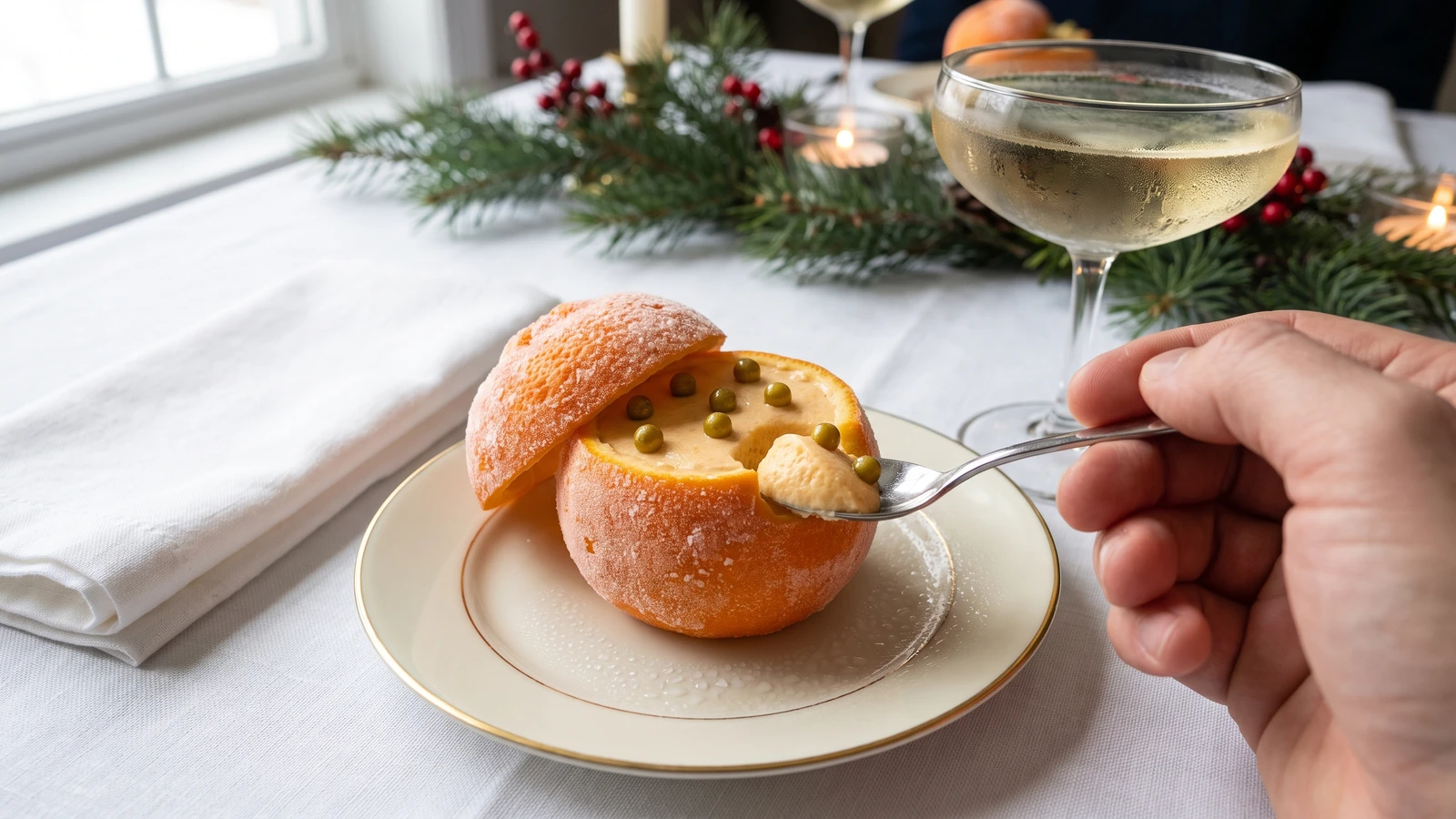
Frosted tangerine shells hide a pale citrus mousse studded with whole Chartreuse bonbons, each cold pearl keeping its herbal bite against bright fruit in a celebration dessert made for the home freezer.
Mandarines Glacées aux Perles des Alpes (frosted tangerines with Chartreuse pearls) teach one clean lesson: in a frozen mousse, temperature is structure. The mousse must be cold and softly holding before the Chartreuse bonbons enter, or their sugar shells bleed and their herbal centers disappear into the filling. Fold them in cold so the pearls stay whole.
The original recipe assumed a pastry brigade with trays of emptied fruit, prepared mousse, a stock of liqueur bonbons, and a freezing cabinet large enough to frost dozens at once. For one cook, one stove, one evening, six sound tangerines stand upright in a muffin tin, a small cooked-yolk mousse provides stable lightness, and a home freezer builds the rime in thin coats. Production trays and extra hands were scaffolding, so they go. The intact peel, mousse made from its juice, cold whole bonbons, fitted lid, and final freezing are the dish, so they stay.
The reward is a bright orange shell under a fine frost, concealing pale tangerine mousse punctuated by little bursts of green, herbal Chartreuse. Cool the mousse until it holds a soft mound before the pearls go in. That is the one step to guard.
Mandarines glacées belong to the Parisian grand-service family of entremets glacés, where citrus skins became individual molds, lids, and serving vessels before the dessert moved naturally onto festive household tables. Perles des Alpes are not tapioca, fruit pearls, or a loose poetic garnish: they are Chartreuse bonbons, named for the green herbal liqueur of the Grande Chartreuse in the Dauphiné near Grenoble. The pairing joins fragrant winter citrus with an Alpine confection, and its character depends as much on the intact sugar shell as on the liqueur within.
Quantity
8 (about 2¼ lb / 1 kg total)
6 chosen for firm, unblemished shells
Quantity
1 cup (240 ml / 245 g)
from the fruit above
Quantity
½ cup (120 ml / 100 g)
Quantity
1 teaspoon (5 ml / 3 g)
Quantity
1 tablespoon (15 ml / 15 g)
for blooming the gelatin
Quantity
3
Quantity
1 cup (240 ml / 240 g)
Quantity
⅓ cup (80 ml / 55 g)
kept whole and frozen for at least 2 hours
Quantity
½ cup (120 ml / 120 g), as needed
for frosting the shells
| Ingredient | Quantity |
|---|---|
| large mandarins or tangerines6 chosen for firm, unblemished shells | 8 (about 2¼ lb / 1 kg total) |
| strained fresh tangerine juicefrom the fruit above | 1 cup (240 ml / 245 g) |
| granulated sugar | ½ cup (120 ml / 100 g) |
| powdered gelatin | 1 teaspoon (5 ml / 3 g) |
| cold waterfor blooming the gelatin | 1 tablespoon (15 ml / 15 g) |
| large egg yolks | 3 |
| cold heavy cream | 1 cup (240 ml / 240 g) |
| small sugar-shelled Chartreuse bonbonskept whole and frozen for at least 2 hours | ⅓ cup (80 ml / 55 g) |
| ice-cold waterfor frosting the shells | ½ cup (120 ml / 120 g), as needed |
Spread the Chartreuse bonbons in one layer on a small plate and freeze them for at least 2 hours. Chill a mixing bowl and the whisk or beaters for the cream. Cold is part of the structure here: warm bonbons soften at the surface and bleed their Chartreuse syrup into the mousse, while frozen ones stay distinct.
Wash and dry the fruit. Choose the six soundest mandarins and cut a neat lid from the top fifth of each, keeping every lid with its shell. Slide a narrow teaspoon between the flesh and peel, lift out the segments gently, and leave enough white pith to support the shell. Stand the emptied shells and lids in a muffin tin. Press the removed flesh and the two extra fruits through a fine sieve, then measure 1 cup (240 ml / 245 g) juice. If a shell tears, use one of the spare fruits for a new shell and add the damaged one to the juice. Ça se rattrape.
Sprinkle the gelatin over the tablespoon of cold water and leave it for 5 minutes. Whisk the yolks, sugar, and measured juice in a heatproof bowl, then set the bowl over a bain-marie, a hot-water bath held at the barest simmer. Keep the bowl above the water and whisk steadily until the mixture lightly coats a spoon and reaches 180°F / 82°C, about 8 to 10 minutes. Do not let it boil. At the first sign of graininess, lift the bowl from the heat, whisk in 1 tablespoon of the measured cold cream, and strain immediately; gentle heat will give you a smooth base, while a hard boil gives you sweet scrambled yolk.
Remove the bowl from the bain-marie and whisk in the bloomed gelatin until completely dissolved. Strain the base into a clean bowl set over ice and stir until cold, slightly thickened, and no warmer than 68°F / 20°C. If it begins setting into lumps, warm the bowl for a few seconds over the still-warm water and whisk it smooth. Whip the remaining cream to soft peaks, then fold it into the tangerine base in three additions. The finished mousse should hold a soft mound, not pour like cream.
Set the mousse over ice for 10 to 15 minutes if it still runs from the spatula. Only when it is cold and softly holding should you add the frozen Chartreuse bonbons. Fold them through with three or four broad turns, keeping every pearl whole. If the mousse loosens, stop and chill it over ice until it mounds again before filling the shells. This is the step that decides the dish.
Spoon the mousse into the six cold tangerine shells, distributing the bonbons evenly and filling each shell just to its cut edge. Fit the matching lids back in place. Freeze the covered fruits upright in the muffin tin until the mousse is firm throughout, at least 4 hours.
Work with one frozen fruit at a time. Brush the peel and lid with the thinnest possible film of ice-cold water, avoiding the seam, then return it to the freezer for 10 minutes. Repeat once or twice until the orange skin carries a fine crystalline rime. Large drops make a hard clear glaze, so blot them away before freezing and rebuild with a thinner coat. Give the finished mandarins a final 45 minutes in the freezer.
Set each mandarin on a chilled dessert plate and leave it at cool room temperature for 5 to 7 minutes. The mousse should yield cleanly to a spoon without slumping, and the Chartreuse pearls should remain whole inside it. Tip each lid slightly askew at the table. À table!
1 serving (about 120g)
Culinary guides, cultural storytelling, and the editorial depth that makes cooking meaningful.
Discover Culinary ExplorerChef Juliette
Five almond preparations, one discipline: remove the skins cleanly, dry every kernel through, then cut, toast, or cloak it in pale caramel without letting its fragrant oils escape.

Chef Juliette
A pastry pantry lesson in one tray: filberts warmed only until their red skins release, rubbed clean, cooled, and chopped into a fragrant mise-en-place for cakes, creams, pralines, and petits fours.

Chef Juliette
The smallest pâtisserie discipline decides whether a cake leaves its mould intact: clarified butter in every corner, followed by the lightest veil of dry flour or fécule.

Chef Juliette
Four whites, one spotless bowl, and a patient change of speed: whisk gently until loosened, then briskly to glossy stiffness, with powdered sugar waiting if the foam begins to granulate.