
Chef Juliette
Various Almond Preparations
Five almond preparations, one discipline: remove the skins cleanly, dry every kernel through, then cut, toast, or cloak it in pale caramel without letting its fragrant oils escape.
A cooking platform built around craft, culture, and the stories behind what we eat.
Created by Chef Juliette
Based on No. 2791, Mandarines Glacées, from Le Guide Culinaire (1907) by Auguste Escoffier
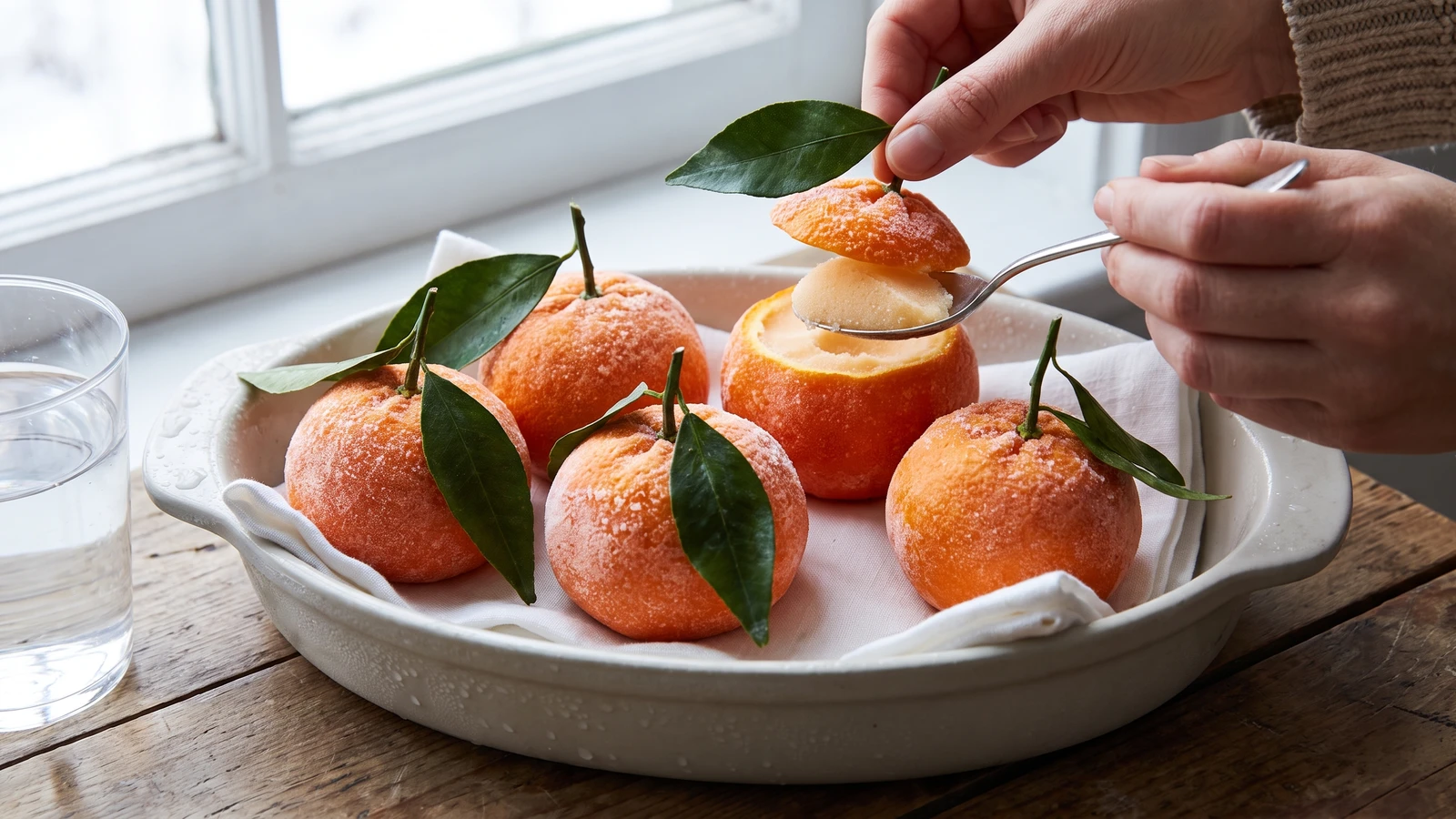
Leaf-on tangerines become their own frozen dessert: bright, smooth fruit ice tucked back into frosted shells, each green-topped lid restored for a celebration that looks grand and asks only for care.
Mandarines Glacées (tangerines filled with their own ice) teach the first law of fruit ices: the mixture must taste a touch sweeter and more fragrant before freezing than you want at the table, because cold quiets both sugar and perfume. Get that balance right, and the result is pure tangerine, smooth enough for a spoon, held inside the peel that gave it.
The original kitchen sent the strained juice to its glacier, the cook responsible for frozen desserts, while another pair of hands cut identical lids with a round cutter. Its cold room could frost the filled fruits on command. At home, a small paring knife makes the roundels, an ice-cream machine or shallow metal pan freezes the juice, and a household freezer sets the brushed water into frost. The special cutter and extra hands were brigade scaffolding. The stalked lids, tangerine ice, recapping, and frosted rind are the dish, so all four stay. Six fruits are enough for a generous table. One cook, one stove, one evening.
Keep the leaf on the stalk. It makes the dish. Choose the six soundest shells before you cut, keep every cap beside its own fruit, and taste the base before it freezes. When it seems just a shade sweeter and more fragrant than you would drink, the cold will bring it into line.
Mandarines glacées belong to the Parisian grand-kitchen repertoire and to the work of the glacier, rather than to a single citrus-growing region. They share the fruit-in-its-own-skin presentation of oranges and lemons givrés, which traveled from formal dining rooms to bourgeois celebration tables as home freezing became practical. In this preparation, glacées is made literal twice: the fruit is frozen within, while water brushed over the peel produces its delicate outer frost.
Quantity
8 (about 2 lb / 900 g)
reserve the 6 soundest for shells; extract and strain 1½ cups (360 ml / 360 g) juice
Quantity
½ cup (120 ml / 100 g)
Quantity
⅓ cup (80 ml / 80 g)
Quantity
2 tablespoons (30 ml / 30 g)
for frosting the shells
| Ingredient | Quantity |
|---|---|
| firm, seedless leaf-on tangerinesreserve the 6 soundest for shells; extract and strain 1½ cups (360 ml / 360 g) juice | 8 (about 2 lb / 900 g) |
| granulated sugar | ½ cup (120 ml / 100 g) |
| cold water | ⅓ cup (80 ml / 80 g) |
| ice-cold waterfor frosting the shells | 2 tablespoons (30 ml / 30 g) |
Wash the tangerines gently and dry them without bruising the leaves. Choose the six firmest fruits with unbroken skins, upright stalks, and at least one sound leaf. Set each fruit in its own cup of a muffin tin, with space beside it for the matching lid; this keeps the round shells upright and prevents a small cap from wandering onto the wrong fruit.
Score a neat round lid about 1½ inches (4 cm) wide around each stalk, using a plain cutter as a guide if you have one. Cut only through the peel, then angle the point of a small paring knife inward and lift away the roundel with its stalk and leaf intact. Ease a teaspoon between the segments and the white membrane, removing the flesh without piercing the rind; leave the white lining in place because it strengthens the shell. If a tiny split appears, stop pulling and free the remaining flesh with the knife. Ça se rattrape: once cold, the shell can stand in its muffin cup and the thick fruit ice will not leak through a small tear.
Press the removed segments gently through a fine sieve, then juice the two remaining tangerines. Measure 1½ cups (360 ml / 360 g), straining out seeds, loose membrane, and pulp. Do not grind the white pith against the sieve, because its bitterness has no place in this clean fruit ice. Chill the empty shells, their matching lids, and the strained juice while you make the syrup.
Combine the sugar and cold water in a small saucepan. Warm gently, stirring only until every crystal dissolves, then let the clear syrup barely simmer for one minute. Take it off the heat and cool it completely over a bowl of ice water. The tangerine juice must meet cold syrup, not warm, or its fresh perfume flattens.
Hold back 2 tablespoons each of the syrup and tangerine juice, then whisk the remainder together. Taste before freezing. It should be vivid and just slightly sweeter than you want to eat; if it is cloying, add the reserved juice by teaspoons, and if it is sharply thin, add the reserved syrup the same way. Cold mutes both sweetness and aroma, so this small excess at room temperature becomes balance at the table. Cover and chill for one hour.
Churn the cold base in an ice-cream machine until dense, smooth, and able to hold the ridges of a spoon, usually 20 to 30 minutes. Without a machine, pour it into a shallow metal pan and freeze until firm around the edges, then beat it vigorously with a fork every 30 minutes until the crystals become fine and the ice holds softly. If it escapes you and freezes into a solid sheet, leave it at room temperature for five minutes, break it into pieces, and beat or process it briefly until smooth. Do not let it melt completely.
Spoon the soft tangerine ice into the cold shells, pressing lightly so no hollow pocket remains. Mound the ice just above each opening and settle the matching stalked lid back into place. Return the fruits upright to the muffin tin and freeze until thoroughly firm, at least 1½ hours. If the ice becomes too soft while you work, put the bowl back in the freezer for ten minutes before filling the remaining shells.
About 20 minutes before serving, brush the rinds lightly with ice-cold water, leaving scattered droplets rather than a heavy coat. Freeze the fruits uncovered for 10 minutes, then repeat with the faintest second brushing if the frost looks sparse. If the water begins running into a clear sheet, blot it immediately and stipple the rind again with barely wet bristles. Set the frosted mandarines on a folded white napkin, as the original service directs, and carry them straight to the table. À table!
1 serving (about 90g)
Culinary guides, cultural storytelling, and the editorial depth that makes cooking meaningful.
Discover Culinary ExplorerChef Juliette
Five almond preparations, one discipline: remove the skins cleanly, dry every kernel through, then cut, toast, or cloak it in pale caramel without letting its fragrant oils escape.

Chef Juliette
A pastry pantry lesson in one tray: filberts warmed only until their red skins release, rubbed clean, cooled, and chopped into a fragrant mise-en-place for cakes, creams, pralines, and petits fours.

Chef Juliette
The smallest pâtisserie discipline decides whether a cake leaves its mould intact: clarified butter in every corner, followed by the lightest veil of dry flour or fécule.

Chef Juliette
Four whites, one spotless bowl, and a patient change of speed: whisk gently until loosened, then briskly to glossy stiffness, with powdered sugar waiting if the foam begins to granulate.