
Chef Juliette
Various Almond Preparations
Five almond preparations, one discipline: remove the skins cleanly, dry every kernel through, then cut, toast, or cloak it in pale caramel without letting its fragrant oils escape.
A cooking platform built around craft, culture, and the stories behind what we eat.
Created by Chef Juliette
Based on No. 2785, Glace Francillon, from Le Guide Culinaire (1907) by Auguste Escoffier
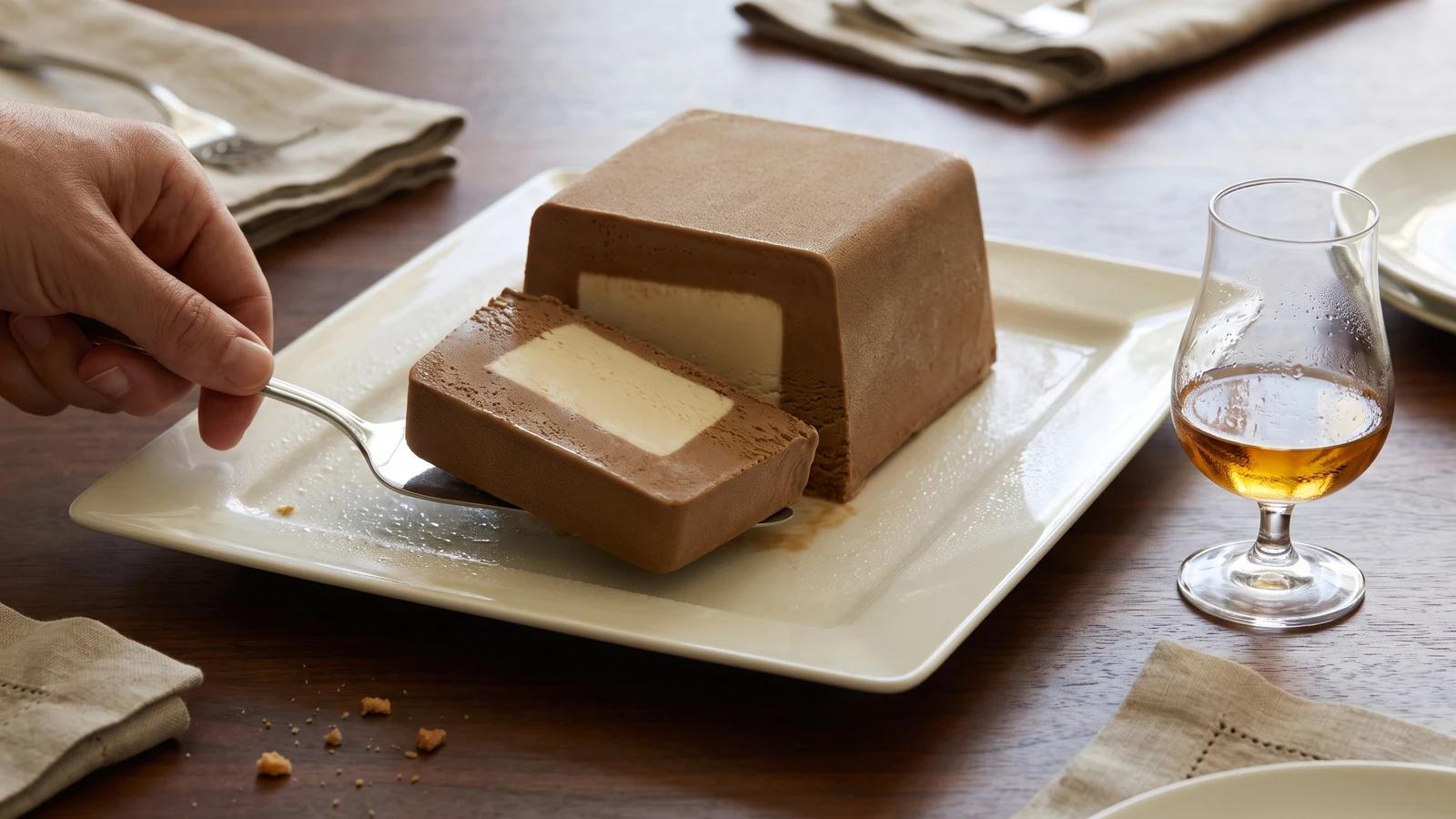
Two ices, one clean square: deep coffee around a pale Cognac center, served without garnish. Glace Francillon teaches that moulding rests on temperature, timing, and a decisive unmoulding.
Glace Francillon (coffee-clothed liqueur-brandy ice) teaches the governing principle of every moulded ice: texture is architecture. Before you touch a pan, know this one true thing. The coffee ice must be firm enough to hold an even wall yet supple enough to reach the square corners, while the brandy ice must pack inside without melting that wall. The governing technique is chemiser (to clothe the mould), and the word carries the technique.
The original line assumed two finished ices waiting in a pastry freezer, a square mould kept rigid in salted ice, and another pair of hands ready when each texture reached its moment. The home equivalent is an ice-cream maker, a well-frozen metal mould, and two small crèmes anglaises (pouring custards) cooked back-to-back. Brigade quantity and the salted-ice apparatus have gone because they are scaffolding. The coffee shell, the brandy filling, and their precise sequence are the dish, so they stay. One cook, one stove, one evening.
Turned out, the Francillon should be almost severe: a plain coffee-brown square that cuts to reveal a pale, aromatic center. There is no garnish to distract from weak coffee or careless moulding. Make the coffee infusion bold, then give the chemisage your full attention; that even shell is the step that decides everything.
Glace Francillon belongs to the Parisian repertoire of entremets glacés, composed frozen desserts whose names often nodded to the theatre and salon rather than to a French province; Francillon itself was a celebrated title on the Paris stage. Its construction reflects the grand pastry kitchen's method: two complete ices, one used as architecture and the other as filling. As mechanical freezing reached home kitchens, the packed salt and ice disappeared, but the contrast of coffee and liqueur-brandy remained intact.
Quantity
1½ cups (360 ml / 371 g)
divided
Quantity
1 cup (240 ml / 238 g)
Quantity
½ cup (120 ml / 50 g)
coarsely cracked
Quantity
4
Quantity
½ cup (120 ml / 100 g)
Quantity
¾ cup (180 ml / 185 g)
Quantity
¾ cup (180 ml / 178 g)
Quantity
3
Quantity
⅓ cup (80 ml / 67 g)
Quantity
3 tablespoons (45 ml / 43 g)
Quantity
⅛ teaspoon (0.6 ml / 0.75 g)
divided between the two ices
Quantity
1 procedural reference (No. 916)
used only for the clothing-the-mould technique; no aspic enters the dessert
| Ingredient | Quantity |
|---|---|
| whole milk for the coffee icedivided | 1½ cups (360 ml / 371 g) |
| heavy cream for the coffee ice | 1 cup (240 ml / 238 g) |
| whole medium-dark coffee beanscoarsely cracked | ½ cup (120 ml / 50 g) |
| large egg yolks for the coffee ice | 4 |
| superfine sugar for the coffee ice | ½ cup (120 ml / 100 g) |
| whole milk for the liqueur-brandy ice | ¾ cup (180 ml / 185 g) |
| heavy cream for the liqueur-brandy ice | ¾ cup (180 ml / 178 g) |
| large egg yolks for the liqueur-brandy ice | 3 |
| superfine sugar for the liqueur-brandy ice | ⅓ cup (80 ml / 67 g) |
| Cognac or fine French grape brandy | 3 tablespoons (45 ml / 43 g) |
| fine sea saltdivided between the two ices | ⅛ teaspoon (0.6 ml / 0.75 g) |
| Another Method of Preparing Aspics de Filets de Solesused only for the clothing-the-mould technique; no aspic enters the dessert | 1 procedural reference (No. 916) |
Set a 1 to 1.1 liter square metal mould on a flat freezer shelf for at least 30 minutes. Chill an offset spatula and a small covered container beside it. The ice-cream maker's bowl must already be completely frozen according to its maker's instructions; a half-frozen bowl gives you sweet cream slush, and no amount of ceremony will persuade slush to hold a square corner.
Reserve ¼ cup (60 ml) of the coffee-ice milk. Put the remaining milk, the coffee-ice cream, and the cracked beans in a saucepan. Heat until tiny bubbles gather at the edge, then remove from the heat, cover, and infuse for 20 minutes. Strain through a fine sieve without crushing the beans, which would bring bitterness, then add the reserved milk. The infusion should smell almost too strong for a cup of coffee because freezing will soften its aroma.
Whisk the 4 yolks with the coffee-ice sugar and half the salt until smooth, not frothy. Bring the infused dairy back to a gentle heat, whisk one-third of it into the yolks, then return everything to the saucepan. Stir constantly over low heat until the anglaise reaches 80 to 82°C (176 to 180°F) and becomes nappé (thick enough to coat the back of a spoon). Never let it boil. If fine grains appear, pull the pan off the heat at once, set its base in ice water, blend briefly, and strain; it can be rescued while the grains are small, but a fully boiled custard cannot be returned to silk.
Heat the brandy-ice milk and cream until bubbles gather around the edge. Whisk the remaining yolks with the brandy-ice sugar and remaining salt, temper them with one-third of the hot dairy, then return the mixture to the pan. Stir over low heat to the same nappé stage, 80 to 82°C (176 to 180°F), and strain immediately into a clean bowl. Do not add the Cognac while the custard is hot; heat throws away its perfume.
Set both bowls over ice water and stir until thoroughly cold, then cover and refrigerate for at least 1 hour. Stir the Cognac into the cold brandy anglaise. Keep to the measured amount: more brandy does not make a finer ice, it makes one too soft to hold its place inside the mould.
Churn the coffee anglaise until dense and softly ridged. The chemisage follows Another Method of Preparing Aspics de Filets de Soles (No. 916): spoon the coffee ice into the frozen mould and use the chilled spatula to spread an even layer about 1½ cm (⅝ inch) thick across the bottom and up all four sides, pressing it firmly into the corners. Reserve about 1 cup (240 ml) of coffee ice for the top. Freeze the clothed mould and the covered reserve for 35 to 45 minutes. If the walls slide, the ice is still too loose. Ça se rattrape: scrape it back into its container, freeze for 10 minutes, stir well, and chemiser again.
Churn the liqueur-brandy anglaise until it holds soft ridges. Pack it into the coffee shell a spoonful at a time, pressing toward the corners so no air pockets remain, and stop 1½ cm (⅝ inch) below the rim. If the brandy ice stays slushy after a normal churning cycle, spread it in a shallow chilled pan and freeze for 10 to 15 minutes, stirring once, before filling. Let the reserved coffee ice soften for a few minutes if necessary, then spread it across the top to seal the brandy ice completely. Level the surface, cover tightly, and freeze for at least 4 hours.
Chill a flat serving platter. Dip the mould only to its rim in lukewarm water for 3 seconds, dry it, invert it onto the platter, and lift. If it refuses, repeat for 2 seconds rather than tugging; patience keeps the square sharp. Return the unmoulded Francillon to the freezer for 10 minutes if its surface has softened. Cut it with a long knife dipped in hot water and wiped dry between slices. Serve it bare, exactly as intended. À table!
1 serving (about 205g)
Culinary guides, cultural storytelling, and the editorial depth that makes cooking meaningful.
Discover Culinary ExplorerChef Juliette
Five almond preparations, one discipline: remove the skins cleanly, dry every kernel through, then cut, toast, or cloak it in pale caramel without letting its fragrant oils escape.

Chef Juliette
A pastry pantry lesson in one tray: filberts warmed only until their red skins release, rubbed clean, cooled, and chopped into a fragrant mise-en-place for cakes, creams, pralines, and petits fours.

Chef Juliette
The smallest pâtisserie discipline decides whether a cake leaves its mould intact: clarified butter in every corner, followed by the lightest veil of dry flour or fécule.

Chef Juliette
Four whites, one spotless bowl, and a patient change of speed: whisk gently until loosened, then briskly to glossy stiffness, with powdered sugar waiting if the foam begins to granulate.