
Chef Juliette
Various Almond Preparations
Five almond preparations, one discipline: remove the skins cleanly, dry every kernel through, then cut, toast, or cloak it in pale caramel without letting its fragrant oils escape.
A cooking platform built around craft, culture, and the stories behind what we eat.
Created by Chef Juliette
Based on No. 2784, Glace Fleurette, from Le Guide Culinaire (1907) by Auguste Escoffier
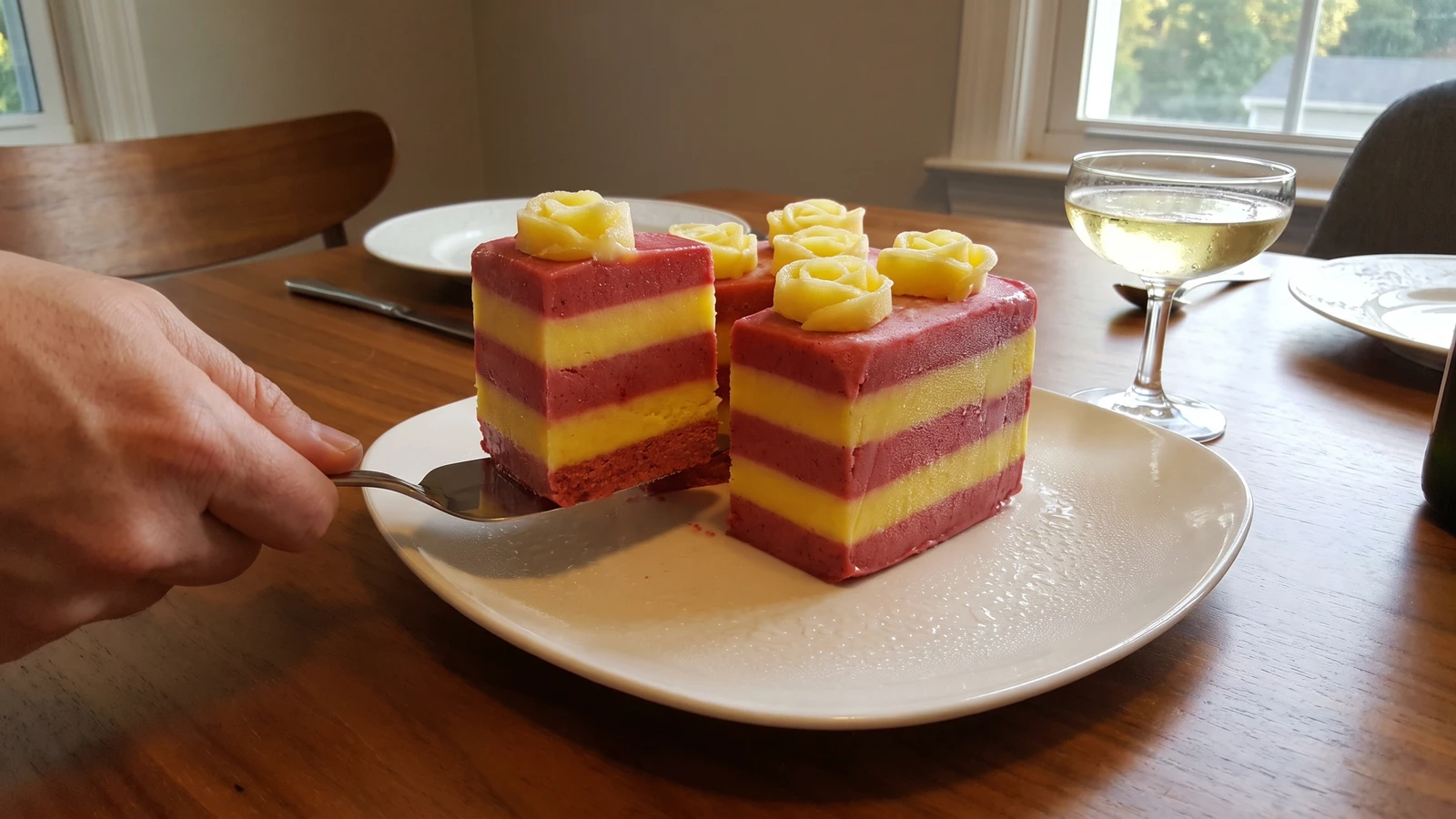
A square of vivid strawberry and pineapple ices, built in six exact layers and finished with lemon ice: the frozen dessert that teaches patience, clean edges, and the value of a level hand.
Glace Fleurette (a square mould of layered strawberry and pineapple ices with lemon ice) teaches one principle plainly: the layers must be level before they freeze, because cold preserves every ridge, hollow, and hurried stroke. The fruit gives the colour, but precision gives the dessert its character.
The original assumed a confectioner's station where three fruit ices were already churning, along with a metal mould packed in salted ice. Your honest equivalent is three shallow trays, a food processor, a straight-sided 6-inch square pan, and a domestic freezer. What changed is the freezing apparatus and the brigade quantity. What stays is the dish itself: alternating, even layers and a decoration made only from lemon ice. One cook, one stove, one evening.
When it is right, each cut reveals six clean bands of strawberry red and pineapple yellow beneath pale lemon rosettes. Level every layer while it is pliable, then freeze it firm before adding the next. That pause is the one step that matters most.
Glace Fleurette belongs to the Parisian repertoire of entremets glacés, moulded frozen desserts prepared by the confectioner's section for the formal dessert course. It traveled through pastry workrooms and grand dining rooms as a display of colour and control, with strawberry, pineapple, and lemon remaining distinct until the first slice revealed their arrangement. Despite the name, the source composition contains no crème fleurette; this is a fruit-ice construction, and adding cream would change the dish.
Quantity
2⅔ cups (640 ml / 400 g)
hulled and quartered
Quantity
¾ cup (180 ml / 150 g)
Quantity
½ cup (120 ml / 120 g)
Quantity
1 tablespoon (15 ml / 15 g)
Quantity
2½ cups (600 ml / 400 g)
peeled, cored, and chopped
Quantity
½ cup plus 1 tablespoon (135 ml / 115 g)
Quantity
½ cup (120 ml / 120 g)
Quantity
1 tablespoon (15 ml / 15 g)
Quantity
⅓ cup (80 ml / 82 g)
Quantity
6 tablespoons (90 ml / 90 g)
Quantity
6 tablespoons (90 ml / 75 g)
Quantity
Finely grated zest of 1 lemon
Quantity
⅛ teaspoon (0.6 ml / 0.7 g)
divided among the three ices
| Ingredient | Quantity |
|---|---|
| strawberries, for the strawberry icehulled and quartered | 2⅔ cups (640 ml / 400 g) |
| granulated sugar, for the strawberry ice | ¾ cup (180 ml / 150 g) |
| water, for the strawberry ice | ½ cup (120 ml / 120 g) |
| fresh lemon juice, for the strawberry ice | 1 tablespoon (15 ml / 15 g) |
| ripe pineapple, for the pineapple icepeeled, cored, and chopped | 2½ cups (600 ml / 400 g) |
| granulated sugar, for the pineapple ice | ½ cup plus 1 tablespoon (135 ml / 115 g) |
| water, for the pineapple ice | ½ cup (120 ml / 120 g) |
| fresh lemon juice, for the pineapple ice | 1 tablespoon (15 ml / 15 g) |
| fresh lemon juice, for the lemon ice | ⅓ cup (80 ml / 82 g) |
| water, for the lemon ice | 6 tablespoons (90 ml / 90 g) |
| granulated sugar, for the lemon ice | 6 tablespoons (90 ml / 75 g) |
| lemon zest | Finely grated zest of 1 lemon |
| fine sea saltdivided among the three ices | ⅛ teaspoon (0.6 ml / 0.7 g) |
Set the freezer to 0°F (-18°C) or colder. Chill a straight-sided 6-inch (15 cm) square metal mould, three shallow freezer trays, the food processor bowl, and a small offset spatula. Clear a perfectly level shelf for the mould; a tilted freezer shelf gives tilted layers before the fruit has any chance to object.
Combine the strawberry sugar and water in a small saucepan. Bring to a simmer, stirring only until the sugar dissolves, then cook for 1 minute. Cool the syrup until barely warm. Blend it with the strawberries, lemon juice, and a small pinch of salt until completely smooth, then press through a fine sieve to remove the seeds. Pour the mixture into a shallow tray and chill it before freezing.
Rinse the saucepan, then combine the pineapple sugar and water. Bring to a simmer, dissolve the sugar, and cook for 1 minute. Cool until barely warm, then blend with the pineapple, lemon juice, and another small pinch of salt until no fibres remain visible. Pour into the second shallow tray. Pineapple carries more fibre than strawberry, so give it the full blending time; an uneven purée makes a rough layer.
Combine the lemon-ice water, sugar, zest, and remaining salt in the rinsed saucepan. Simmer for 1 minute, cover, and leave the zest to infuse for 10 minutes. Strain, cool completely, and stir in the lemon juice. Pour into the third shallow tray. Adding the juice after cooling keeps its flavour bright rather than cooked.
Freeze all three trays until the mixtures are firm at the edges and solid enough to cut into chunks, about 2½ to 3½ hours. Process the strawberry ice until dense, smooth, and able to hold a soft peak, then repeat with the pineapple ice in the cleaned processor. Divide each flavour into three equal portions, about 215 g apiece, and keep them frozen in separate chilled containers. Leave the lemon ice in its tray for now. If either fruit ice crumbles instead of smoothing, let the chunks stand for 3 minutes and process again. If it turns slushy, return it to the freezer for 15 minutes. Ça se rattrape.
Spread one portion of strawberry ice across the bottom of the chilled mould, pushing it firmly into every corner and levelling it into an even layer with the chilled spatula. Freeze for 25 to 30 minutes, until the surface resists a light fingertip. Soften one portion of pineapple ice just until spreadable and level it over the strawberry. Continue alternating strawberry and pineapple until all six layers are built, finishing with pineapple. Do not add a new layer over a soft one. If the colours smear, stop, freeze the mould for 15 minutes, lift away the mixed patch, and fill it with the correct ice before levelling again. The even layers are the dish.
Smooth the final surface, press a square of parchment directly against it, and wrap the mould tightly. Freeze on the level shelf for at least 2 hours, until hard through the centre. This final set binds the layers firmly enough to survive turning out and slicing.
Process the lemon ice until smooth and firm enough to pipe, then place it in a chilled piping bag fitted with a large star tip. Remove the parchment from the mould, dip the outside in barely warm water for 5 seconds, dry it, and invert it onto a chilled platter. If it clings, repeat in 2-second intervals; holding it in the water until the edges run will blur the square. Pipe small lemon-ice rosettes around the top. If they slump, scrape them back into the bowl, freeze the lemon ice for 10 minutes, and pipe again. Return the decorated Glace Fleurette to the freezer for 20 minutes.
Let the Glace Fleurette stand at room temperature for 8 to 10 minutes, just until a knife enters without cracking the layers. Warm a heavy knife under hot water, dry it thoroughly, and cut straight down, cleaning and warming the blade between slices. Serve on chilled plates with the alternating bands fully visible. Nothing else belongs on it. À table!
1 serving (about 190g)
Culinary guides, cultural storytelling, and the editorial depth that makes cooking meaningful.
Discover Culinary ExplorerChef Juliette
Five almond preparations, one discipline: remove the skins cleanly, dry every kernel through, then cut, toast, or cloak it in pale caramel without letting its fragrant oils escape.

Chef Juliette
A pastry pantry lesson in one tray: filberts warmed only until their red skins release, rubbed clean, cooled, and chopped into a fragrant mise-en-place for cakes, creams, pralines, and petits fours.

Chef Juliette
The smallest pâtisserie discipline decides whether a cake leaves its mould intact: clarified butter in every corner, followed by the lightest veil of dry flour or fécule.

Chef Juliette
Four whites, one spotless bowl, and a patient change of speed: whisk gently until loosened, then briskly to glossy stiffness, with powdered sugar waiting if the foam begins to granulate.