
Chef Juliette
Various Almond Preparations
Five almond preparations, one discipline: remove the skins cleanly, dry every kernel through, then cut, toast, or cloak it in pale caramel without letting its fragrant oils escape.
A cooking platform built around craft, culture, and the stories behind what we eat.
Created by Chef Juliette
Based on No. 2782, Glace Dora, from Le Guide Culinaire (1907) by Auguste Escoffier
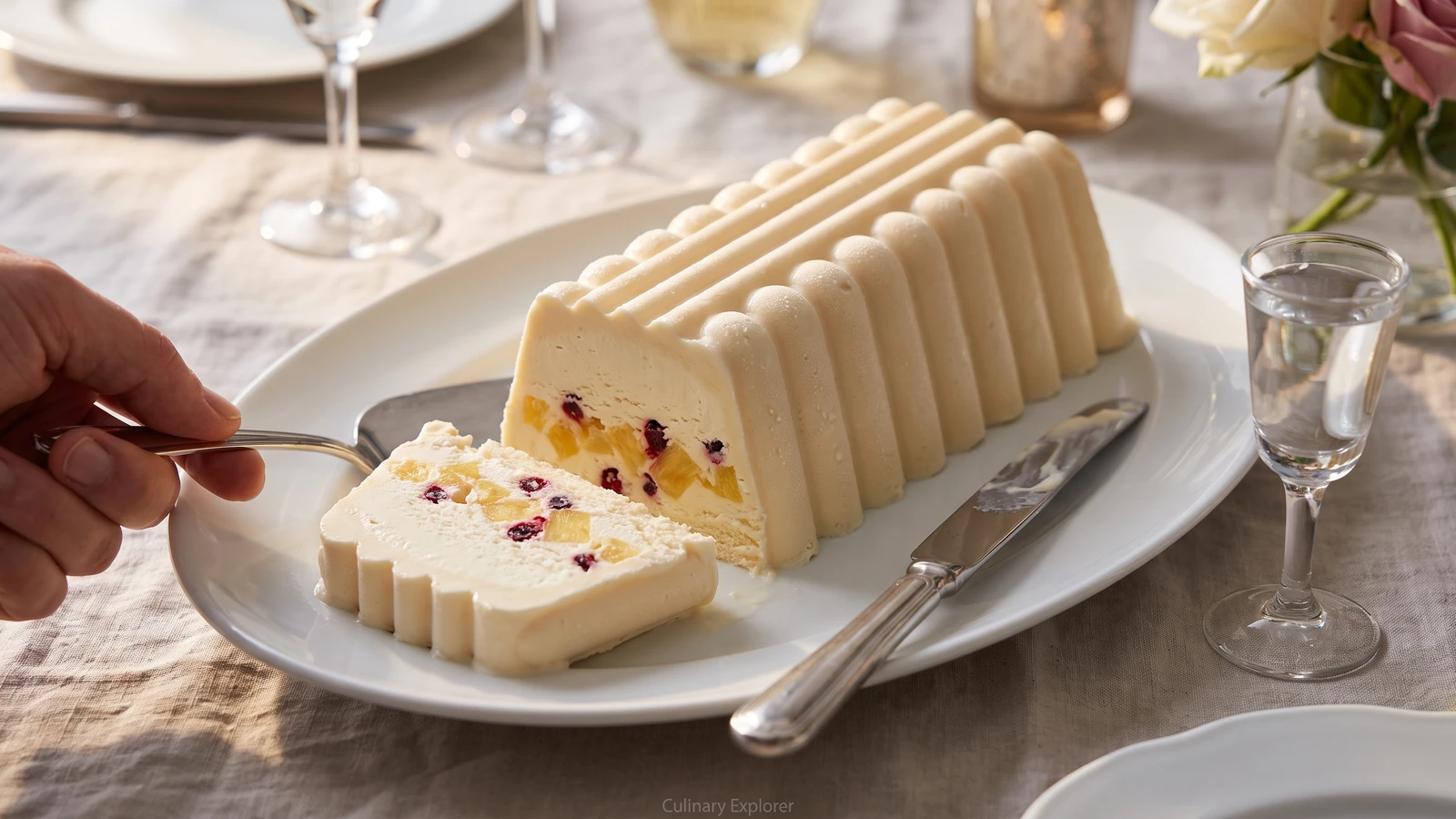
A scallop-shaped shell of vanilla ice cream holds kirsch Chantilly, neat pineapple dice, and jewel-bright Bar-le-Duc currants. Freeze each layer before asking it to support the next.
Glace Dora (moulded vanilla ice cream with kirsch whipped cream) teaches one true thing: a frozen dessert stands or collapses by the firmness of its layers. The vanilla shell must be frozen hard before the Chantilly enters. Rush that point and the filling presses through; wait, and the narrow scallop turns out cleanly with its ivory ridges intact.
The original assumed a pastry section with vanilla ice cream ready, a large metal Madeleine-mould, and freezing equipment close at hand. At home, use a dense prepared vanilla ice cream, because the source itself treats the ice cream as a finished component, and a 1.25-litre scalloped or fluted metal mould. A narrow metal loaf tin is the honest equivalent when the old mould can't be found; only the silhouette changes. Making the ice cream during assembly is brigade scaffolding and can go. Clothing the mould evenly, whipping a kirsch-scented Chantilly, and folding in pineapple and Bar-le-Duc preserve are the dish, and they stay.
This quantity gives six generous portions, manageable by one cook and a household freezer. Cut it open and the pale vanilla shell reveals cream-white Chantilly, gold pineapple dice, and garnet currants. Before you begin, clear a level freezer shelf and chill the mould thoroughly. That cold shell is the step that decides everything.
Glace Dora sits in the Parisian grand-service family of named moulded ices, desserts constructed from a firm ice-cream shell and a softer, liqueur-scented centre before being turned out whole. Its strongest regional marker is Bar-le-Duc in the Meuse, where redcurrants are traditionally deseeded one by one with a goose quill before being suspended in clear preserve. The canon records Dora through its composition rather than a regional tradition, and the origin of the name remains uncertain.
Quantity
3 cups (720 ml / about 430 g)
Quantity
1 cup plus 2 tablespoons (270 ml / 270 g)
Quantity
2 tablespoons (30 ml / 16 g)
Quantity
1½ tablespoons (22 ml / 21 g)
Quantity
½ cup (120 ml / 100 g)
cut into 5 to 6 mm dice, thoroughly drained and dried
Quantity
¼ cup (60 ml / 80 g)
Quantity
Technique reference only (No. 916)
consulted for clothing the mould; no aspic enters this dessert
| Ingredient | Quantity |
|---|---|
| good vanilla ice cream | 3 cups (720 ml / about 430 g) |
| cold heavy cream | 1 cup plus 2 tablespoons (270 ml / 270 g) |
| icing sugar | 2 tablespoons (30 ml / 16 g) |
| kirsch | 1½ tablespoons (22 ml / 21 g) |
| pineapplecut into 5 to 6 mm dice, thoroughly drained and dried | ½ cup (120 ml / 100 g) |
| Bar-le-Duc redcurrant jam | ¼ cup (60 ml / 80 g) |
| Another Method of Preparing Aspics de Filets de Solesconsulted for clothing the mould; no aspic enters this dessert | Technique reference only (No. 916) |
Set a 1.25-litre Madeleine-mould, meaning one large narrow scallop-shell mould, or a similarly sized fluted metal mould in the freezer for 20 minutes. Drain the pineapple, spread the dice over a clean towel, and blot until their surfaces no longer shine. Water becomes hard ice inside the Chantilly, so dryness matters more than whether the pineapple is fresh or preserved. Stir the Bar-le-Duc jam gently to loosen it without crushing the currants.
Reserve 1 cup (240 ml) of the vanilla ice cream in the freezer for sealing the base. Let the remaining 2 cups (480 ml) soften only until a spoon passes through with resistance, never until liquid. The book points to Another Method of Preparing Aspics de Filets de Soles (No. 916) for the principle of clothing the mould: press an even 8 to 10 mm layer over the bottom and sides, following every ridge and carrying it fully to the rim. Freeze for 45 to 60 minutes, until hard. If you find a thin patch, don't add soft ice cream and continue. Ça se rattrape: freeze the shell first, patch the bare place with a little more softened ice cream, then freeze again.
Pour 1 cup (240 ml) of the cream into a cold bowl and keep the remaining 2 tablespoons cold for rescue. Add the icing sugar and whisk until the cream forms soft peaks. Drizzle in the kirsch while whisking, then stop at medium peaks that hold their curve without looking dry. This Chantilly is the filling's structure. If it turns grainy from overwhipping, stop immediately. Ça se rattrape: fold in the reserved cold cream a teaspoon at a time until smooth. If the kirsch leaves it slack, chill the bowl for 10 minutes and finish whisking gently by hand.
Fold the cold, dry pineapple dice through the Chantilly with a broad spatula. Add the Bar-le-Duc jam and turn the mixture only three or four more times, distributing the preserve while leaving some garnet streaks and whole currants visible. Work lightly. Crushed pineapple releases juice, and heavy stirring knocks out the air that keeps the centre softer than the vanilla shell. If the filling begins to slump, return the entire bowl to the freezer for 10 minutes before continuing.
Spoon the filling into the frozen shell, pressing it carefully into the scalloped ends without flattening the Chantilly. Leave about 1 cm below the rim and freeze for 30 minutes, just until the surface is firm. Soften the reserved vanilla ice cream and spread it over the filling as a complete lid, meeting the frozen shell at every edge. Smooth the base level so the Glace Dora will stand without rocking.
Cover the mould and freeze it level for at least 6 hours, preferably overnight. The kirsch keeps the Chantilly centre a little softer than the vanilla clothing, which is precisely the contrast wanted. Don't compensate by adding more ice cream or reducing the kirsch; the firm outer shell carries the softer heart.
Chill the serving platter for 15 minutes. Dip only the outside of the mould into lukewarm water for 5 seconds, dry it, invert it over the platter, and lift gently. If it holds, repeat for 2 seconds rather than forcing it. Should the ridges soften during release, return the unmoulded dessert to the freezer for 10 minutes. Cut with a thin knife warmed in water and wiped completely dry between slices. Serve at once. À table!
1 serving (about 153g)
Culinary guides, cultural storytelling, and the editorial depth that makes cooking meaningful.
Discover Culinary ExplorerChef Juliette
Five almond preparations, one discipline: remove the skins cleanly, dry every kernel through, then cut, toast, or cloak it in pale caramel without letting its fragrant oils escape.

Chef Juliette
A pastry pantry lesson in one tray: filberts warmed only until their red skins release, rubbed clean, cooled, and chopped into a fragrant mise-en-place for cakes, creams, pralines, and petits fours.

Chef Juliette
The smallest pâtisserie discipline decides whether a cake leaves its mould intact: clarified butter in every corner, followed by the lightest veil of dry flour or fécule.

Chef Juliette
Four whites, one spotless bowl, and a patient change of speed: whisk gently until loosened, then briskly to glossy stiffness, with powdered sugar waiting if the foam begins to granulate.