
Chef Juliette
Various Almond Preparations
Five almond preparations, one discipline: remove the skins cleanly, dry every kernel through, then cut, toast, or cloak it in pale caramel without letting its fragrant oils escape.
A cooking platform built around craft, culture, and the stories behind what we eat.
Created by Chef Juliette
Based on No. 2781, Glace Dame-Jeanne, from Le Guide Culinaire (1907) by Auguste Escoffier
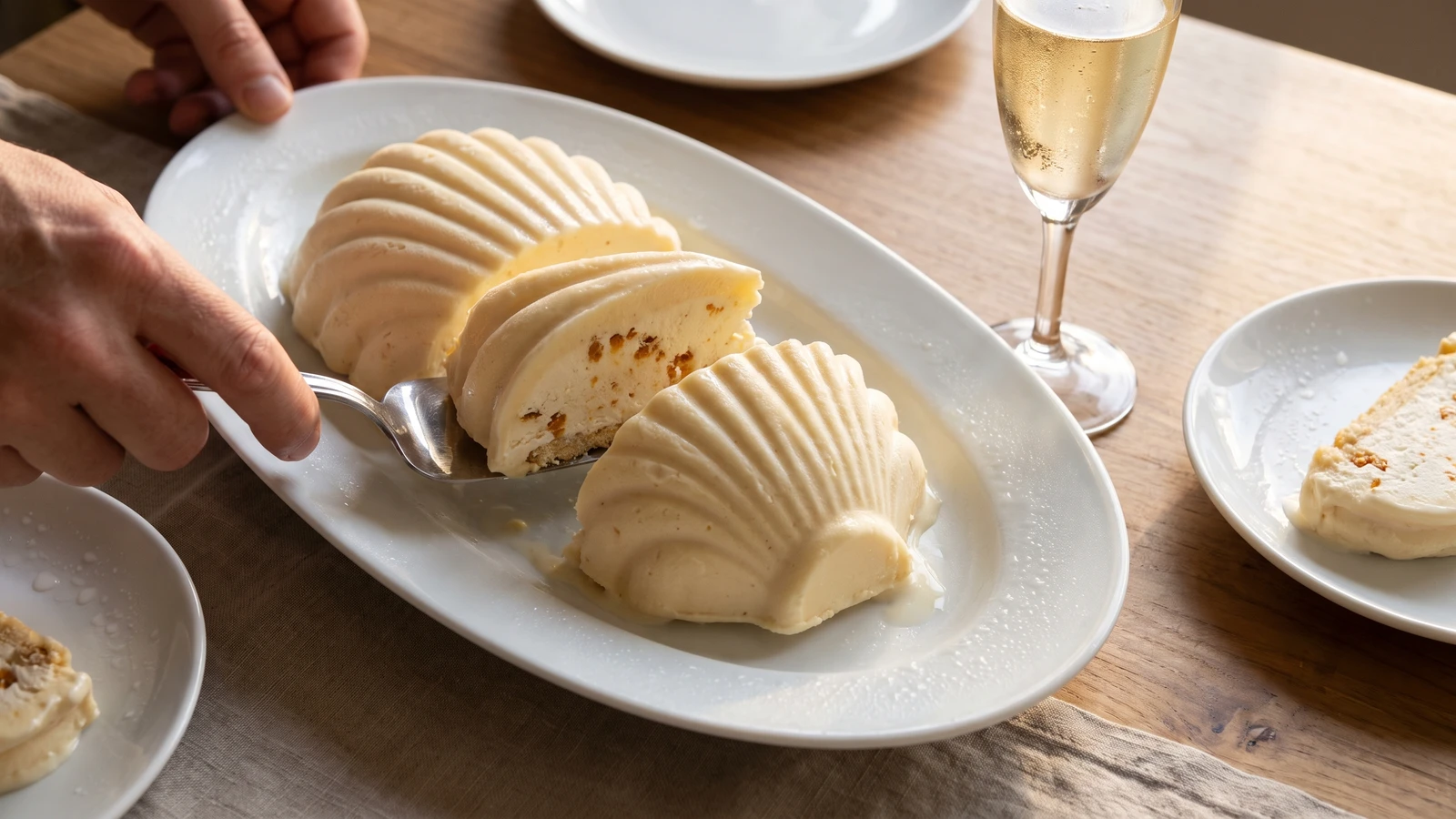
Glace Dame-Jeanne teaches the frozen mould: a clean shell of vanilla ice cream enclosing orange-blossom pralin Chantilly, fine enough to melt as silk instead of crunching like sand.
Glace Dame-Jeanne (a vanilla ice-cream shell filled with orange-blossom pralin Chantilly) teaches the essential grammar of a moulded ice: the outside must freeze evenly, while the centre stays light enough to soften on the tongue. The one truth to know before touching the pan is this: the pralin must be completely cold and fine enough to pass through a sieve before it meets the cream. One coarse caramel pebble will announce itself in every spoonful.
The original formula assumed a pâtisserie station with vanilla ice cream already made, a deep freezing cabinet, and a large narrow scallop-shell Madeleine-mould. It also sends the cook to Another Method of Preparing Aspics de Filets de Soles (No. 916) for the technique called clothing the mould. No sole or jelly enters the dessert, naturally; the reference supplies the method of coating a cold mould evenly before it is filled. At home, dense purchased vanilla ice cream replaces a separate brigade production, and one 1-litre shell or pudding mould replaces the specialist form. That is scaffolding. The even vanilla shell and the Chantilly combined with Pralined orange flowers are the dish, and they stay exactly where the source puts them.
The entry gives no proportions, so these quantities have been set for one cook and a six-person table: enough vanilla ice cream to clothe and seal the mould, with enough Chantilly to fill it without leftovers. When cut, the pale vanilla shell should hold a softer ivory centre, finely freckled with orange-flower pralin. Sieve that pralin patiently. Everything depends upon it.
Glace Dame-Jeanne belongs to the Parisian grande-cuisine repertory of entremets glacés, decorative frozen sweets carried whole to the table and cut for the guests. Its Madeleine-mould is one narrow scallop-shell form, not the familiar tray of small cake hollows, and the cross-reference to a sole aspic reveals that savory and sweet kitchens shared the same technique of clothing a chilled mould before filling it. The dish passes naturally to the home freezer because its identity rests on that structure and its orange-flower pralin, not on the specialist freezing station that once supported it.
Quantity
3 cups (720 ml / approximately 550 g)
softened only until spreadable
Quantity
1/3 cup (80 ml / 35 g)
Quantity
3 tablespoons (45 ml / 38 g)
Quantity
1 tablespoon (15 ml / 15 g)
Quantity
1 1/2 teaspoons (7.5 ml / approximately 0.8 g)
Quantity
3/4 cup (180 ml / 180 g)
Quantity
2 teaspoons (10 ml / 5 g)
Quantity
1/2 teaspoon (2.5 ml / 2 g)
Quantity
1 technique reference (No. 916)
consulted only for the mould-clothing operation; no fish or jelly is used
| Ingredient | Quantity |
|---|---|
| dense vanilla ice creamsoftened only until spreadable | 3 cups (720 ml / approximately 550 g) |
| blanched sliced almonds | 1/3 cup (80 ml / 35 g) |
| caster sugar | 3 tablespoons (45 ml / 38 g) |
| water | 1 tablespoon (15 ml / 15 g) |
| food-grade dried bitter-orange blossoms | 1 1/2 teaspoons (7.5 ml / approximately 0.8 g) |
| very cold heavy cream | 3/4 cup (180 ml / 180 g) |
| confectioners' sugar | 2 teaspoons (10 ml / 5 g) |
| pure vanilla extract | 1/2 teaspoon (2.5 ml / 2 g) |
| Another Method of Preparing Aspics de Filets de Solesconsulted only for the mould-clothing operation; no fish or jelly is used | 1 technique reference (No. 916) |
Clear a level space in the freezer and chill the empty 1-litre Madeleine-mould for at least 30 minutes. Metal gives the cleanest shell and freezes fastest; silicone works, but set it on a rigid tray before filling so it cannot bend. Chill the mixing bowl, whisk, and serving platter at the same time.
Toast the almonds in a small dry saucepan over medium heat until pale gold and fragrant, then tip them onto a plate. Put the caster sugar and water in the pan and heat gently until the sugar dissolves. Raise the heat and boil without stirring until the syrup turns a clear amber. If crystals gather at the sides, cover the pan for 30 seconds so the condensation washes them down. Once amber, remove the pan from the heat, immediately stir in the toasted almonds and dried orange blossoms, and pour the mixture onto a silicone mat in a thin layer. Let it become completely cold and hard. Dark, acrid caramel cannot be repaired, so if it burns, remake it before proceeding.
Break the cold caramel into small pieces and grind it in short pulses until it becomes a fine, dry pralin, meaning caramelized almond sugar ground to powder. Pass it through a fine-mesh sieve. Return every coarse particle to the grinder and repeat rather than forcing it through; if the first grinding leaves pebbles, ça se rattrape. The finished pralin should feel like floury crumbs between the fingers, with no hard granules capable of gritting the Chantilly. Keep it completely cold and dry.
Let two-thirds of the vanilla ice cream soften until it spreads like cold putty but remains matte, never glossy or runny. Use the mould-clothing principle cited in Another Method of Preparing Aspics de Filets de Soles (No. 916): press the ice cream over the bottom and sides of the frozen mould in an even layer about 8 to 10 mm thick, turning the mould as you work. Run the back of a spoon over the lining to close air pockets, then hold it toward the light and patch any thin place immediately. Freeze for 45 minutes, until hard. A torn or uneven lining is not a verdict; patch it with more ice cream and freeze for another 15 minutes.
Reserve 1 tablespoon of the cold cream. Whip the remainder with the confectioners' sugar and vanilla until it holds soft, rounded peaks, then continue only until those peaks gain enough body to stand. Fold in the cold sieved pralin in two additions, reaching to the bottom of the bowl so no heavy streak remains. If the Chantilly begins looking slightly grainy from overwhipping, fold in the reserved unwhipped cream one teaspoon at a time until it smooths. If it has separated fully into butter and liquid, remake it; stopping at soft peaks is the simpler wisdom.
Spoon the orange-flower pralin Chantilly into the frozen vanilla shell, pressing gently into the scalloped corners without crushing out all its air. Leave about 1 cm free at the top. Soften the reserved vanilla ice cream just enough to spread, then cover the Chantilly completely and join this cap to the frozen lining around the rim. Smooth the base level, cover closely, and freeze for at least 4 hours, preferably overnight.
Set the chilled platter over the mould and invert both together. Wrap the outside of a metal mould for several seconds with a cloth wrung from hot water, then lift carefully. If the glace refuses to release, warm the mould for another two seconds rather than pulling at the dessert. Should an edge soften, return the whole platter to the freezer for 10 minutes; it will set cleanly again. Rest the unmoulded Glace Dame-Jeanne for 5 minutes, then cut it with a thin knife dipped in hot water and wiped dry between slices. À table!
1 serving (about 135g)
Culinary guides, cultural storytelling, and the editorial depth that makes cooking meaningful.
Discover Culinary ExplorerChef Juliette
Five almond preparations, one discipline: remove the skins cleanly, dry every kernel through, then cut, toast, or cloak it in pale caramel without letting its fragrant oils escape.

Chef Juliette
A pastry pantry lesson in one tray: filberts warmed only until their red skins release, rubbed clean, cooled, and chopped into a fragrant mise-en-place for cakes, creams, pralines, and petits fours.

Chef Juliette
The smallest pâtisserie discipline decides whether a cake leaves its mould intact: clarified butter in every corner, followed by the lightest veil of dry flour or fécule.

Chef Juliette
Four whites, one spotless bowl, and a patient change of speed: whisk gently until loosened, then briskly to glossy stiffness, with powdered sugar waiting if the foam begins to granulate.