
Chef Juliette
Various Almond Preparations
Five almond preparations, one discipline: remove the skins cleanly, dry every kernel through, then cut, toast, or cloak it in pale caramel without letting its fragrant oils escape.
A cooking platform built around craft, culture, and the stories behind what we eat.
Created by Chef Juliette
Based on No. 2772, Peach Ice, from Le Guide Culinaire (1907) by Auguste Escoffier
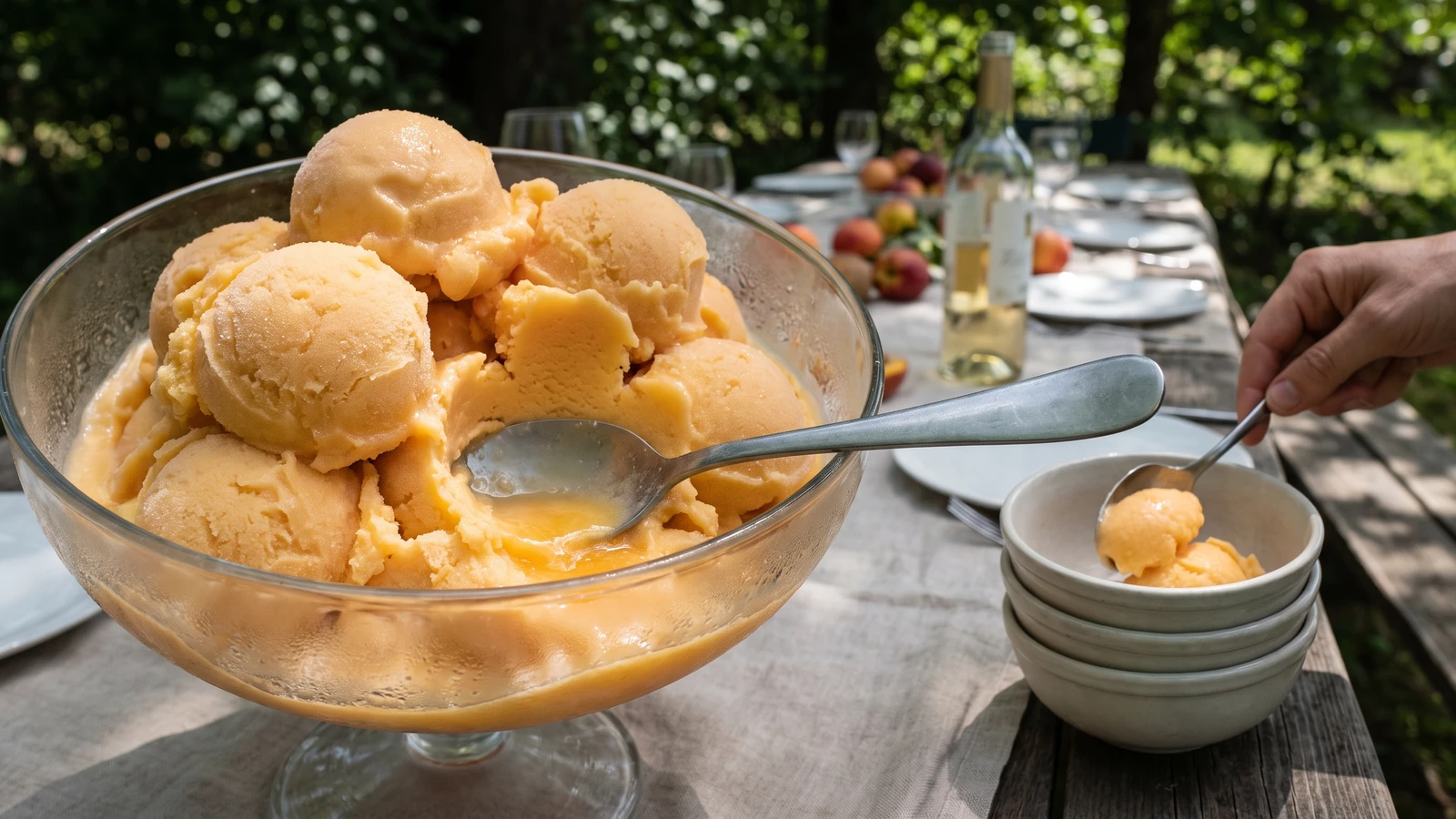
Glace aux pêches is ripe peach held at its brightest: equal measures of fresh purée and calibrated syrup, sharpened with lemon, then frozen smooth enough to yield under the spoon.
Glace aux pêches (peach ice) teaches the law of every fruit ice: ripeness supplies body as surely as aroma. Sugar cannot make a hard peach taste ripe; it can only make pale water sweet. Choose peaches that smell fragrant before you cut them, wall-grown fruit if fortune hands it to you, with flesh that gives readily beneath the thumb.
The original pastry kitchen reached for prepared purée, standard syrup, a saccharometer, and a freezing pail packed with salted ice. At home, a small saucepan, a scale, and an ice cream machine or shallow metal pan do the same honest work. I have halved the book's pint-for-pint formula for four generous portions. The brigade quantity and hand-cranked pail were scaffolding, so they can go; equal measures of purée and syrup, the lemon, and the final density are the dish and must stay. One cook, one stove, one evening.
Properly made, the glace aux pêches is softly coral, fragrant, and fine-grained, with enough lemon to lift the fruit without announcing itself. Taste and calibrate the mixture before it freezes, because cold mutes both sweetness and perfume. The step that matters most comes first: don't begin until the peaches smell fully ripe.
Glace aux pêches belongs to the French family of entremets glacés, whose pastry kitchens organized fruit purée, syrup, lemon, and measured density into repeatable formulas rather than disguising the fruit with cream. The prized wall peaches point especially to Montreuil, east of Paris, where fruit was trained against sun-holding plaster walls and protected with painstaking care for the capital's tables. Peach ice borrowed the proportions of Apricot Ice (No. 2761) because the canon treated the fruits as close cousins, though an underripe peach produces neither the apricot's colour nor its body.
Quantity
1 cup (240 ml / 250 g), replacing the apricot purée in Apricot Ice (No. 2761)
made from about 3 medium fully ripe peaches, peeled, pitted, puréed, and strained
Quantity
1 cup (240 ml / 300 g), made from ¾ cup plus 1 tablespoon (195 ml / 165 g) granulated sugar and ½ cup plus 1 tablespoon (135 ml / 135 g) water
cooled completely
Quantity
1, yielding about 3 tablespoons (45 ml / 45 g) juice
juiced
| Ingredient | Quantity |
|---|---|
| fresh peach puréemade from about 3 medium fully ripe peaches, peeled, pitted, puréed, and strained | 1 cup (240 ml / 250 g), replacing the apricot purée in Apricot Ice (No. 2761) |
| sugar syrupcooled completely | 1 cup (240 ml / 300 g), made from ¾ cup plus 1 tablespoon (195 ml / 165 g) granulated sugar and ½ cup plus 1 tablespoon (135 ml / 135 g) water |
| large lemonjuiced | 1, yielding about 3 tablespoons (45 ml / 45 g) juice |
Put the sugar and water in a small saucepan. Warm gently, stirring only until the liquid turns perfectly clear, then bring it to a quiet simmer for 1 minute. Remove it from the heat and cool completely. If crystals gather around the sides, add a tablespoon of water, cover the pan for 1 minute, and warm gently until they dissolve. Ça se rattrape.
Peel and pit the peaches, catching every drop of their juice. Purée the flesh until completely smooth, then press it through a fine-mesh sieve and measure exactly 1 cup (240 ml / 250 g). Work promptly so the purée keeps its fresh colour. If the peaches fight the knife, smell of very little, or leave hard pale flesh around the stone, stop and choose better fruit; freezing will expose the weakness, not conceal it.
Follow the governing preparation, Apricot Ice (No. 2761): whisk together equal measures of fresh fruit purée and cold syrup, then add the lemon juice. This home batch halves the source formula from 1 pint of each and 2 lemons to 1 cup of each and 1 lemon. Nothing else enters the bowl. The exact proportion is what gives the peach enough sugar to freeze tenderly while keeping the flavour clean.
The source pastry kitchen brought the mixture to 18° or 19° on its saccharometer. On a modern refractometer that is roughly 32° to 34° Brix, depending on the instrument's scale. Without one, chill a spoonful on a frozen saucer for 8 minutes: it should become softly slushy at the edge and taste slightly sweeter and sharper than you want at the table. If the reading is low and the sample freezes hard, dissolve sugar a teaspoon at a time in a little mixture; if it is high and remains syrupy, add water a teaspoon at a time. Fruit varies, and this small correction is precisely why the original measured.
Cover the mixture and chill it for at least 2 hours, until thoroughly cold. A cold base freezes quickly and forms finer crystals; a warm one lingers in the machine and turns coarse. Stir it well before churning because dense fruit pulp settles.
Churn the cold base in an ice cream machine until thick, smooth, and softly mounded, usually 20 to 25 minutes. For the honest home equivalent without a machine, pour it into a shallow metal pan and freeze, scraping and beating it vigorously every 30 minutes for 2½ to 3 hours, until the crystals become fine and the mixture holds a soft scoop. The old salted-ice pail supplied constant movement; your whisk supplies the same grammar.
Pack the glace aux pêches into a chilled lidded container, press parchment directly against its surface, and freeze for about 3 hours. Let it stand in the refrigerator for 10 to 15 minutes before scooping. If it has frozen into a coarse, stubborn block, soften it until a knife can enter, break it into pieces, pulse briefly in a food processor, and refreeze for 20 minutes. Ça se rattrape. Serve in cold bowls while the colour is bright and the texture yields easily. À table!
1 serving (about 150g)
Culinary guides, cultural storytelling, and the editorial depth that makes cooking meaningful.
Discover Culinary ExplorerChef Juliette
Five almond preparations, one discipline: remove the skins cleanly, dry every kernel through, then cut, toast, or cloak it in pale caramel without letting its fragrant oils escape.

Chef Juliette
A pastry pantry lesson in one tray: filberts warmed only until their red skins release, rubbed clean, cooled, and chopped into a fragrant mise-en-place for cakes, creams, pralines, and petits fours.

Chef Juliette
The smallest pâtisserie discipline decides whether a cake leaves its mould intact: clarified butter in every corner, followed by the lightest veil of dry flour or fécule.

Chef Juliette
Four whites, one spotless bowl, and a patient change of speed: whisk gently until loosened, then briskly to glossy stiffness, with powdered sugar waiting if the foam begins to granulate.