
Chef Juliette
Various Almond Preparations
Five almond preparations, one discipline: remove the skins cleanly, dry every kernel through, then cut, toast, or cloak it in pale caramel without letting its fragrant oils escape.
A cooking platform built around craft, culture, and the stories behind what we eat.
Created by Chef Juliette
Based on No. 2771, Orange Ice, from Le Guide Culinaire (1907) by Auguste Escoffier
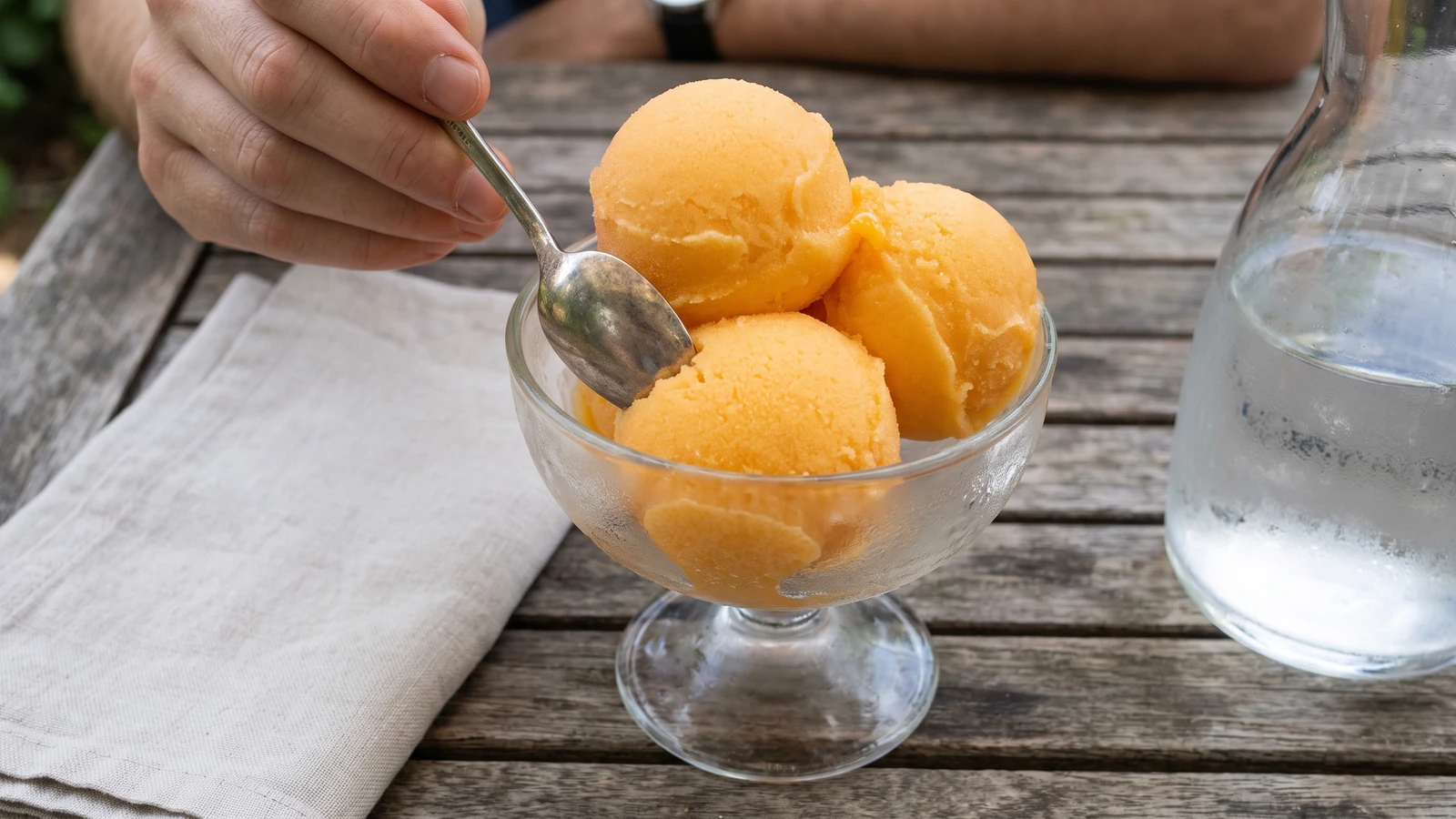
Glace à l’Orange is sugar concentration made delicious: zest infused in boiling syrup, fresh juice added cold, and lemon sharpening the fruit into a fine, bright ice that scoops cleanly.
Glace à l’Orange (orange ice) teaches the central grammar of every fruit ice: sugar is structure, not merely sweetness. Too little and the mixture freezes into hard, coarse crystals; too much and it slumps without ever setting. At the right concentration, the ice churns fine, holds a generous scoop, and melts across the tongue with nothing between you and the orange.
The original entry gives one quart of boiling syrup, the zest and juice of four oranges, and one lemon, then leaves the freezing unstated because the pastry kitchen’s syrup gauge and salted-ice freezer were already waiting. Here the formula is halved exactly for a domestic machine: two cups of syrup, two oranges, and half a lemon, making six home portions. A refractometer translates the old 21° syrup reading, and a domestic churn replaces the freezing pail. That equipment and brigade quantity were scaffolding; the zest infusion, cold juice, lemon ratio, sieve, and density target are the dish, and they stay. One cook, one stove, one evening.
The lemon is not there for itself; it sharpens the orange. Add both juices only after the zest syrup is completely cool, so their perfume remains fresh rather than cooked. The step that decides the Glace à l’Orange is the final syrup balance before churning: reach 21° Baumé, approximately 38° Brix, and the freezer will do the rest.
Glace à l’Orange belongs to the repertory of Parisian confiseurs and bourgeois dessert tables rather than to a single orange-growing province. Oranges came north through Mediterranean trade, while confectioners made their juice freeze smoothly by measuring syrup density rather than burying the fruit beneath cream. The book’s instruction that the mixture reach 21° refers to a saccharometer reading, not temperature, and the lemon serves only to sharpen the orange.
Quantity
1½ cups (355 ml / 300 g), plus up to 2 tablespoons (30 ml / 25 g) for adjustment if needed
Quantity
1¼ cups (300 ml / 300 g), plus up to ¼ cup (60 ml / 60 g) for adjustment if needed
Quantity
2, yielding about ¾ cup (180 ml / 185 g) juice
zest removed in thin strips, then juiced
Quantity
½, yielding about 1½ tablespoons (22 ml / 23 g) juice
juiced
| Ingredient | Quantity |
|---|---|
| granulated sugar | 1½ cups (355 ml / 300 g), plus up to 2 tablespoons (30 ml / 25 g) for adjustment if needed |
| water | 1¼ cups (300 ml / 300 g), plus up to ¼ cup (60 ml / 60 g) for adjustment if needed |
| large orangeszest removed in thin strips, then juiced | 2, yielding about ¾ cup (180 ml / 185 g) juice |
| large lemonjuiced | ½, yielding about 1½ tablespoons (22 ml / 23 g) juice |
Wash and dry the oranges thoroughly. With a sharp vegetable peeler, remove all their zest, the glossy coloured outer film of the rind, in thin strips. Leave every trace of bitter white pith behind. Juice the oranges and half lemon separately, keeping all the juice from those pieces; the stated volumes are guides, while the final syrup reading governs the texture. Cover and keep the juices cold.
Combine the main 1½ cups (300 g) sugar and 1¼ cups (300 g) water in a nonreactive saucepan. Heat gently, stirring only until the sugar dissolves, then bring the syrup to a full boil. Drop in all the orange zest while the syrup is boiling, let it bubble for 10 seconds, and remove the pan from the heat. Cover and leave the whole to cool completely, about 45 minutes. The brief contact with boiling syrup draws out the fragrant oils; prolonged boiling drags bitterness from the rind.
When the zest syrup is completely cool, stir in the orange juice and lemon juice. Never add them to hot syrup; heat dulls the fresh perfume that must carry this simple ice. Rub the mixture through a fine sieve into a clean bowl, pressing the wet pulp gently to recover its liquid, then discard the spent zest and pulp.
Check the strained mixture at room temperature with a syrup hydrometer or refractometer. The source calls for 21° Baumé, approximately 38° Brix. If the reading is higher, the mixture contains too much sugar and may remain soft, so whisk in cold water 1 tablespoon (15 ml / 15 g) at a time. If it is lower, dissolve equal weights of the reserved sugar and hot water into a small syrup, cool it, and add it 1 tablespoon at a time. Without a gauge, freeze 2 tablespoons of mixture on a chilled saucer for 15 minutes: it should form fine, yielding crystals rather than a brittle sheet or a sticky puddle.
Cover the base and chill it until thoroughly cold, at least 1 hour. Churn in a domestic ice cream machine until it becomes a dense, fine-grained slush that holds the trail of the paddle, usually 20 to 30 minutes. If it remains syrupy after a full churn, thaw it completely and dilute with cold water 1 tablespoon at a time; if it freezes coarse and hard, thaw it and add cooled equal-weight sugar syrup in the same small additions. Rechill and churn again. Ça se rattrape.
Pack the churned Glace à l’Orange into a chilled lidded container, press parchment directly against the surface, and freeze for about 2 hours, until scoopable but firm. If frozen overnight, let it stand in the refrigerator for 10 to 15 minutes before serving. Spoon generous scoops into chilled glass coupes and serve without ornament. The orange has done enough. À table!
1 serving (about 140g)
Culinary guides, cultural storytelling, and the editorial depth that makes cooking meaningful.
Discover Culinary ExplorerChef Juliette
Five almond preparations, one discipline: remove the skins cleanly, dry every kernel through, then cut, toast, or cloak it in pale caramel without letting its fragrant oils escape.

Chef Juliette
A pastry pantry lesson in one tray: filberts warmed only until their red skins release, rubbed clean, cooled, and chopped into a fragrant mise-en-place for cakes, creams, pralines, and petits fours.

Chef Juliette
The smallest pâtisserie discipline decides whether a cake leaves its mould intact: clarified butter in every corner, followed by the lightest veil of dry flour or fécule.

Chef Juliette
Four whites, one spotless bowl, and a patient change of speed: whisk gently until loosened, then briskly to glossy stiffness, with powdered sugar waiting if the foam begins to granulate.