
Chef Juliette
Various Almond Preparations
Five almond preparations, one discipline: remove the skins cleanly, dry every kernel through, then cut, toast, or cloak it in pale caramel without letting its fragrant oils escape.
A cooking platform built around craft, culture, and the stories behind what we eat.
Created by Chef Juliette
Based on No. 2770, Melon Ice, from Le Guide Culinaire (1907) by Auguste Escoffier
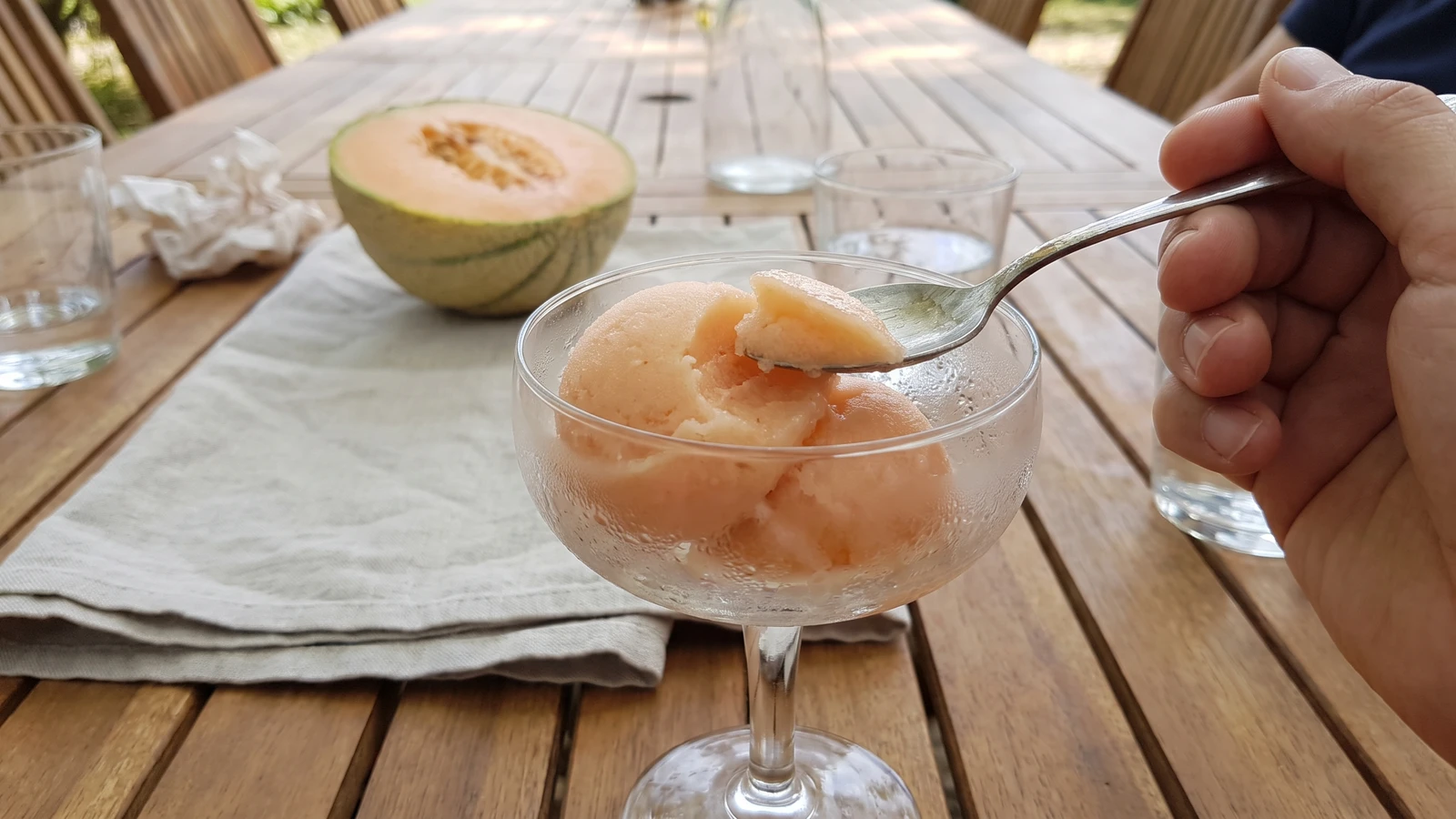
Glace au melon is summer held cold: ripe perfumed fruit, measured syrup, bright citrus, and orange flower, churned fine enough to melt on the tongue before its fragrance disappears.
Glace au melon teaches the first law of fruit ices: sugar controls texture, but fruit decides whether the dessert is worth making. The melon must be ripe enough to scent the kitchen before the knife finishes its work. There is no technique that can put perfume back into green fruit.
The book's formula assumed a pot of finished syrup, a syrup gauge, a hand-worked freezing vessel, and service quantities measured in pints. Your kitchen gets a measured light syrup, a blender, a fine sieve, and a small ice cream machine or shallow metal pan. I have halved the entry to one cup of pulp and one cup of syrup, then halved its citrus and orange-flower water exactly. What changes is the quantity and equipment, never the proportion. One cook, one stove, one evening.
The finished glace should be pale coral, fragrant before it reaches the tongue, and fine enough to soften rather than crack beneath the spoon. The sieve isn't brigade scaffolding and cannot go; it removes the coarse fibres that become more obvious once frozen. Before you touch the saucepan, cut and smell the melon. That is the step that decides the dish.
Glaces aux fruits belong to the French confectioner's repertoire, and Parisian kitchens made their sweetness a matter of measured syrup while relying on fragrant melons brought from the south. This version points more precisely toward Provence and the melons of Cavaillon, with orange-flower water carrying the accent of the Mediterranean larder as the ice traveled from confectioners' freezing pots to bourgeois dining rooms. Orange and lemon are not competing flavours here; their acidity sharpens the melon and keeps the syrup from tasting flat.
Quantity
2/3 cup (160 ml / 135 g)
Quantity
1 cup (240 ml / 240 g)
Quantity
1 cup (240 ml / 245 g)
seeded, peeled, cubed, and crushed to a pulp
Quantity
1, yielding about 1/3 cup (80 ml / 82 g) juice
juiced and strained
Quantity
1/2, yielding about 1 1/2 tablespoons (22 ml / 23 g) juice
juiced and strained
Quantity
1 1/2 teaspoons (7.5 ml / 7.5 g)
Quantity
Up to 1 tablespoon (15 ml / 15 g)
| Ingredient | Quantity |
|---|---|
| granulated sugar | 2/3 cup (160 ml / 135 g) |
| water | 1 cup (240 ml / 240 g) |
| very ripe Charentais melon or aromatic cantaloupe pulpseeded, peeled, cubed, and crushed to a pulp | 1 cup (240 ml / 245 g) |
| large orangejuiced and strained | 1, yielding about 1/3 cup (80 ml / 82 g) juice |
| medium lemonjuiced and strained | 1/2, yielding about 1 1/2 tablespoons (22 ml / 23 g) juice |
| orange-flower water | 1 1/2 teaspoons (7.5 ml / 7.5 g) |
| cold water for density correction (optional) | Up to 1 tablespoon (15 ml / 15 g) |
Combine the sugar and water in a small saucepan. Warm gently, stirring only until the sugar dissolves and the syrup turns perfectly clear, then let it simmer for one minute. Do not reduce it, because boiling away water changes the concentration that governs the finished texture. Cool completely, measure exactly 1 cup (240 ml / about 280 g) for the glace, and reserve the remainder for correcting the base.
Cut the melon before doing anything else and smell it. The flesh should perfume the room and yield easily beneath a spoon, with no green hardness near the rind. If it smells faint, stop here. Syrup and orange-flower water can frame ripe melon, but they cannot manufacture its fragrance; use that fruit for breakfast and wait for a better one.
Measure 1 cup of melon pulp into a blender. Add exactly 1 cup of the cold syrup, then the strained orange juice, lemon juice, and orange-flower water. Blend for about ten seconds, only until uniform, then rub the entire mixture through a fine-mesh sieve with a flexible spatula. Press until only coarse fibre remains. The blender removes labor; the sieve stays because it gives the frozen mixture its fine, clean texture.
The source's final check is 22° on its syrup gauge. Syrup scales are not interchangeable, so use that figure only with a gauge calibrated to the book's scale. The measured light syrup and one-to-one volume ratio here are the household equivalent. To verify the balance without a gauge, freeze a tablespoon of base on a chilled saucer for ten minutes. It should turn softly slushy at the edge. If it freezes hard, stir one teaspoon of reserved syrup into the base and retest; if it remains wet and loose, stir in one teaspoon of cold water. Ça se rattrape.
Cover the strained mixture and chill it for at least two hours, until thoroughly cold. A cold base freezes quickly and forms finer crystals; a lukewarm one spends too long in the machine and becomes coarse. Stir once before churning because a little fruit pulp may settle.
Pour the cold base into a 1-quart ice cream machine and churn until thick, fine-grained, and able to hold a soft ridge, usually twenty to twenty-five minutes. If it remains liquid after fifteen minutes, stop and return the base to the refrigerator; refreeze the machine bowl completely before trying again. Continuing with a warm bowl only builds larger crystals.
Pack the churned glace into a chilled shallow container, press parchment directly against its surface, and freeze for two to three hours. Let it stand in the refrigerator for ten minutes before scooping. It should yield beneath the spoon and melt cleanly, with melon arriving first, citrus sharpening the middle, and orange flower lingering quietly. Serve in cold coupes. À table!
1 serving (about 117g)
Culinary guides, cultural storytelling, and the editorial depth that makes cooking meaningful.
Discover Culinary ExplorerChef Juliette
Five almond preparations, one discipline: remove the skins cleanly, dry every kernel through, then cut, toast, or cloak it in pale caramel without letting its fragrant oils escape.

Chef Juliette
A pastry pantry lesson in one tray: filberts warmed only until their red skins release, rubbed clean, cooled, and chopped into a fragrant mise-en-place for cakes, creams, pralines, and petits fours.

Chef Juliette
The smallest pâtisserie discipline decides whether a cake leaves its mould intact: clarified butter in every corner, followed by the lightest veil of dry flour or fécule.

Chef Juliette
Four whites, one spotless bowl, and a patient change of speed: whisk gently until loosened, then briskly to glossy stiffness, with powdered sugar waiting if the foam begins to granulate.