
Chef Juliette
Various Almond Preparations
Five almond preparations, one discipline: remove the skins cleanly, dry every kernel through, then cut, toast, or cloak it in pale caramel without letting its fragrant oils escape.
A cooking platform built around craft, culture, and the stories behind what we eat.
Created by Chef Juliette
Based on No. 2768, Red-currant Ice, from Le Guide Culinaire (1907) by Auguste Escoffier
Glace aux Groseilles proves that balance is the dessert: red-currant juice and syrup, frozen fine, with the fruit’s own acidity doing the work lemon usually must.
Glace aux groseilles teaches the structural work sugar does in a frozen dessert. The one true thing to know before touching the pan is this: sugar controls texture as surely as it controls sweetness. Too little and the ice freezes hard and coarse; too much and it slumps without setting. Red-currant juice brings such clean, forceful acidity that lemon would only muddy the lesson.
The original entry assumed a pastry pantry with strained juice, calibrated syrup, a syrup gauge, and a dedicated hand tending the packed-ice freezer. Here its two-pint batch is halved to one pint, the syrup is made in a small saucepan, and a domestic ice-cream machine or shallow metal pan takes the freezer’s place. The larger batch and the hand standing over it are brigade scaffolding and can go. Equal measures of juice and syrup, followed by the 20° balance test, are the dish and must stay. One cook, one stove, one evening.
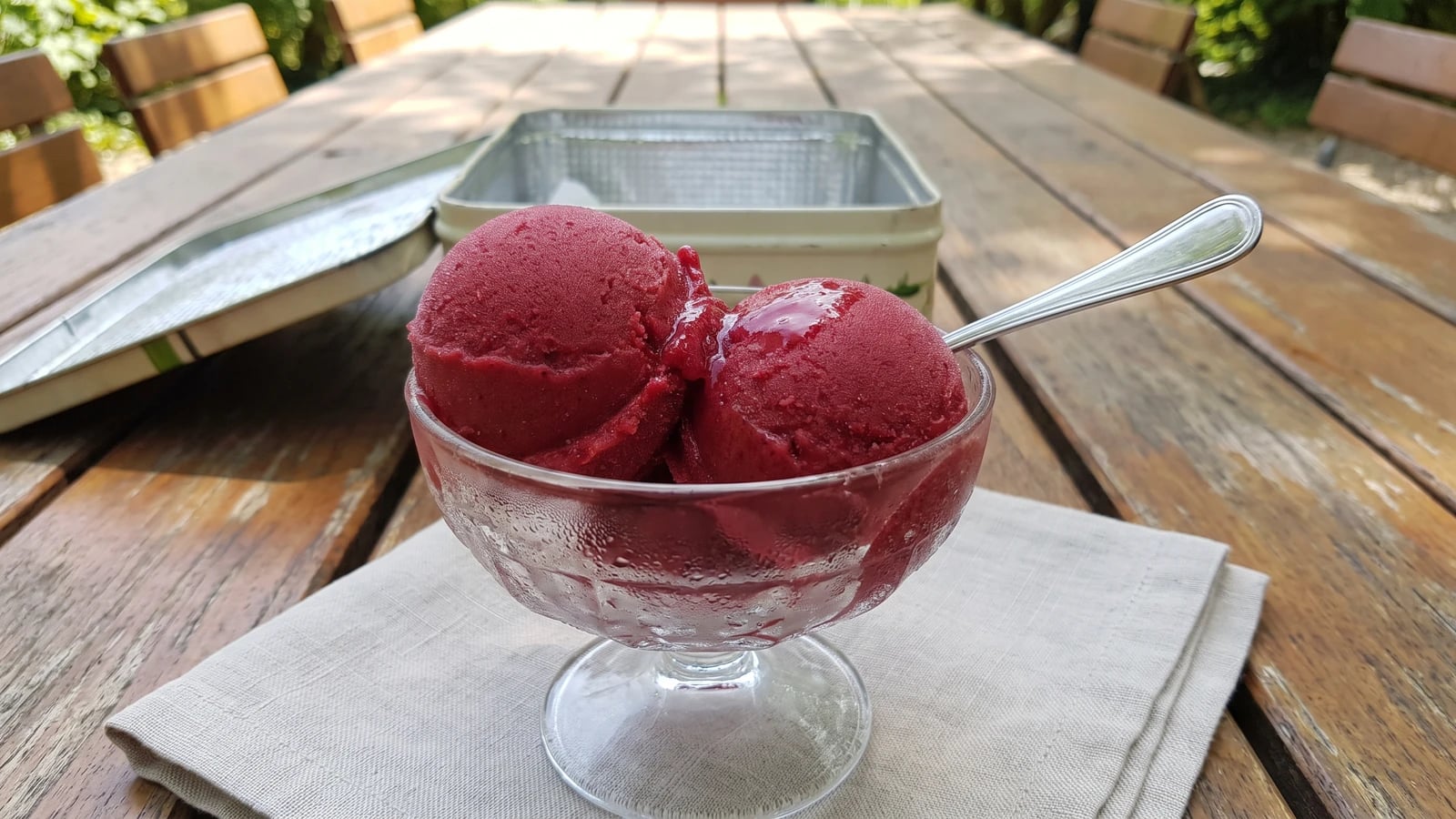
When it is right, the glace aux groseilles is a deep garnet, keen at first taste, then round and clean as it melts. Balance the base before it freezes. That measurement is the step that matters most, and if the fruit varies, ça se rattrape.
Glace aux groseilles belongs to the French glacier’s repertoire, moving from the preserve pantry into urban pâtisseries and formal dining rooms wherever clear fruit juices could be balanced with syrup and frozen fine. Red currants flourish across northern and eastern France, with Lorraine especially celebrated for preserving them, though this ice belongs to the national confectionery canon rather than to Lorraine alone. The missing lemon is deliberate: unlike milder pear or peach preparations, red currants carry enough natural acidity to balance the syrup unaided.
Quantity
1 cup plus 2 tablespoons (270 ml / about 280 g)
finely strained and chilled; reserve 2 tablespoons for balancing
Quantity
1 cup plus 2 tablespoons (270 ml / about 345 g)
make from 1 cup plus 1 tablespoon (255 ml / 210 g) granulated sugar and 1/2 cup plus 1 tablespoon (135 ml / 135 g) water; cool, chill, and reserve 2 tablespoons for balancing
| Ingredient | Quantity |
|---|---|
| unsweetened red-currant juicefinely strained and chilled; reserve 2 tablespoons for balancing | 1 cup plus 2 tablespoons (270 ml / about 280 g) |
| rich sugar syrup at 32° Baumémake from 1 cup plus 1 tablespoon (255 ml / 210 g) granulated sugar and 1/2 cup plus 1 tablespoon (135 ml / 135 g) water; cool, chill, and reserve 2 tablespoons for balancing | 1 cup plus 2 tablespoons (270 ml / about 345 g) |
Put the sugar and water in a small saucepan and warm them gently, stirring only until every crystal has dissolved and the syrup is perfectly clear. Do not give it a long boil, which drives off water and makes the syrup stronger than the formula intends. Cover while it cools so evaporation stays minimal; once cold, it should measure about 1 cup plus 2 tablespoons (270 ml / about 345 g). If it falls short because it boiled too long, add cold water a teaspoon at a time until the original volume is restored, then chill it thoroughly.
Mix exactly 1 cup (240 ml / about 249 g) of the red-currant juice with exactly 1 cup (240 ml / about 307 g) of the rich syrup. The equal-volume proportion comes directly from the classical formula. Test a drop with a temperature-compensated refractometer, aiming for roughly 36° Brix, or use a syrup hydrometer and aim for 20° Baumé, a specific gravity close to 1.16. If the reading is low, the finished ice will be hard, so add reserved syrup one teaspoon at a time; if it is high, add reserved currant juice. Test again after each addition. Ça se rattrape.
Pass the balanced mixture through a fine sieve, cover it, and chill it to 4°C / 40°F or colder for at least 2 hours. If you have no syrup gauge, put a teaspoonful on a small metal saucer and freeze it for 15 minutes. It should scrape into fine, damp crystals at the edge while remaining softly spoonable in the middle. If it freezes rigid, stir a teaspoon of reserved syrup into the base; if it remains wet and loose, stir in a teaspoon of reserved juice. Repeat the test before freezing the full batch.
Pour the cold base into a pre-frozen ice-cream machine and churn until it forms fine, dense folds that hold a soft mound, usually 20 to 30 minutes. Stop before it rides heavily around the paddle. If the machine bowl was not cold enough and the base remains liquid, return both bowl and mixture to the freezer, chill them completely, and begin again. Without a machine, pour the base into a shallow metal pan and freeze it, raking and beating the crystals vigorously with a fork every 30 minutes for about 3 hours; the texture will be slightly coarser but entirely proper.
Pack the glace aux groseilles into a chilled, shallow container, press parchment directly against the surface, cover, and freeze for at least 2 hours. Let it stand in the refrigerator for 10 minutes before scooping if it has hardened overnight. Serve generous scoops in cold coupes with no lemon, cream, or decorative greenery. The garnet colour and currant acidity need no assistance. À table!
1 serving (about 156g)
Culinary guides, cultural storytelling, and the editorial depth that makes cooking meaningful.
Discover Culinary ExplorerChef Juliette
Five almond preparations, one discipline: remove the skins cleanly, dry every kernel through, then cut, toast, or cloak it in pale caramel without letting its fragrant oils escape.

Chef Juliette
A pastry pantry lesson in one tray: filberts warmed only until their red skins release, rubbed clean, cooled, and chopped into a fragrant mise-en-place for cakes, creams, pralines, and petits fours.

Chef Juliette
The smallest pâtisserie discipline decides whether a cake leaves its mould intact: clarified butter in every corner, followed by the lightest veil of dry flour or fécule.

Chef Juliette
Four whites, one spotless bowl, and a patient change of speed: whisk gently until loosened, then briskly to glossy stiffness, with powdered sugar waiting if the foam begins to granulate.