
Chef Juliette
Various Almond Preparations
Five almond preparations, one discipline: remove the skins cleanly, dry every kernel through, then cut, toast, or cloak it in pale caramel without letting its fragrant oils escape.
A cooking platform built around craft, culture, and the stories behind what we eat.
Created by Chef Juliette
Based on No. 2765, Lemon Ice, from Le Guide Culinaire (1907) by Auguste Escoffier
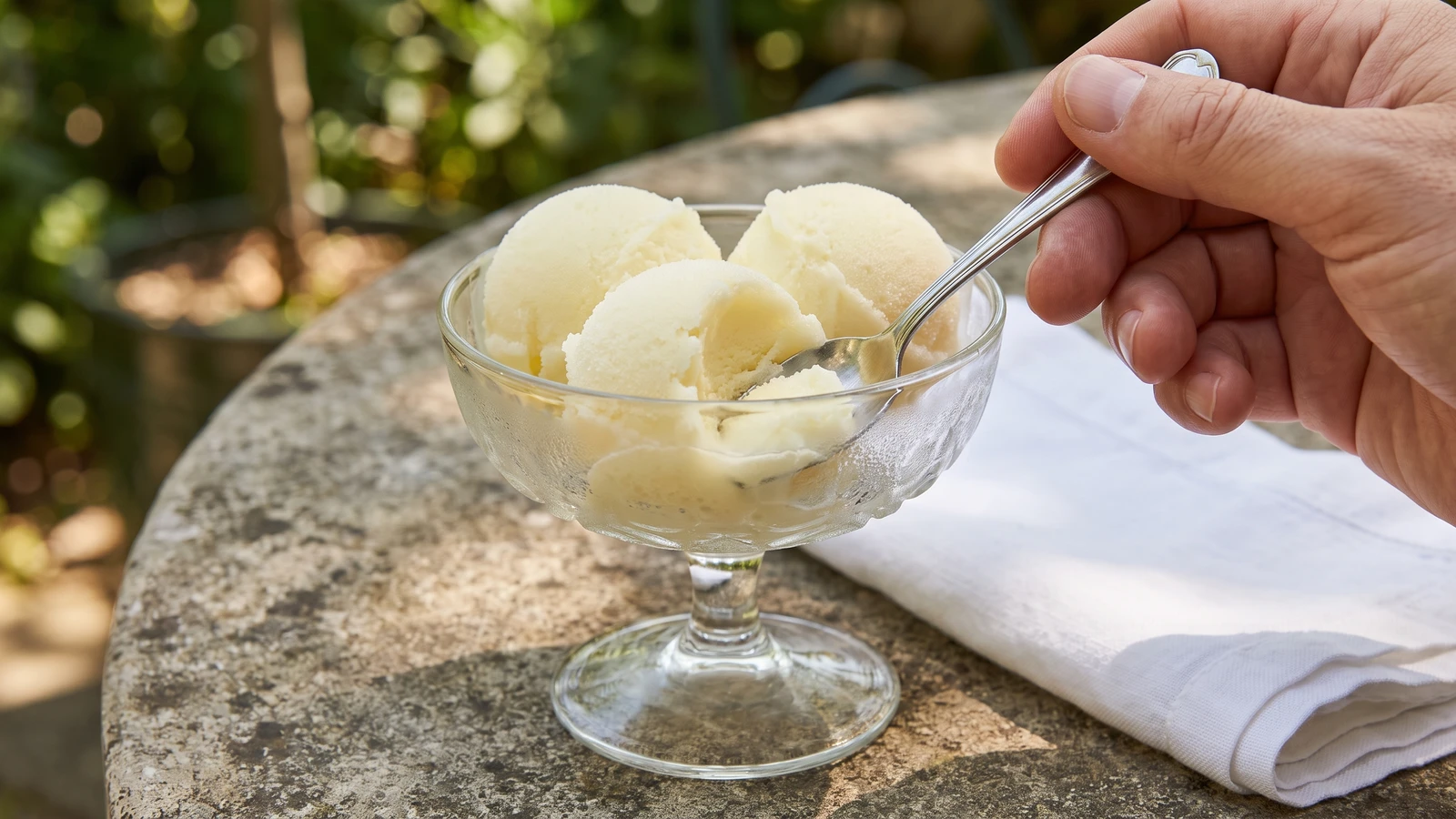
Three lemon zests, four lemons, and two oranges make a clean, fragrant glace au citron, steeped cold and churned fine: the frozen lesson in sweetness, acid, and patience.
Glace au citron teaches the central rule of every fruit ice: sweetness and acidity must be balanced before freezing, because the cold will quiet them both. Here the perfume comes from zest, the outermost coloured film of the peel, steeped without heat; the juice follows later, leaving the finished glace pale, clean, and intensely citrus rather than bitter.
The classical entry assumed a pâtisserie bench supplied with cold stock syrup, a pèse-sirop (syrup gauge), and an ice-and-salt freezing pail. A small saucepan, a kitchen scale, and an ice-cream machine are their honest home equivalents. The book's pint of syrup already makes a sensible household batch, about six portions, so its ratio of three zests, four lemons, and two oranges stays intact. The service equipment is scaffolding. The cold infusion is the dish.
Keep the syrup truly cold and take only the yellow zest, never the white pith. That three-hour infusion is the one step that decides whether your glace au citron tastes fragrant and clear or bluntly bitter.
Glace au citron belongs to the Parisian repertoire of glaciers and pâtissiers, who balanced fruit against stock syrup with a pèse-sirop before sending the mixture to the freezing pail. It carried citrus from France's Mediterranean trade and growing regions into the city confiserie, then from the professional shop to the bourgeois table. The orange juice in this classical formula is not an embellishment: it rounds the harder edge of lemon while leaving lemon unmistakably in command.
Quantity
1¾ cups (420 ml / 350 g)
for the cold syrup
Quantity
1 cup plus 1 tablespoon (255 ml / 255 g)
for the cold syrup
Quantity
4, yielding about ¾ cup (180 ml / 185 g) juice
zest removed from 3 and all 4 juiced
Quantity
2, yielding about ½ cup (120 ml / 125 g) juice
juiced
| Ingredient | Quantity |
|---|---|
| granulated sugarfor the cold syrup | 1¾ cups (420 ml / 350 g) |
| waterfor the cold syrup | 1 cup plus 1 tablespoon (255 ml / 255 g) |
| medium lemonszest removed from 3 and all 4 juiced | 4, yielding about ¾ cup (180 ml / 185 g) juice |
| medium orangesjuiced | 2, yielding about ½ cup (120 ml / 125 g) juice |
Put the sugar and water in a small saucepan and warm them gently, stirring only until the liquid turns completely clear and no crystals remain. Do not boil the syrup down; the aim is about 1 pint (2 cups / 480 ml / about 605 g), not a reduction. Cool it to room temperature, then refrigerate until thoroughly cold, about 4°C. The classical kitchen kept this syrup ready by the bucket; one cook needs only this panful.
Wash and dry the lemons. With a sharp vegetable peeler, remove the zest from three of them in broad, thin strips. Zest means the glossy yellow film alone. Turn over every strip and inspect it; if any white pith clings underneath, shave it away with a small knife before it reaches the syrup.
Submerge the three lemons' zest in the fully cold syrup, cover, and refrigerate for exactly three hours. Keep the infusion cold from beginning to end. Heat would pull harshness from the peel, while the patient cold steep captures its perfume. If a strip carrying pith escaped inspection and the syrup begins tasting bitter, strain it immediately and continue chilling it without the zest. Ça se rattrape.
After the three-hour infusion, juice all four lemons and both oranges. Add their juices to the syrup, then strain the whole mixture through a fine sieve into a cold jug. Press the zest only lightly; wringing it out extracts the very bitterness the cold infusion was meant to avoid.
The strained mixture should register about 22° Baumé, approximately 39 to 40 Brix on a modern refractometer. The measured syrup and expected juice yield place it close without requiring the old pèse-sirop. Without an instrument, taste the base well chilled: it should seem a little sweeter and more forcefully acidic than you want at the table, because freezing softens both impressions. Refrigerate it for another 30 minutes if squeezing and straining have allowed it to warm.
Pour the cold base into the prepared ice-cream machine and churn until it becomes opaque, finely grained, and firm enough to hold the track of the paddle, usually 20 to 30 minutes. If it remains loose and slushy, the bowl or base was too warm. Stop, return both to the cold, and begin again once properly chilled; don't keep churning a warm mixture and hope it will surrender.
Pack the glace au citron into a chilled, shallow container, press parchment directly against the surface, cover, and freeze for at least two hours. Let it stand in the refrigerator for 10 minutes before scooping if it has hardened fully. Serve in cold glasses or small bowls, with nothing scattered over its clean surface. À table!
1 serving (about 153g)
Culinary guides, cultural storytelling, and the editorial depth that makes cooking meaningful.
Discover Culinary ExplorerChef Juliette
Five almond preparations, one discipline: remove the skins cleanly, dry every kernel through, then cut, toast, or cloak it in pale caramel without letting its fragrant oils escape.

Chef Juliette
A pastry pantry lesson in one tray: filberts warmed only until their red skins release, rubbed clean, cooled, and chopped into a fragrant mise-en-place for cakes, creams, pralines, and petits fours.

Chef Juliette
The smallest pâtisserie discipline decides whether a cake leaves its mould intact: clarified butter in every corner, followed by the lightest veil of dry flour or fécule.

Chef Juliette
Four whites, one spotless bowl, and a patient change of speed: whisk gently until loosened, then briskly to glossy stiffness, with powdered sugar waiting if the foam begins to granulate.