
Chef Juliette
Various Almond Preparations
Five almond preparations, one discipline: remove the skins cleanly, dry every kernel through, then cut, toast, or cloak it in pale caramel without letting its fragrant oils escape.
A cooking platform built around craft, culture, and the stories behind what we eat.
Created by Chef Juliette
Based on No. 2763, Banana Ice, from Le Guide Culinaire (1907) by Auguste Escoffier
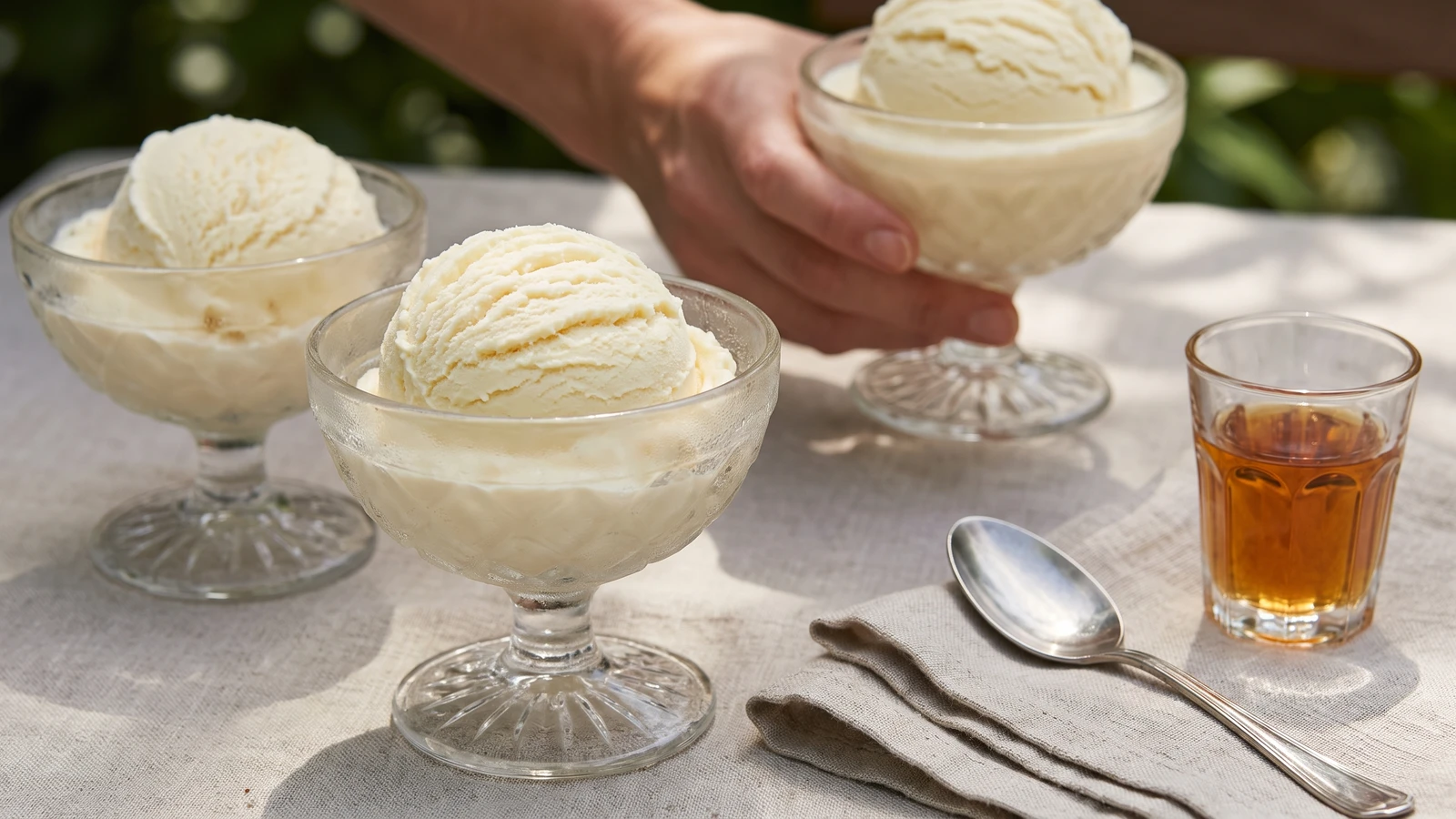
Glace aux Bananes proves that sweetness needs opposition: ripe banana and maraschino softened by a two-hour maceration, then cut with all three lemons and churned to a pale, fragrant ice.
Glace aux Bananes teaches the governing rule of fruit ices: sweetness needs opposition. Before you touch the pan, know this one true thing: all three lemons stay. Banana without that hard acid turns flat and cloying once frozen, while the full measure leaves its perfume intact and gives the finish a clean edge.
The original kitchen assumed pounded fruit, a hair sieve, a saccharometer, and a hand-turned freezing pail attended through service. Your honest equivalents are a processor or mortar, a fine-mesh sieve, a small refractometer, and a home ice-cream machine. The entry's two equal pints already make a sensible eight-serving batch, so I have kept that ratio and every lemon. The brigade scaffolding that can go is the hand pounding and salt-ice freezer; the two-hour maceration, sieving, and final sugar reading are the dish itself. One cook, one stove, one evening.
Finished properly, the ice is pale ivory, satin-dense, and fragrant with ripe banana, with maraschino appearing as a quiet cherry perfume rather than a taste of spirits. Add the lemon only after the full maceration, then check the density before freezing. That final balance is the step that decides the texture.
Glace aux Bananes belongs to the Parisian repertoire of glaciers, specialist ice makers, and grand-house entremets, where imported bananas were handled through the same measured syrup system used for orchard fruit. Maraschino, the clear cherry liqueur of the Dalmatian coast, supplies perfume, while lemon sets the balance; this is a fruit ice, not a cream-based glace. The final reading of 20° to 21° Baumé explains the surprising three lemons: acidity and sugar govern the texture together.
Quantity
5 medium, yielding 2⅓ cups (570 ml / 535 g) pulp
peeled and pounded smooth
Quantity
2⅓ cups (570 ml / about 720 g)
made from 2⅛ cups (510 ml / 420 g) granulated sugar, 1 cup (240 ml / 240 g) water, and ¼ cup (60 ml / 65 g) maraschino liqueur; chilled
Quantity
3, yielding about ½ cup plus 1 tablespoon (135 ml / 140 g) juice
juiced
Quantity
up to ¼ cup (60 ml / 60 g)
Quantity
up to ¼ cup (60 ml / 50 g)
| Ingredient | Quantity |
|---|---|
| very ripe bananaspeeled and pounded smooth | 5 medium, yielding 2⅓ cups (570 ml / 535 g) pulp |
| Maraschino-flavoured syrupmade from 2⅛ cups (510 ml / 420 g) granulated sugar, 1 cup (240 ml / 240 g) water, and ¼ cup (60 ml / 65 g) maraschino liqueur; chilled | 2⅓ cups (570 ml / about 720 g) |
| medium lemonsjuiced | 3, yielding about ½ cup plus 1 tablespoon (135 ml / 140 g) juice |
| cold water (optional) | up to ¼ cup (60 ml / 60 g) |
| superfine sugar (optional) | up to ¼ cup (60 ml / 50 g) |
Put the granulated sugar and water for the syrup in a medium saucepan. Warm gently, stirring only until the sugar has dissolved and the syrup is perfectly clear; do not reduce or colour it. Cool completely, then stir in the maraschino liqueur so its cherry perfume remains fresh. Measure exactly 2⅓ cups (570 ml) of syrup and chill it thoroughly. If evaporation has left you a teaspoon short, replace only that lost volume with cold water.
Pound or process the bananas into a completely smooth, dense pulp without beating in unnecessary air. Measure exactly 2⅓ cups (570 ml / 535 g) into a nonreactive bowl, then fold in the equal volume of cold Maraschino-flavoured syrup. Cover and refrigerate for two full hours. Keep the lemon aside for now. The maceration is not idle waiting; it carries the banana through the syrup and is one of the steps that must stay.
After two hours, stir in the juice of all three lemons. Three is not a slip: frozen banana needs that hard acid or its sweetness loses all shape. Rub the mixture through a fine-mesh sieve with a flexible spatula until only dry fibres remain. If the sieve clogs, work in smaller spoonfuls and scrape its underside frequently. Do not thin the pulp merely to hurry it through. Ça se rattrape with patience and a clean section of mesh.
Check the sieved base with a syrup hydrometer or refractometer. It should register 20° to 21° Baumé, approximately 37° to 39° Brix on a home refractometer. If it reads higher, stir in cold water 1 tablespoon (15 ml / 15 g) at a time. If it reads lower, warm 2 tablespoons of the base just enough to dissolve 1 tablespoon (15 ml / 12 g) superfine sugar, cool it completely, and return it to the bowl. Repeat only as needed. Never churn a warm correction into the base.
Chill the balanced base to 4°C / 40°F or colder, then churn in a fully frozen ice-cream machine until thick, pale, and softly ridged, usually 25 to 35 minutes. Use a 2-quart machine or divide the base between two smaller batches. If it remains loose after the machine begins warming, stop rather than stirring it warm: spread the mixture in a shallow metal pan, freeze until the edges firm, beat it smooth, and finish freezing.
Pack the churned ice into a chilled 1.5-litre container, press parchment directly against the surface, and freeze for at least four hours. Let it stand in the refrigerator for 10 to 15 minutes before scooping; maraschino keeps it supple, but a deep freeze still needs tempering. Serve in chilled coupes with no garnish to distract from the banana, cherry perfume, and lemon. À table!
1 serving (about 175g)
Culinary guides, cultural storytelling, and the editorial depth that makes cooking meaningful.
Discover Culinary ExplorerChef Juliette
Five almond preparations, one discipline: remove the skins cleanly, dry every kernel through, then cut, toast, or cloak it in pale caramel without letting its fragrant oils escape.

Chef Juliette
A pastry pantry lesson in one tray: filberts warmed only until their red skins release, rubbed clean, cooled, and chopped into a fragrant mise-en-place for cakes, creams, pralines, and petits fours.

Chef Juliette
The smallest pâtisserie discipline decides whether a cake leaves its mould intact: clarified butter in every corner, followed by the lightest veil of dry flour or fécule.

Chef Juliette
Four whites, one spotless bowl, and a patient change of speed: whisk gently until loosened, then briskly to glossy stiffness, with powdered sugar waiting if the foam begins to granulate.