Culinary Explorer

A cooking platform built around craft, culture, and the stories behind what we eat.
Discover Culinary Explorer
Pine-apple Ice

Pine-apple Ice

Created by Chef Juliette

Based on No. 2762, Pine-apple Ice, from Le Guide Culinaire (1907) by Auguste Escoffier

Glace à l'ananas turns ripe fruit, patient maceration, lemon, and a whisper of kirsch into a bright, fine-textured ice. Two quiet hours in syrup decide everything.

Desserts
French
Dinner Party
Outdoor Dining
Make Ahead
25 min
Active Time
5 min cook5 hr 30 min total
Yield4 servings (about 1 pint / 475 ml)

Glace à l'ananas (pineapple ice) teaches the discipline behind every good fruit ice: extraction comes before freezing. Grated pineapple must sit in syrup for the full two hours so its perfume moves into the liquid. Hurry it and the syrup says nothing, however ripe the fruit.

The original entry assumed cold syrup waiting on the pastry station, a hair sieve, a pèse-sirop (syrup hydrometer), and a sorbetière (hand-cranked freezer) packed with salted ice. A home saucepan makes the syrup, a fine-mesh sieve does the rubbing, an optional refractometer reads the same sugar balance, and a countertop churn or shallow metal pan handles the freezing. The source's pint of fruit and pint of syrup are halved to one cup each, preserving its equal-volume ratio while giving four generous servings. One cook, one stove, one evening.

Prepared syrup and the tending of salted ice were brigade scaffolding; they can go. Maceration, sieving, lemon, kirsch, and testing to 18° to 20° Baumé stay because they are the dish. The one step that matters most is the two-hour maceration. Give it every minute.

Glace à l'ananas belongs to the Parisian repertoire of entremets glacés, where imported pineapple was grated or pounded, steeped in syrup, passed through a sieve, and frozen in a sorbetière. It traveled from grand dining rooms to bourgeois tables as hand-cranked freezers made fruit ices manageable at home, but its structure remained that of the confectioner's pantry rather than a dairy ice cream. The pèse-sirop reading was practical, not ceremonial: sugar concentration determined whether the ice froze smoothly or became either a hard block or a sweet slush.

The technique, the tradition, and the story behind every dish.

Discover Culinary Explorer

Ingredients

granulated sugar

Quantity

3/4 cup (180 ml / 150 g)

water

Quantity

1/2 cup plus 2 tablespoons (150 ml / 150 g)

ripe pineapple flesh

Quantity

1 packed cup (240 ml / about 225 g)

peeled, eyes and hard core removed, then finely grated

fresh lemon juice

Quantity

1 1/2 tablespoons (22 ml / 22 g)

from about 1/2 large lemon

kirsch

Quantity

3 to 4 drops (about 0.2 ml / 0.2 g)

granulated sugar for density correction (optional)

Quantity

Up to 1 tablespoon (15 ml / 12 g)

cold water for density correction (optional)

Quantity

Up to 2 tablespoons (30 ml / 30 g)

Equipment Needed

  • Small heavy saucepan
  • Fine grater or food processor
  • Fine-mesh sieve
  • Flexible spatula or small ladle
  • 1-quart ice-cream maker or shallow metal freezer pan
  • Digital Brix refractometer, optional

Instructions

  1. 1

    Make the syrup

    Combine the 3/4 cup sugar and 150 ml water in a small saucepan. Warm gently, stirring only until every crystal has dissolved and the syrup is perfectly clear, then take it off the heat. Don't boil it down; you need about 1 cup (240 ml / about 300 g), the equal partner to the cup of pineapple. If a hard boil steals too much water, measure the cooled syrup and add cold water until it returns to 1 cup. Cool completely, then chill it.

    Hot syrup dulls fresh pineapple and begins cooking its surface. Let the syrup become thoroughly cold before the fruit goes in.
  2. 2

    Grate the pineapple

    Remove the peel, every dark eye, and the hard central core. Finely grate the flesh over a bowl so none of its juice escapes, then measure 1 packed cup. A food processor may be used in short pulses, but stop at a wet, finely pounded pulp rather than a frothy purée. Keep every drop of juice with the fruit.

  3. 3

    Macerate two hours

    Mix the grated pineapple with the full cup of cold syrup, cover, and refrigerate for exactly two hours, stirring once halfway through. This macération, the steeping that draws the fruit's perfume into the syrup, is the foundation. Don't shorten it. If dinner moves later, a third or fourth hour in the cold does no harm; the failure is haste, not an extra wait.

  4. 4

    Rub through sieve

    Set a fine-mesh sieve over a cold bowl and pour in the pineapple mixture. Rub it through firmly with a flexible spatula or the back of a ladle, working in batches until only dry, stringy fibre remains. Scrape the thick purée clinging beneath the sieve into the bowl. If the mesh clogs, clear its underside and continue; don't dilute the mixture and don't discard the pulp that has passed through.

  5. 5

    Balance the base

    Stir in the lemon juice, then the kirsch, counting the drops. Test the mixture with a pèse-sirop at 18° to 20° Baumé, or with a digital refractometer at approximately 33° to 36° Brix. Below that range, the ice will freeze hard and coarse: warm 2 tablespoons of base with 1 teaspoon of the correction sugar until dissolved, cool it, stir it back, and retest. Above the range, add cold water 1 teaspoon at a time and retest. Ça se rattrape. Without a meter, freeze a teaspoon on a metal saucer for 10 minutes; it should scrape into a smooth, soft curl, neither a hard flake nor sticky syrup. The unfrozen base should taste one shade sweeter than you want because cold quiets sweetness.

    Kirsch is seasoning here, not a pour. Three or four drops sharpen the pineapple's perfume without making the ice taste of spirits.
  6. 6

    Chill and churn

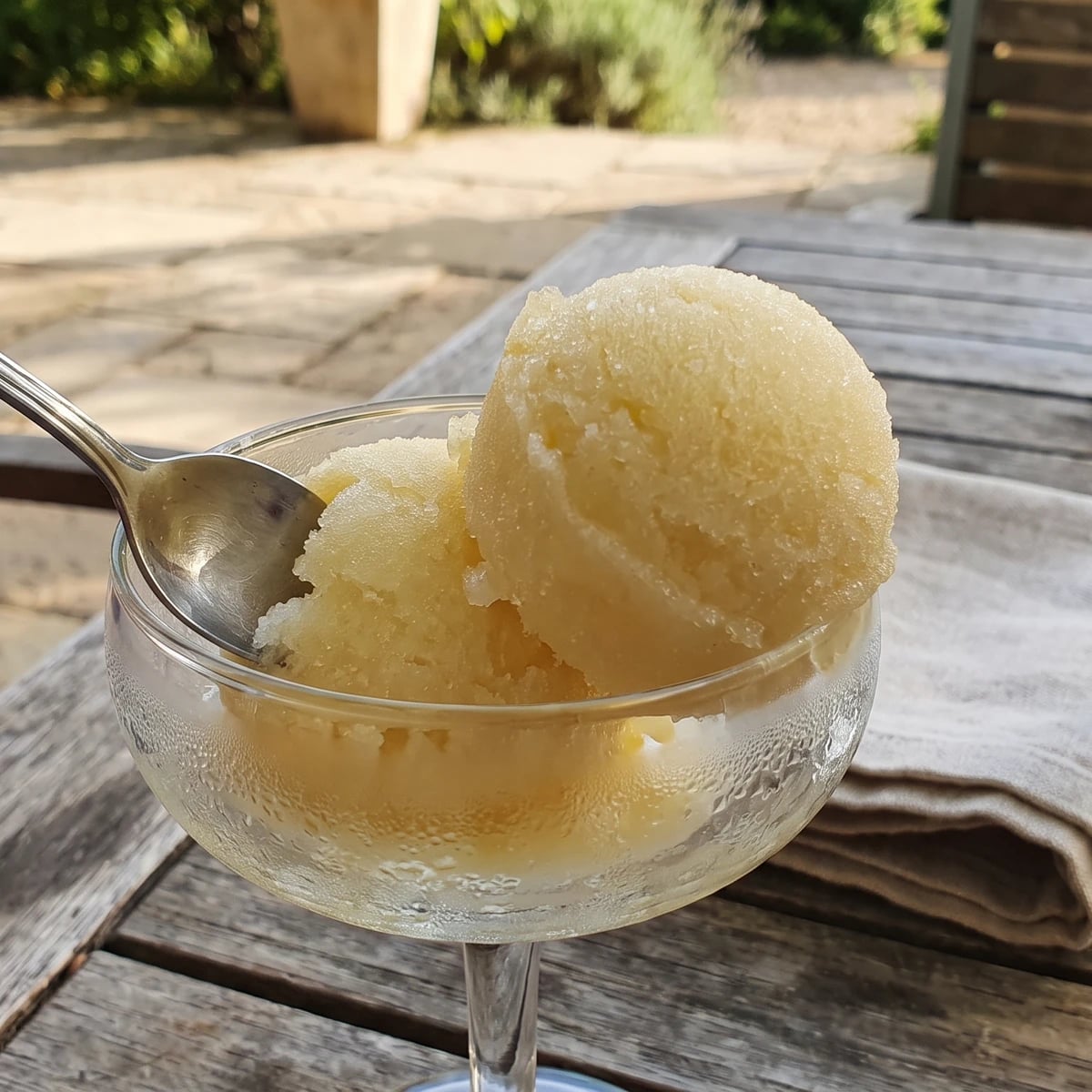
    Chill the balanced base until thoroughly cold, at least 30 minutes if any portion was warmed. Churn in an ice-cream maker until it holds soft folds and the crystals feel fine, usually 20 to 25 minutes. Without a machine, pour it into a prechilled shallow metal pan and freeze, scraping and beating it vigorously every 30 minutes until evenly frozen, about 2 to 3 hours. If it becomes grainy, let it soften to a thick slush, beat it smooth, and freeze again; if the density tested low, make the sugar correction before refreezing.

  7. 7

    Firm and serve

    Pack the churned glace à l'ananas into a shallow covered container and freeze for about two hours, until scoopable but firm. If it has frozen overnight, leave it at room temperature for 5 to 10 minutes before scooping. Serve two generous scoops in each chilled glass coupe. It needs no decorative fuss; ripe pineapple, lemon, and that breath of kirsch are the finish. À table!

Chef Tips

  • Choose a pineapple that feels heavy and smells clearly of fruit at the base. Colour alone proves little. If the fresh fruit at the market smells of nothing, well-drained canned pineapple in juice is the honest pantry answer, used in the same measured quantity, though its flavour will be rounder and less floral.
  • The sieve is part of the texture, not a ceremonial inconvenience. Rubbing removes the pineapple's stubborn fibres while keeping the fine pulp that gives the ice body; blending alone leaves threads behind.
  • A small digital refractometer replaces the old syrup scale neatly, but the frozen-saucer test will still tell you what matters. Hard and coarse means too little sugar. Sticky and reluctant to freeze means too much.
  • Glace à l'ananas is brightest within three days. After that, its perfume recedes and larger ice crystals begin to form, though a brief softening and vigorous beating will restore much of the texture.

Advance Preparation

  • The syrup may be prepared up to three days ahead and kept covered in the refrigerator. Measure it again before use, since the pineapple and syrup must meet in equal volumes.
  • The strained, balanced base may be refrigerated for up to one day before churning. Keep it tightly covered so its pineapple perfume stays in the bowl.
  • For a dinner party, churn the ice earlier the same day and firm it in its serving container. Transfer it to the refrigerator for about 10 minutes before serving if your freezer runs especially cold.

Frequently Asked Questions

Nutrition Information

1 serving (about 125g)

Calories
175 calories
Total Fat
0 g
Saturated Fat
0 g
Trans Fat
0 g
Unsaturated Fat
0 g
Cholesterol
0 mg
Sodium
1 mg
Total Carbohydrates
45 g
Dietary Fiber
1 g
Sugars
43 g
Protein
0 g

Note: Chef personas and recipes are created with AI assistance. Cook with care: follow safe food-handling practices, check doneness with a thermometer when needed, and adapt for allergies and your kitchen.

Where cooking meets culture.

Culinary guides, cultural storytelling, and the editorial depth that makes cooking meaningful.

Discover Culinary Explorer

More from Ices and Sherbets

Browse the full collection