
Chef Juliette
Various Almond Preparations
Five almond preparations, one discipline: remove the skins cleanly, dry every kernel through, then cut, toast, or cloak it in pale caramel without letting its fragrant oils escape.
A cooking platform built around craft, culture, and the stories behind what we eat.
Created by Chef Juliette
Based on No. 2759, The Making of Fruit Ice Preparations, from Le Guide Culinaire (1907) by Auguste Escoffier
Two classical paths, one clean lesson: balance fruit and sugar while the mixture is cold, then churn it fine. Master that correction and every ripe fruit can become a proper glace.
Glaces aux fruits teach the governing principle of frozen dessert: sugar is structure as much as sweetness, and you cannot judge either warm. Before you touch a pan, know this one thing: the preparation must be completely cold when you test it, because cold dulls sweetness and an unbalanced base freezes either hard as a paving stone or loose as slush.
The old formula assumed a confectioner's pèse-sirop (syrup hydrometer), bowls of 32° syrup already cold, and a salt-and-ice sorbetière (ice-cream freezer) turned by hand. Here the pèse-sirop becomes an optional refractometer, the syrup is one small saucepan, and the sorbetière becomes a domestic ice-cream machine. Bulk tubs and hand-turning were brigade scaffolding and can go; equal purée and syrup, ten ounces of sugar to each pound of fruit, the fine sieve, and the cold correction are the dish, so they stay. One cook, one stove, one evening.
The first route lets a fine purée down with an equal volume of cold 32° syrup, then adds lemon according to the fruit's acidity. The second pounds fruit with the book's average quantity of sugar, rubs it through a sieve, and waters it back to the proper strength. Both arrive at bright fruit and a fine, spoonable texture, with no dairy to blur the perfume. Test cold and correct before churning. That is the step that decides the dish.
Glaces aux fruits belong to the confectioners and glaciers of Paris, specialist makers of ices who balanced fruit purées with measured syrup before freezing them in salt-and-ice sorbetières. The formula welcomed the fruit of each larder, including berries from northern gardens, apricots and peaches from the Rhône Valley, and citrus from Provence. A glace aux fruits is not a granité; sieving and churning give it a fine, cohesive body rather than deliberate ice crystals.
Quantity
2 cups (480 ml / 500 g)
made from ripe prepared fruit and rubbed through a fine sieve
Quantity
2 cups plus 1 tablespoon (495 ml / 420 g)
for the 32° syrup
Quantity
1 cup plus 2 tablespoons plus 2 teaspoons (280 ml / 280 g)
for the 32° syrup
Quantity
up to 1 cup (240 ml / 240 g)
for correcting an over-strong preparation
Quantity
up to 3 tablespoons (45 ml / 45 g)
strained
Quantity
1 pound (about 3½ cups / 454 g)
washed, trimmed, peeled or stoned as required
Quantity
1⅓ cups plus 1 tablespoon (335 ml / 283 g)
Quantity
1 to 2 cups (240 to 480 ml / 240 to 480 g)
added only as needed
Quantity
up to ¼ cup (60 ml / 50 g)
for correction syrup
| Ingredient | Quantity |
|---|---|
| Route 1, cold fine fruit puréemade from ripe prepared fruit and rubbed through a fine sieve | 2 cups (480 ml / 500 g) |
| Route 1, granulated sugarfor the 32° syrup | 2 cups plus 1 tablespoon (495 ml / 420 g) |
| Route 1, filtered waterfor the 32° syrup | 1 cup plus 2 tablespoons plus 2 teaspoons (280 ml / 280 g) |
| Route 1, cold filtered water (optional)for correcting an over-strong preparation | up to 1 cup (240 ml / 240 g) |
| Route 1, fresh lemon juice (optional)strained | up to 3 tablespoons (45 ml / 45 g) |
| Route 2, ripe prepared fruitwashed, trimmed, peeled or stoned as required | 1 pound (about 3½ cups / 454 g) |
| Route 2, granulated sugar | 1⅓ cups plus 1 tablespoon (335 ml / 283 g) |
| Route 2, cold filtered wateradded only as needed | 1 to 2 cups (240 to 480 ml / 240 to 480 g) |
| Route 2, additional granulated sugar (optional)for correction syrup | up to ¼ cup (60 ml / 50 g) |
Use one route, not both. Route 1 suits fruit that readily becomes a smooth purée, such as raspberries, strawberries, currants, apricots, peaches, or plums. Blend or pound the prepared fruit, then rub it through a fine sieve and measure 2 cups (480 ml / 500 g). For Route 2, leave the pound of prepared fruit in pieces until it meets the sugar. Keep all fruit cold; warmth makes the sweetness seem louder than it will taste when frozen.
For Route 1, combine the 420 g sugar and 280 g filtered water in a small saucepan. Warm over medium-low heat, stirring only until every crystal dissolves and the syrup turns perfectly clear, about 3 to 5 minutes. Do not reduce it; the point is dissolution, not caramel. This 3-to-2 ratio by weight gives the practical home equivalent of cold syrup at 32° Baumé, about 60° Brix. Cool the saucepan in an ice bath, then refrigerate the syrup until thoroughly cold. You will have a little more than 2 cups, leaving enough for correction.
Measure 2 cups of cold fine fruit purée and exactly 2 cups of cold 32° syrup into a nonreactive bowl. Stir gently until uniform; do not whip in air. Taste a cold spoonful, then add lemon juice a teaspoon at a time, stopping when the fruit tastes clearer and livelier. A sharp currant may need none, while a sweet peach may want the full measure. Lemon corrects acidity, not freezing strength.
For Route 2, put the pound of prepared fruit and the full 10 ounces (283 g) of sugar into a food processor or sturdy mortar. Pound or pulse until the sugar draws out the juice and the fruit becomes a wet, fragrant pulp. The processor replaces the old mortar honestly because the endpoint is ruptured fruit, not tired arms. Rub the mixture through the fine sieve, then stir in cold filtered water ¼ cup (60 ml / 60 g) at a time, beginning with 1 cup, until the purée flows like thick juice. The fruit's natural sugar decides how much water it will accept.
Chill either preparation for at least 30 minutes before judging it. With a refractometer, aim for 30° to 32° Brix, a practical range for a domestic freezer. Do not confuse the scales: the Route 1 syrup began at 32° Baumé, about 60° Brix, while this reading is for the diluted finished preparation. If the reading is high, add cold filtered water 1 tablespoon (15 ml / 15 g) at a time. If it is low, add reserved cold 32° syrup; for Route 2, make the same correction syrup with 3 parts of the optional sugar and 2 parts water by weight, warm only to dissolve, then chill it before adding. Retest after every correction.
Chill the corrected preparation until very cold, then churn it in a fully prepared ice-cream machine according to the machine's instructions, usually 20 to 30 minutes. Stop when the glace holds the tracks of the paddle and gathers into a dense, rounded mound. If it remains pourable, first check that the freezer bowl is still properly frozen. If the machine is cold and the base still will not set, the preparation carries too much sugar; chill it again, dilute with cold water or unsweetened fruit purée, retest, and rechurn.
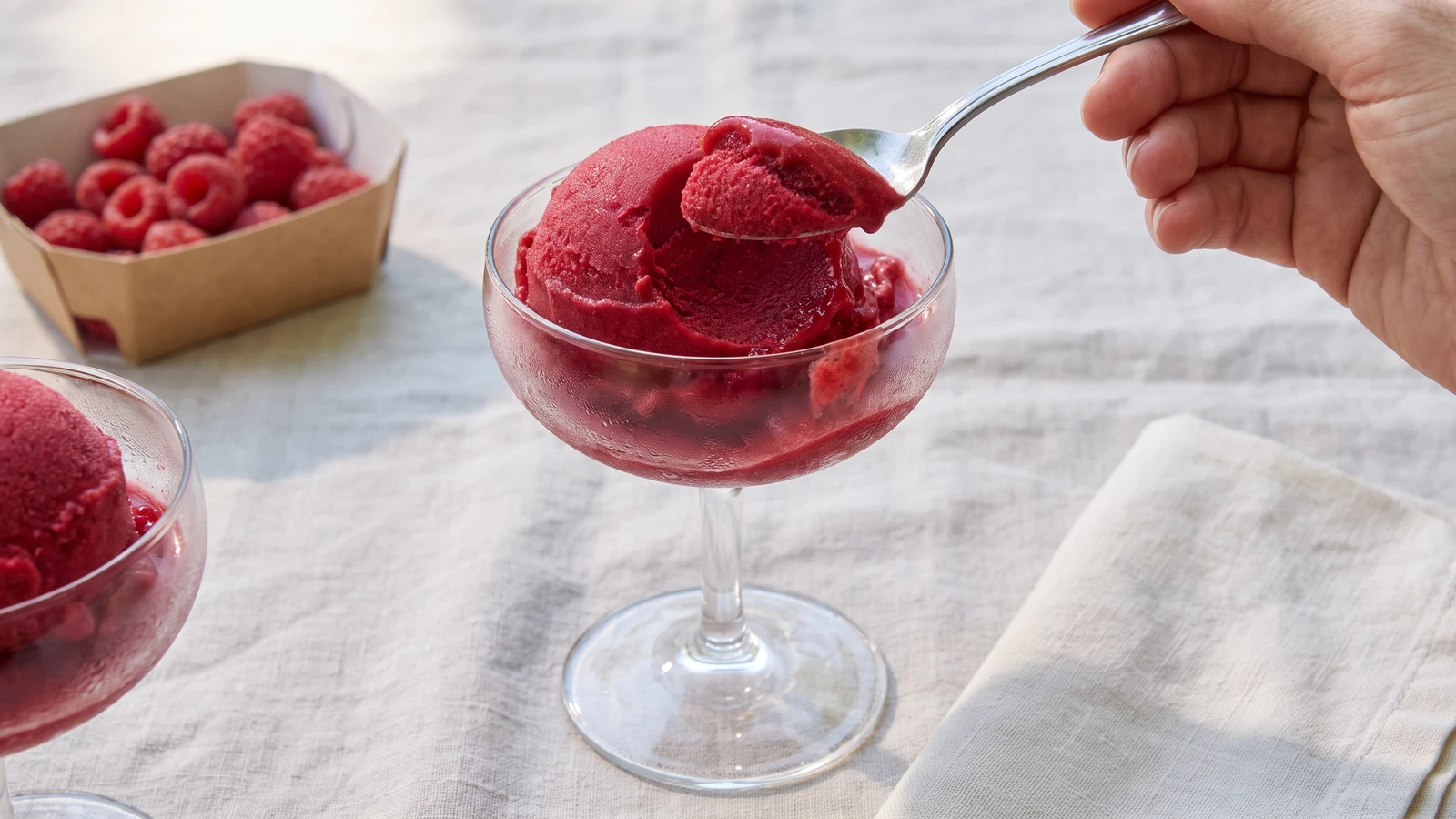
Pack the churned glace into a shallow covered container, press parchment directly against the surface, and freeze for at least 4 hours. Temper it in the refrigerator for 10 to 15 minutes before scooping. If it freezes hard enough to resist the spoon, the base was under-sugared: soften it in the refrigerator until stirrable, work in a little cold 32° syrup, then rechurn. Serve in chilled bowls or coupes while the fruit is vivid and the texture fine. À table!
1 serving (about 150g)
Culinary guides, cultural storytelling, and the editorial depth that makes cooking meaningful.
Discover Culinary ExplorerChef Juliette
Five almond preparations, one discipline: remove the skins cleanly, dry every kernel through, then cut, toast, or cloak it in pale caramel without letting its fragrant oils escape.

Chef Juliette
A pastry pantry lesson in one tray: filberts warmed only until their red skins release, rubbed clean, cooled, and chopped into a fragrant mise-en-place for cakes, creams, pralines, and petits fours.

Chef Juliette
The smallest pâtisserie discipline decides whether a cake leaves its mould intact: clarified butter in every corner, followed by the lightest veil of dry flour or fécule.

Chef Juliette
Four whites, one spotless bowl, and a patient change of speed: whisk gently until loosened, then briskly to glossy stiffness, with powdered sugar waiting if the foam begins to granulate.