
Chef Juliette
Various Almond Preparations
Five almond preparations, one discipline: remove the skins cleanly, dry every kernel through, then cut, toast, or cloak it in pale caramel without letting its fragrant oils escape.
A cooking platform built around craft, culture, and the stories behind what we eat.
Created by Chef Juliette
Based on No. 2758, Preparations for Fruit Ices, from Le Guide Culinaire (1907) by Auguste Escoffier
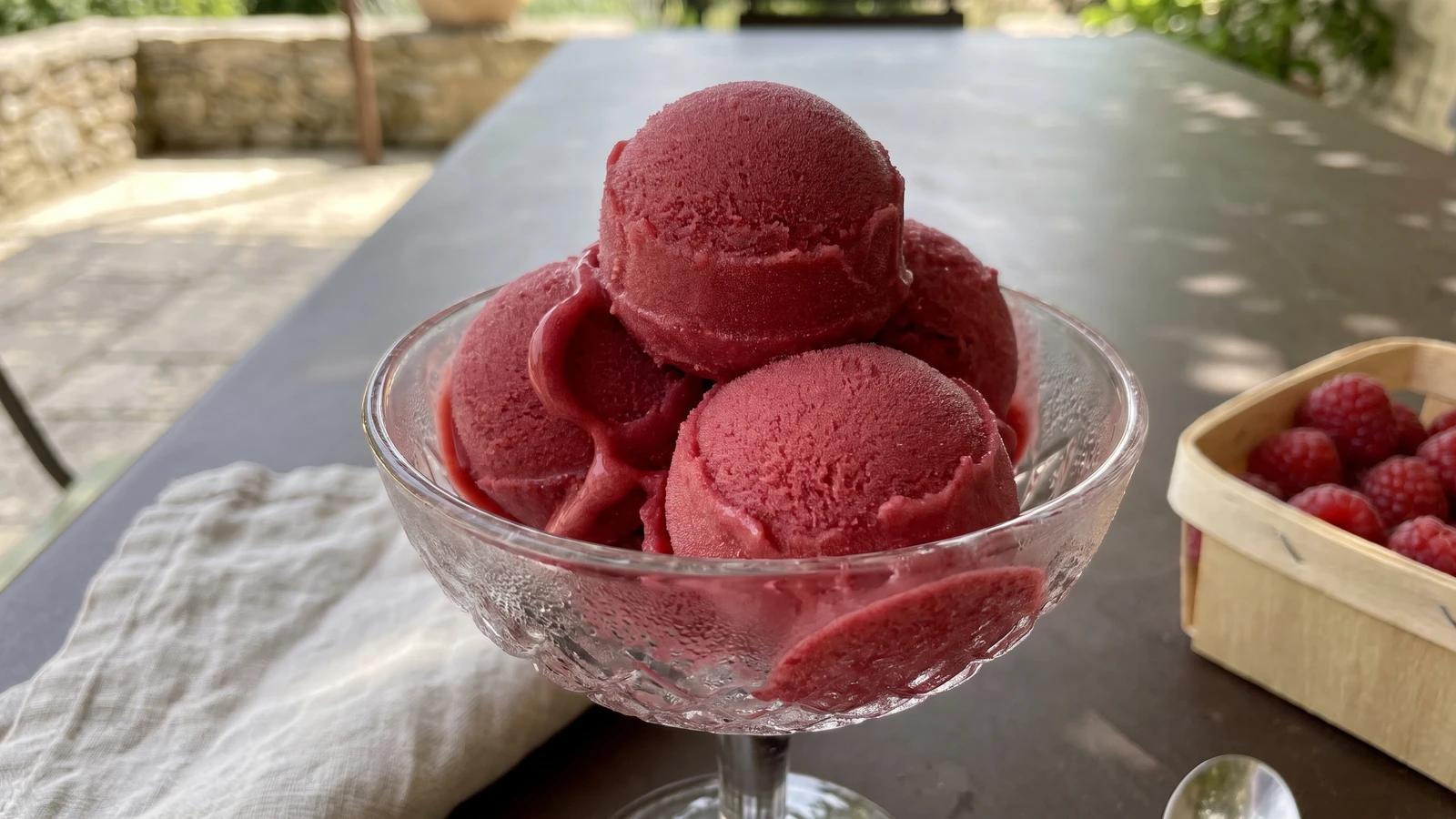
Glaces aux fruits teach the governing balance of frozen fruit: 32° syrup for body, strained purée for character, and at least one whole lemon per quart so the fruit tastes more fully of itself.
Glaces aux fruits (fruit ices) teach balance before anything else. The 32° in the old formula names the density of the syrup, not its temperature, but the one true thing to know before touching a pan is simpler: lemon juice is structural. It sharpens sweetness, controls the finish, and makes ripe fruit taste more completely of itself.
The original preparation assumed a pèse-sirop (syrup gauge), fruit rubbed through a broad tammy cloth, a sorbetière packed with ice and salt, and enough hands to test each batch as the season changed. A digital scale gives the same 32° syrup by weight, a fine-mesh sieve does the tammy's work, and a small electric churn replaces the attendant at the freezer. The entry supplied a working system rather than one fixed fruit-to-syrup ratio, so this home formula makes about one quart from 2¼ cups of purée and up to 1½ cups of syrup, with a little of each held back for adjustment. Scale and equipment changed because one cook needs a usable batch. The sieving, the acid, and the cold balancing stay because they are the dish.
Properly made, the ice is fine-grained and vivid, neither sugary slush nor a hard block, with the fruit arriving first and lemon clearing the palate behind it. Taste the base ice-cold and balance it before churning. That is the step that decides the dish.
Glaces aux fruits belong not to one province but to French pâtisserie and the formal Paris table, where confectioners built frozen preparations by density, measuring syrup on the pèse-sirop before adding sieved fruit, essence, or liqueur. Fresh fruit was not the only respected choice: when the season closed, professional kitchens used preserved fruit juice rather than force a weak fresh one. The method passed readily into home sorbetières because its governing rule was portable, one whole lemon per quart to throw the fruit's own flavor into relief.
Quantity
1⅓ cups (315 ml / 265 g)
Quantity
¾ cup plus 2 teaspoons (190 ml / 190 g)
Quantity
2¼ cups (540 ml / 540 g)
made from about 1½ pounds (680 g) prepared soft fruit
Quantity
3 to 4 tablespoons (45 to 60 ml / 45 to 60 g)
from 1 to 2 large lemons; use no less than the juice of 1 whole lemon
Quantity
2 tablespoons (30 ml / 30 g)
for red-fruit ices, replacing the same volume of fruit purée
Quantity
1 cup (240 ml / 240 g)
very cold and unwhipped, for the red-fruit finish
| Ingredient | Quantity |
|---|---|
| granulated sugar | 1⅓ cups (315 ml / 265 g) |
| cold water | ¾ cup plus 2 teaspoons (190 ml / 190 g) |
| strained ripe fruit puréemade from about 1½ pounds (680 g) prepared soft fruit | 2¼ cups (540 ml / 540 g) |
| fresh lemon juicefrom 1 to 2 large lemons; use no less than the juice of 1 whole lemon | 3 to 4 tablespoons (45 to 60 ml / 45 to 60 g) |
| fresh orange juice (optional)for red-fruit ices, replacing the same volume of fruit purée | 2 tablespoons (30 ml / 30 g) |
| pasteurized heavy cream (optional)very cold and unwhipped, for the red-fruit finish | 1 cup (240 ml / 240 g) |
Weigh the empty saucepan and write down its weight. Add the sugar and water, then warm them gently, stirring only until every crystal dissolves. Bring the clear syrup to the briefest simmer and remove it at once; prolonged boiling drives off water and changes the density. Let the pan settle for 5 minutes, weigh it again, and subtract the empty-pan weight. If the contents weigh less than 455 g, stir in enough hot water to restore that weight. Cool completely. You now have about 1½ cups (355 ml / 455 g) of syrup at the classical 32° pèse-sirop mark, roughly 58 percent sugar by weight. The scale has replaced the syrup gauge, not the formula.
Purée the prepared fruit without adding water, then press it through a tamis, a fine-mesh sieve, with the back of a ladle. Remove berry seeds, tough fibers, and fragments of skin, but don't strain away the fruit's body. Measure 2¼ cups (540 ml / 540 g). Reserve ¼ cup (60 ml / 60 g) for balancing the base. The smoothness of the finished ice begins here; churning cannot make a coarse purée fine.
Reserve ¼ cup (60 ml / 75 g) of the cooled 32° syrup. Combine the remaining 1¼ cups (295 ml / 380 g) with 2 cups (480 ml / 480 g) of the fruit purée and all the juice from 1 whole lemon, never less. For a red-fruit ice, replace 2 tablespoons of the measured purée with the orange juice; orange and lemon together bring remarkable clarity to berries without making the ice taste of orange. Cover and chill the base for at least 2 hours, until thoroughly cold.
Taste the cold base. It should seem a shade sweeter and brighter than you want at the table because freezing mutes both sweetness and aroma. Put a tablespoon on a chilled saucer and freeze it for 10 minutes. If it sets hard and splinters under the spoon, add the reserved 32° syrup 1 tablespoon at a time. If it remains wet, overly soft, and plainly too sweet, add reserved purée 1 tablespoon at a time and sharpen it with more lemon juice. If the fruit tastes flat, add lemon before adding sugar. Retest after each adjustment. Ça se rattrape: the saucer catches the imbalance before a whole quart reaches the churn.
Pour the thoroughly chilled base into the running sorbetière, filling it no more than two-thirds full. Churn until the mixture rises, loses its liquid shine, and holds soft ridges from the paddle, usually 20 to 30 minutes. Stop when a spoonful mounds softly but remains easy to spread. Churning beyond that point gains nothing and begins warming the ice against a struggling motor.
For the source's red-fruit variation, wait until the ice has softly set, then pour the very cold, unwhipped heavy cream into the running machine during its final minute. The proportion stays exact: 1 cup of cream for each quart of prepared ice. Continue only until the color turns evenly pale and the cream disappears into the fruit. If the addition loosens the ice, churn for another 2 minutes; if the machine can no longer manage it, transfer the mixture to its cold container, freeze for 20 minutes, and stir firmly once. The old direction's raw fresh cream means cream added uncooked and unwhipped; pasteurized heavy cream is the honest home choice.
Pack the soft ice into a shallow lidded container, press parchment directly against the surface, and freeze for 2 to 3 hours, just until scoopable and firm. Let it stand in the refrigerator for 10 minutes before serving so its aroma opens and the spoon passes cleanly through it. If storage has made it coarse, soften it in the refrigerator to a thick slush and churn it again briefly. Serve generous scoops in chilled glasses. À table!
1 serving (about 160g)
Culinary guides, cultural storytelling, and the editorial depth that makes cooking meaningful.
Discover Culinary ExplorerChef Juliette
Five almond preparations, one discipline: remove the skins cleanly, dry every kernel through, then cut, toast, or cloak it in pale caramel without letting its fragrant oils escape.

Chef Juliette
A pastry pantry lesson in one tray: filberts warmed only until their red skins release, rubbed clean, cooled, and chopped into a fragrant mise-en-place for cakes, creams, pralines, and petits fours.

Chef Juliette
The smallest pâtisserie discipline decides whether a cake leaves its mould intact: clarified butter in every corner, followed by the lightest veil of dry flour or fécule.

Chef Juliette
Four whites, one spotless bowl, and a patient change of speed: whisk gently until loosened, then briskly to glossy stiffness, with powdered sugar waiting if the foam begins to granulate.