Culinary Explorer

A cooking platform built around craft, culture, and the stories behind what we eat.
Discover Culinary Explorer
Vanilla Ice-cream

Vanilla Ice-cream

Created by Chef Juliette

Based on No. 2757, Vanilla Ice-cream, from Le Guide Culinaire (1907) by Auguste Escoffier

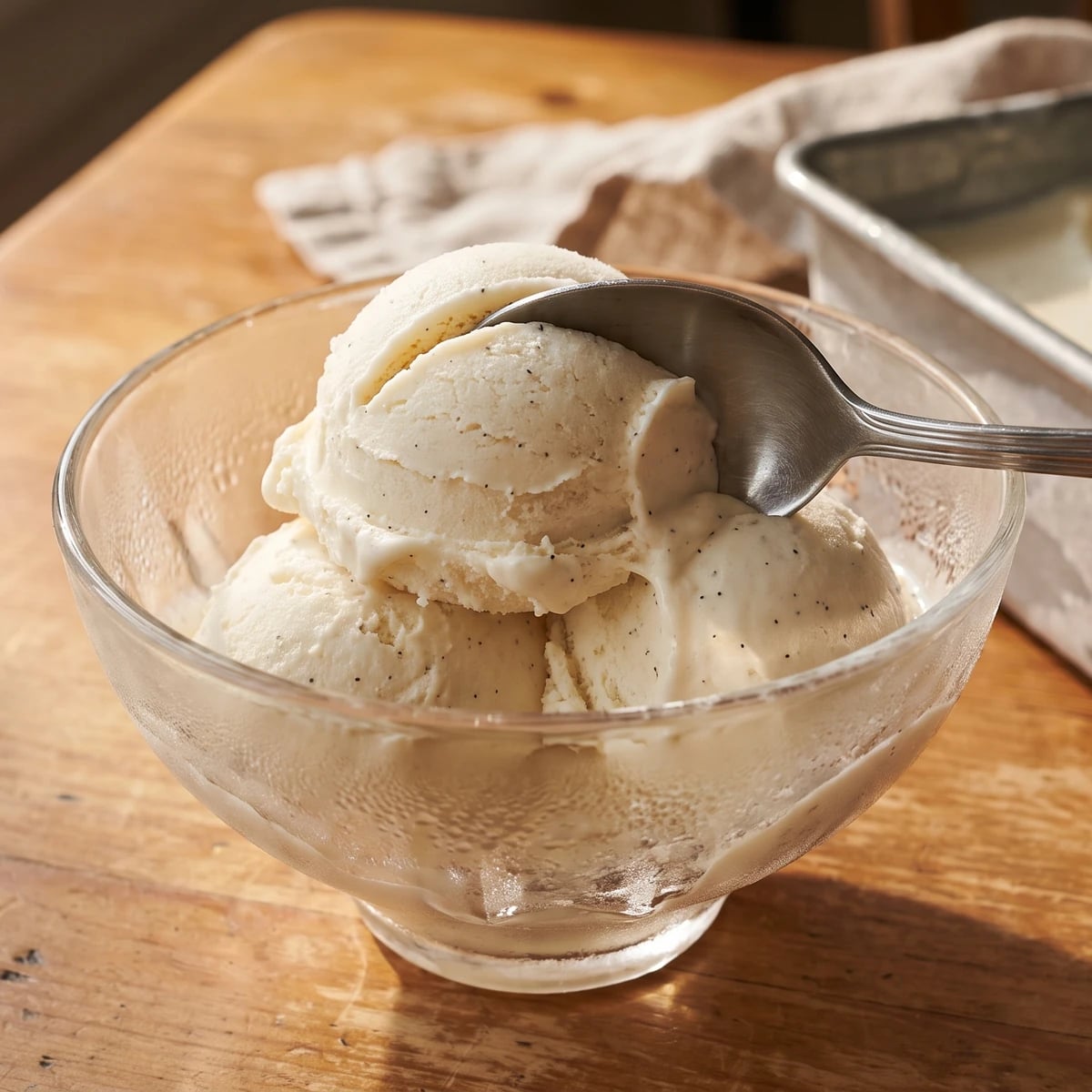
Glace à la vanille teaches the quiet discipline of infusion: boiled milk, one generous vanilla pod, and twenty covered minutes, followed by a gentle custard and a patient churn into fragrant ivory scoops.

Desserts
French
Comfort Food
Make Ahead
Freezer Friendly
25 min
Active Time
15 min cook8 hr 30 min total
YieldAbout 1 quart (8 servings)

Glace à la vanille (vanilla ice cream) teaches that extraction is not the same as boiling. Before you touch a pan, know the one true thing: boil the milk, take it off the heat, then give one plump vanilla pod twenty covered minutes inside it. Boiling the pod drives away the perfume you meant to capture; patient infusion draws it into every spoonful.

The old formula assumed its crème anglaise, the egg-thickened pouring custard, was already familiar, along with service quantities and a sorbetière packed in salted ice that someone stood turning. Here the complete custard makes about one quart, and a countertop ice-cream machine does the turning. The quantity and equipment have changed because one cook has neither a brigade nor a bucket of ice to tend. The flavoring and sequence have not: one large pod, milk brought to the boil, twenty minutes of infusion, then freezing. One cook, one stove, one evening.

The salt-and-ice bucket and spare pair of arms were scaffolding. They can go. The full infusion, gentle cooking, and thorough chilling are the dish itself, and they stay. Give the covered vanilla its full twenty minutes before you build the custard; that quiet wait decides whether the finished ice tastes deeply fragrant or merely sweet.

Glace à la vanille belongs to the Parisian tradition of the glacier and confiseur, whose cooks froze egg custards in salt-packed sorbetières and worked them smooth by hand. Vanilla entered these kitchens as a precious fragrant pod, treated by infusion in boiled milk so its perfume passed into the custard without being cooked away. The cream-heavy preparation sometimes presented as the only French form is a misconception: the classical formula permits milk, cream replacing part or all of that milk, or a measured fold of whipped cream after the ice has congealed.

The technique, the tradition, and the story behind every dish.

Discover Culinary Explorer

Ingredients

whole milk

Quantity

3 cups (720 ml / 740 g)

large plump vanilla bean

Quantity

1

large egg yolks

Quantity

8

granulated sugar

Quantity

¾ cup plus 2 tablespoons (210 ml / 175 g)

cold heavy cream (optional)

Quantity

¼ cup (60 ml / 60 g), yielding a scant ½ cup (95 ml) when softly whipped

whipped to soft peaks

Equipment Needed

  • 1½-quart or larger ice-cream machine
  • 2-quart heavy-bottomed saucepan
  • Instant-read thermometer
  • Fine-mesh sieve
  • Flexible heatproof spatula
  • Shallow 1-quart freezer container

Instructions

  1. 1

    Ready the cold

    Freeze the ice-cream machine canister according to its instructions, usually for at least 24 hours. Set a clean bowl over a larger bowl of ice water and place a fine sieve nearby. Once the custard is cooked, speed matters: rapid chilling stops the eggs cooking and gives the churn a properly cold beginning.

    A canister that sloshes when shaken is not frozen through. Give it more time, or the custard will turn slowly without ever setting.
  2. 2

    Infuse the vanilla

    Bring the milk to a full boil in a medium saucepan, watching closely so it does not climb over the rim. Remove it from the heat. Split the vanilla bean lengthwise, scrape out the seeds, and add both seeds and pod to the boiled milk. Cover and infuse for exactly 20 minutes. Do not keep it simmering; trapped heat extracts the vanilla, while continued boiling spends its perfume into the kitchen instead of the ice.

  3. 3

    Blanchir the yolks

    Whisk the yolks and sugar in a heatproof bowl until the mixture pales, thickens, and falls from the whisk in a broad ribbon. This is blanchir, whisking yolks and sugar until pale. Reheat the vanilla milk just until hot, then remove the pod. Pour one-quarter of the milk into the yolks in a thin stream while whisking constantly, followed gradually by the rest. Tempering the yolks this way keeps them smooth rather than shocking them into curds.

  4. 4

    Cook the crème anglaise

    Return the mixture to the rinsed saucepan and cook over low heat, stirring constantly with a flexible spatula and sweeping the bottom and corners. Stop at 82 to 84°C (180 to 183°F), when the crème anglaise coats the spatula and a finger drawn through it leaves a clean path. Never let it boil. If the first fine curds appear, pull the pan from the heat immediately, strain the custard into the iced bowl, and blend it briefly until smooth. Ça se rattrape. A custard allowed to scramble heavily has gone beyond rescue, so trust the thermometer and the coating test.

  5. 5

    Chill it quickly

    Pass the custard through the fine sieve into the bowl over ice, pressing gently but leaving any cooked specks behind. Stir until no warmth remains, then cover and refrigerate for at least 4 hours, preferably until thoroughly cold. Churning a lukewarm base makes large ice crystals; a cold base freezes quickly and stays fine on the tongue.

  6. 6

    Churn and enrich

    Churn the cold custard according to the machine instructions until it is thick, congealed, and holds deep furrows, usually 20 to 30 minutes. If it remains liquid, the canister or custard was too warm. Pour it back into the bowl, chill it thoroughly, refreeze the canister, and begin again. If using the source's richer finish, stop the machine and fold in a scant ½ cup (95 ml) of softly whipped cream once the ice has set. Fold just until even so you keep the air you worked into it.

  7. 7

    Set and serve

    Transfer the soft ice to a shallow freezer container, press parchment directly against the surface, cover, and freeze for about 3 hours, until scoopable. Let it stand at room temperature for 8 to 10 minutes before serving. If it has frozen very hard, patience is the rescue; digging at it only crushes the texture. Scoop generously into cold dishes. À table!

Chef Tips

  • Use one large, supple vanilla bean, not a dry twig and not extract. The source gives this ice one flavoring only, so the pod must carry the whole perfume.
  • For a creamier ice, replace part or all of the milk with fresh heavy cream, volume for volume. That is the formula's own enrichment, not a change of direction; milk gives a clean vanilla flavor, while cream gives a rounder, softer finish.
  • The second enrichment belongs only after the mixture has congealed: a scant ½ cup (95 ml) of whipped cream for this quart. Add it sooner and the churn knocks out much of the air.
  • Keep the finished ice tightly covered with parchment against its surface. It is at its finest during the first week, before repeated opening and closing of the freezer encourages coarse crystals.

Advance Preparation

  • Freeze the machine canister for at least 24 hours, or for the full period its maker specifies. It should make no liquid sound when shaken.
  • The finished crème anglaise can be chilled up to 24 hours before churning. Keep it covered in the cold and whisk it briefly before pouring it into the machine.
  • The churned ice can be hardened several days ahead. Press parchment against the surface, cover tightly, and let it soften for 8 to 10 minutes before scooping.

Frequently Asked Questions

Nutrition Information

1 serving (about 130g)

Calories
220 calories
Total Fat
10 g
Saturated Fat
5 g
Trans Fat
0 g
Unsaturated Fat
5 g
Cholesterol
200 mg
Sodium
50 mg
Total Carbohydrates
27 g
Dietary Fiber
0 g
Sugars
27 g
Protein
6 g

Note: Chef personas and recipes are created with AI assistance. Cook with care: follow safe food-handling practices, check doneness with a thermometer when needed, and adapt for allergies and your kitchen.

Where cooking meets culture.

Culinary guides, cultural storytelling, and the editorial depth that makes cooking meaningful.

Discover Culinary Explorer

More from Ices and Sherbets

Browse the full collection