
Chef Juliette
Various Almond Preparations
Five almond preparations, one discipline: remove the skins cleanly, dry every kernel through, then cut, toast, or cloak it in pale caramel without letting its fragrant oils escape.
A cooking platform built around craft, culture, and the stories behind what we eat.
Created by Chef Juliette
Based on No. 2756, Tea Ice-cream, from Le Guide Culinaire (1907) by Auguste Escoffier
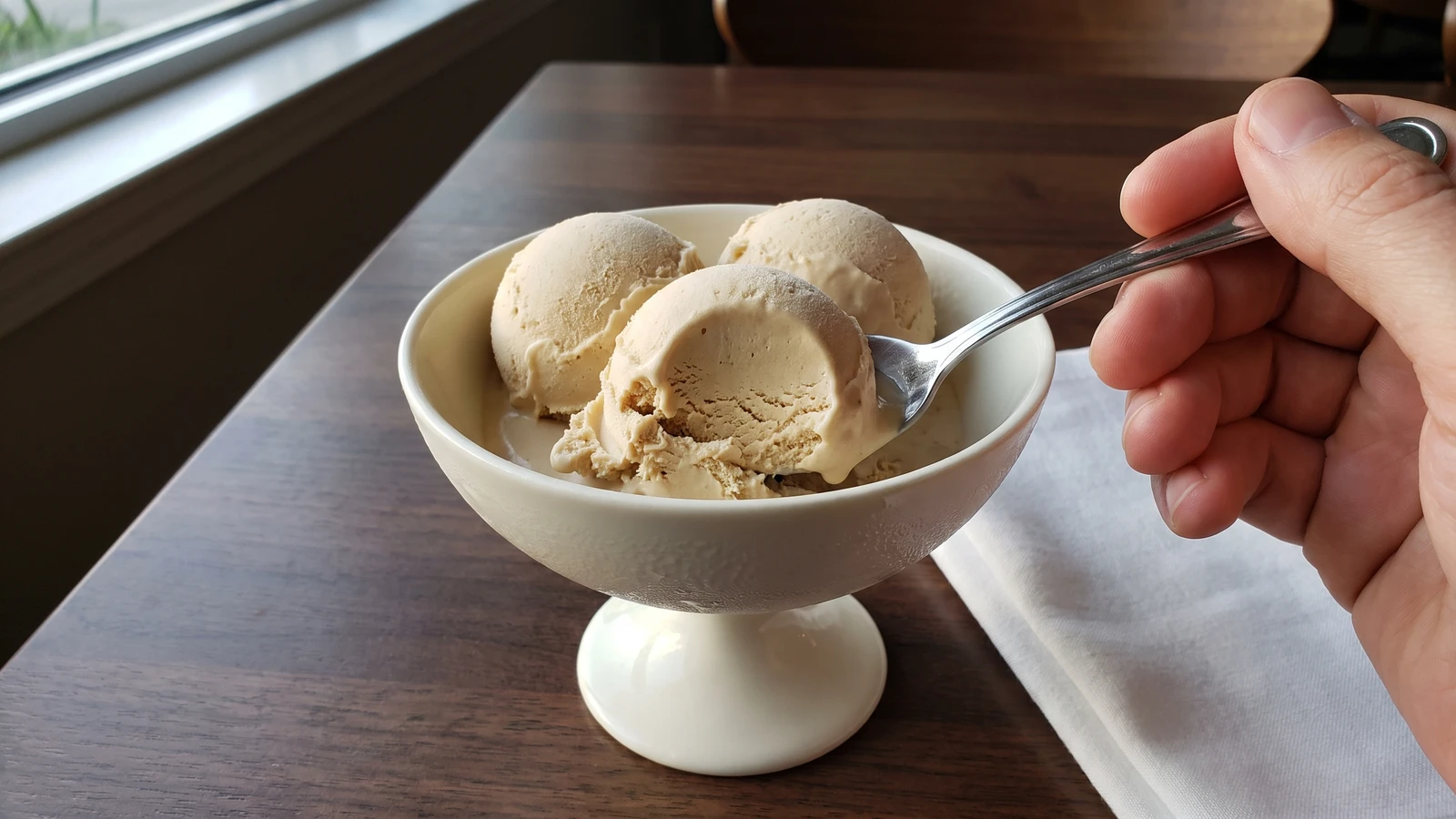
Glace au thé turns one forceful, brief infusion into a pale, silky custard ice, fragrant before it is sweet and firm enough to scoop generously after dinner.
Glace au thé (tea ice cream) teaches one true thing before you touch the pan: strength comes from more tea, not more time. Brew the leaves hard and short, then strain them cleanly. A long steep extracts tannin, and cold does not hide that dry bitterness; it sharpens it.
The classical entry's brief instruction, "make the preparation in the usual way," assumed a pâtisserie where the custard formula was muscle memory, the batch was generous, and a salt-and-ice freezing pail stood ready. This version scales the liquid to one cup of tea and one and a half cups of boiled milk, holding the original two-to-three ratio exactly, while six yolks and 135 grams of sugar make the assumed custard explicit. The large batch and freezing pail were brigade scaffolding, so a saucepan and countertop churn replace them. The brief infusion, boiled milk, yolk custard, and churning are the dish, and they stay. One cook, one stove, one evening's work, with the freezer doing the waiting.
The finished glace au thé should be pale café au lait, softly dense, and fragrant the instant its surface begins to yield beneath the spoon. It tastes of tea first, dairy second, with sweetness holding the two together. The decisive step is the infusion: three minutes, then the leaves come out.
Glace au thé belongs to the Paris confectioner's repertoire, where tea left the salon cup for custards and frozen entremets as ice work became a regular branch of pâtisserie. Its strict proportion, two measures of strong infusion to three of milk, corrects the notion that this is vanilla ice cream merely scented with tea: tea forms part of the liquid foundation, and its clean extraction governs the dish.
Quantity
1¼ cups (300 ml / 300 g)
freshly boiled
Quantity
6 tablespoons (90 ml / 18 g)
Quantity
1½ cups (360 ml / 370 g)
Quantity
6
Quantity
⅔ cup (160 ml / 135 g)
| Ingredient | Quantity |
|---|---|
| waterfreshly boiled | 1¼ cups (300 ml / 300 g) |
| loose-leaf plain black tea, preferably Assam or Ceylon | 6 tablespoons (90 ml / 18 g) |
| whole milk | 1½ cups (360 ml / 370 g) |
| large egg yolks | 6 |
| granulated sugar | ⅔ cup (160 ml / 135 g) |
Freeze the removable bowl of the ice-cream maker until completely solid, following its instructions, usually for at least 24 hours. Set a 1-quart freezer container in the freezer as well. A properly cold bowl freezes the base while beating in fine air bubbles; a merely chilly one gives you sweet soup.
Pour the freshly boiled water over the tea and steep for exactly 3 minutes. Strain at once through a fine-mesh sieve without pressing the leaves, since squeezing releases the tannin you have carefully avoided. Measure exactly 1 cup (240 ml / 240 g) of strong infusion; the extra brewing water accounts for what the leaves retain, and if you are a little short, top it up with just-boiled water. If the tea has stood beyond 4 minutes and leaves your mouth dry, brew it again. More leaf gives strength. More time gives bitterness.
Pour the whole milk into a medium saucepan and bring it just to a full boil over medium heat, stirring across the bottom so it cannot scorch. Pull it from the heat the instant it rises, then stir in the measured strong tea. This preserves the source formula's exact sequence and its ratio of two measures tea to three measures boiled milk.
Whisk the yolks and sugar in a heatproof bowl until smooth and slightly lighter, without beating in a great head of foam. Pour in one-third of the hot tea and milk in a thin stream while whisking constantly, then whisk in the remainder. This gradual tempering raises the yolks' temperature without scrambling them.
Return everything to the rinsed saucepan. Cook the crème anglaise (pouring custard) over low heat, stirring constantly with a flexible spatula and sweeping the corners, until it reaches 180 to 183°F (82 to 84°C). This is cuire à la nappe, cooking until the custard coats the back of a spoon and a finger drawn through it leaves a clean path. Never let it boil. If fine curds appear, take the pan off the heat immediately, strain the custard into a cold bowl, and blend it briefly until smooth. Ça se rattrape.
Set the bowl of custard over a larger bowl of ice water and stir until thoroughly cold, then cover directly against the surface and refrigerate for at least 2 hours. Fast cooling stops the cooking and protects the tea's clean perfume. The base should be no warmer than 40°F (4°C) before churning.
Strain the cold base once more, then churn it according to the machine's instructions until thick, softly mounded, and holding the trail of the paddle, usually 20 to 30 minutes. If it still sloshes after 30 minutes, stop rather than grinding on. Return the base to the refrigerator, freeze the bowl completely, and churn again later.
Pack the glace au thé into the frozen container, pressing parchment directly against its surface, and freeze for 3 to 4 hours until scoopable but firm. Because this is a milk custard rather than a cream-heavy ice, it sets with a clean, close texture. Let it stand at room temperature for 8 to 10 minutes before serving in generous scoops. À table!
1 serving (about 105g)
Culinary guides, cultural storytelling, and the editorial depth that makes cooking meaningful.
Discover Culinary ExplorerChef Juliette
Five almond preparations, one discipline: remove the skins cleanly, dry every kernel through, then cut, toast, or cloak it in pale caramel without letting its fragrant oils escape.

Chef Juliette
A pastry pantry lesson in one tray: filberts warmed only until their red skins release, rubbed clean, cooled, and chopped into a fragrant mise-en-place for cakes, creams, pralines, and petits fours.

Chef Juliette
The smallest pâtisserie discipline decides whether a cake leaves its mould intact: clarified butter in every corner, followed by the lightest veil of dry flour or fécule.

Chef Juliette
Four whites, one spotless bowl, and a patient change of speed: whisk gently until loosened, then briskly to glossy stiffness, with powdered sugar waiting if the foam begins to granulate.