Culinary Explorer

A cooking platform built around craft, culture, and the stories behind what we eat.
Discover Culinary Explorer
Walnut Ice-cream

Walnut Ice-cream

Created by Chef Juliette

Based on No. 2753, Walnut Ice-cream, from Le Guide Culinaire (1907) by Auguste Escoffier

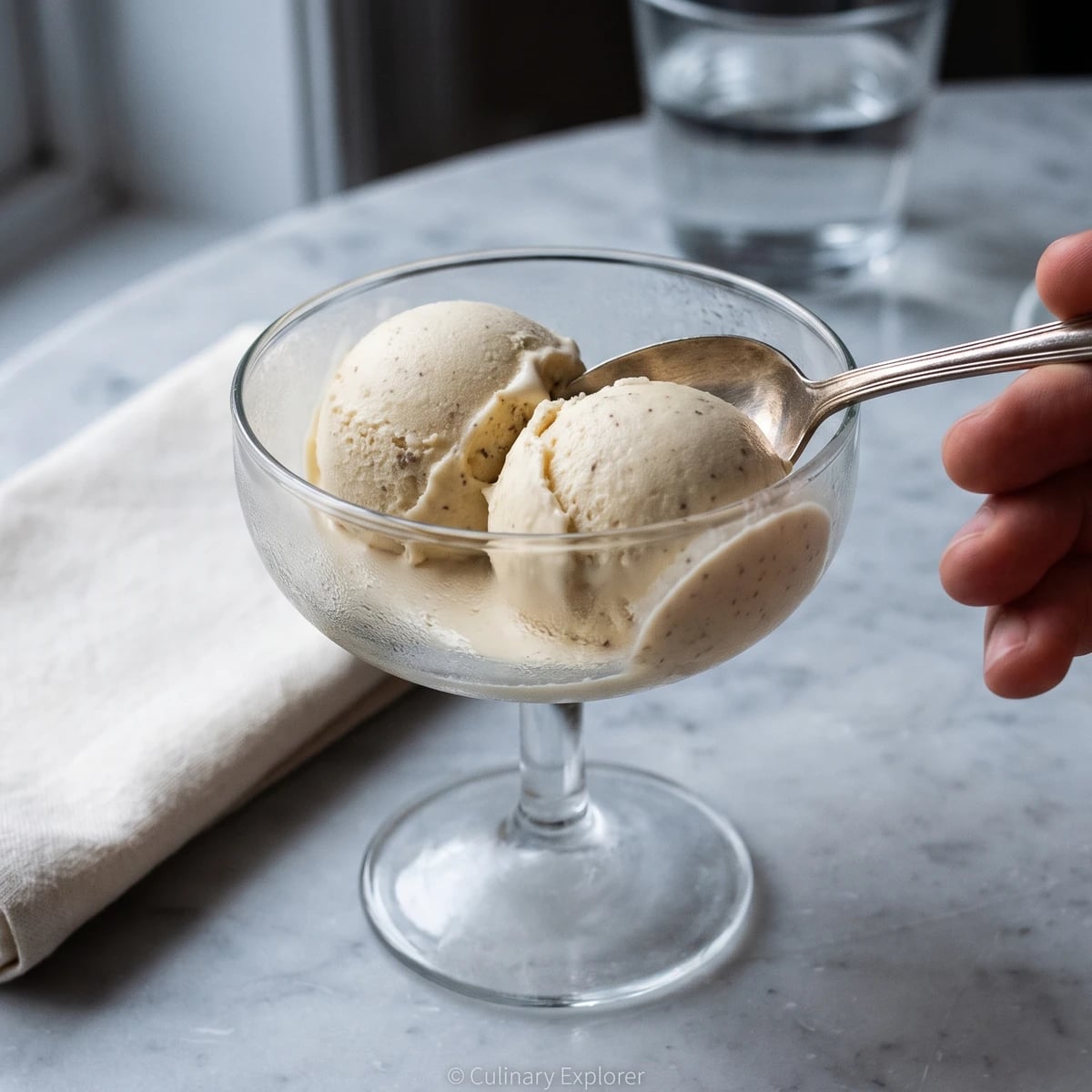
Glace aux noix turns peeled walnuts, boiling milk, and a gentle crème anglaise into pale, deeply nutty ice cream. Remove every bitter skin, then the custard and freezer can do their quiet work.

Desserts
French
Make Ahead
Comfort Food
Freezer Friendly
45 min
Active Time
30 min cook8 hr total
YieldAbout 1 quart (8 servings)

Glace aux noix (walnut ice cream) teaches one uncompromising thing: the walnut's thin brown pellicle must come off. The flesh beneath is sweet, milky, and quietly aromatic. The bitterness many cooks mistake for walnut strength belongs to the skin, and no amount of sugar can make that bitterness elegant.

The source entry assumes a cook who already knows the house crème glacée base, a mortar ready for pounding, and someone available to turn a salt-and-ice freezer. It records the flavoring operation precisely: three and a half ounces of peeled walnuts, a few spoonfuls of water, and twenty minutes in boiling milk. Here, the unwritten crème anglaise, the stirred custard base, is made explicit and scaled to about one quart. A mini processor replaces the mortar, and an electric churn replaces the attendant at the freezer. That is brigade scaffolding. The peeled walnut paste and its full twenty-minute infusion are the dish, and they stay exactly where they belong.

One cook, one stove, one evening of attention, then the freezer takes over. Keep the custard gentle, and if it begins to grain, ça se rattrape. Before you touch the pan, settle in to remove every last patch of walnut skin. That patient peeling is the step that decides the glace aux noix.

Glace aux noix belongs to the national repertoire of French glaciers and confiseurs, while its defining nut has strong homes in Dauphiné around Grenoble and in Périgord, two walnut countries with distinct tables. Professional formulas often recorded only the perfumed-milk operation because the crème glacée base and hand-turned freezing were understood workshop grammar. The insistence on peeling corrects a stubborn misconception: good walnut ice cream tastes round and milky, not bitter from the brown pellicle.

The technique, the tradition, and the story behind every dish.

Discover Culinary Explorer

Ingredients

raw walnut kernels

Quantity

1 cup (240 ml / 100 g)

shelled, with every brown skin removed

cool water

Quantity

3 tablespoons (45 ml / 45 g)

whole milk

Quantity

2 cups (480 ml / 495 g)

large egg yolks

Quantity

5

granulated sugar

Quantity

¾ cup (180 ml / 150 g)

heavy cream

Quantity

1 cup (240 ml / 238 g)

cold

fine sea salt

Quantity

¼ teaspoon (1.25 ml / 1.5 g)

Equipment Needed

  • Small paring knife
  • Mortar and pestle or mini food processor
  • 2-quart heavy saucepan
  • Instant-read thermometer
  • Fine-mesh sieve
  • Immersion blender
  • Ice cream maker
  • 1-quart freezer container

Instructions

  1. 1

    Peel the walnuts

    Drop the walnut kernels into a small pan of boiling water and blanch them for 60 to 90 seconds. Drain a few at a time, keeping the rest warm, then rub away the loosened brown pellicle with a clean towel and lift stubborn patches with the tip of a small paring knife. Return any obstinate kernel to the hot water rather than scraping away its flesh. Spread the peeled walnuts on a towel and pat them dry. Do not toast them; the source calls for their pale, milky flavor, not roasted depth.

    Peel while the walnuts are warm. Once cold, the skins tighten again and turn a patient job into an argument.
  2. 2

    Pound to a paste

    Put the peeled walnuts in a mortar or mini food processor. Add the cool water one tablespoon at a time and pound or process, scraping frequently, until the nuts become a very fine ivory paste with no pieces larger than coarse sand. Stop before the walnut oil forms a separate slick. If it begins to separate, add one spoonful of the measured milk and work briefly until the paste comes together again. Ça se rattrape.

  3. 3

    Infuse the milk

    Bring the whole milk to a full boil in a heavy saucepan, stirring across the bottom so it cannot scorch. The moment it rises, remove it from the heat and whisk in the walnut paste. Cover and leave it undisturbed for exactly 20 minutes. This infusion is not brigade scaffolding and cannot be hurried; it draws the walnut's perfume and oil into the milk without cooking the nuts harshly.

  4. 4

    Cook the crème anglaise

    Whisk the egg yolks, sugar, and salt in a heatproof bowl until smooth and slightly pale. Reheat the infused milk until it trembles at the edge, then pour it into the yolks a little at a time while whisking. Return everything to the saucepan and cook over low heat, stirring constantly across the floor and into the corners, until the crème anglaise reaches 79 to 82°C and coats the back of a spoon. The walnut paste gives the mixture body before the yolks are fully cooked, so trust the thermometer as well as your eye. Never let it boil. At the first sign of graininess, take it off the heat, whisk in ¼ cup of the measured cold cream, blend briefly with an immersion blender, and strain at once. Ça se rattrape before the yolks become firm curds.

  5. 5

    Strain and chill

    Pass the custard through a fine-mesh sieve into a clean bowl, pressing the walnut pulp gently but thoroughly with the back of a ladle. Discard the dry, fibrous residue. Whisk in all the cold cream, or the remainder if some was used to rescue the custard. Set the bowl over ice and stir until completely cool, then cover and refrigerate for at least 4 hours. A thoroughly cold base freezes quickly and forms smaller ice crystals; a merely cool one churns heavy and coarse.

  6. 6

    Churn until dense

    Churn the cold base in an ice cream maker according to its instructions, usually 20 to 25 minutes, until it holds soft folds and has the density of thick crème fraîche. Do not wait for it to become hard in the machine. Overchurning warms the mixture and can leave butter grains on the tongue.

    Without a machine, pour the base into a shallow metal pan and freeze it, beating vigorously every 30 minutes while scraping the frozen edges into the center. Repeat until evenly frozen, about 3 hours. The texture will be denser, but the walnut flavor remains true.
  7. 7

    Harden and serve

    Pack the churned glace aux noix into a shallow freezer container, press parchment directly against the surface, cover, and freeze for at least 3 hours. Let it stand at room temperature for 8 to 10 minutes before scooping. It should be pale ivory, finely textured, and supple enough to curl from the scoop rather than crumble. Serve it generously and without decoration. À table!

Chef Tips

  • Buy the freshest walnuts you can and taste one before beginning. A rancid walnut smells of old oil and stays rancid under sugar and cream; technique can refine a modest nut, but it cannot restore a spoiled one.
  • The brown pellicle is not a harmless cosmetic layer. It carries the tannic bitterness that spoils this delicate infusion, so blanch, peel, and rewarm stubborn kernels until every patch is gone.
  • Do not toast the walnuts. Toasted walnut ice cream can be pleasant, but it is another formula. This one depends on the clean, almost milky perfume of peeled raw kernels.
  • Chill the custard until it is cold all the way through before churning. If time allows, leave it overnight; the walnut flavor becomes rounder and the texture freezes more finely.
  • Keep the finished ice cream tightly covered with parchment against its surface. It is best within one week, before freezer odors and oxidation flatten the walnut's delicate aroma.

Advance Preparation

  • The walnuts can be blanched and peeled one day ahead. Dry them well, seal them airtight, and refrigerate until you are ready to pound them.
  • The strained custard base can be refrigerated for up to 24 hours before churning. This rest deepens the infusion and ensures the base is thoroughly cold.
  • Churn and harden the glace aux noix the day before serving. Let it soften for 8 to 10 minutes before scooping.

Frequently Asked Questions

Nutrition Information

1 serving (about 135g)

Calories
330 calories
Total Fat
24 g
Saturated Fat
10 g
Trans Fat
0 g
Unsaturated Fat
13 g
Cholesterol
170 mg
Sodium
115 mg
Total Carbohydrates
25 g
Dietary Fiber
1 g
Sugars
23 g
Protein
6 g

Note: Chef personas and recipes are created with AI assistance. Cook with care: follow safe food-handling practices, check doneness with a thermometer when needed, and adapt for allergies and your kitchen.

Where cooking meets culture.

Culinary guides, cultural storytelling, and the editorial depth that makes cooking meaningful.

Discover Culinary Explorer

More from Ices and Sherbets

Browse the full collection