
Chef Juliette
Various Almond Preparations
Five almond preparations, one discipline: remove the skins cleanly, dry every kernel through, then cut, toast, or cloak it in pale caramel without letting its fragrant oils escape.
A cooking platform built around craft, culture, and the stories behind what we eat.
Created by Chef Juliette
Based on No. 2752, Chocolate Ice-cream, from Le Guide Culinaire (1907) by Auguste Escoffier
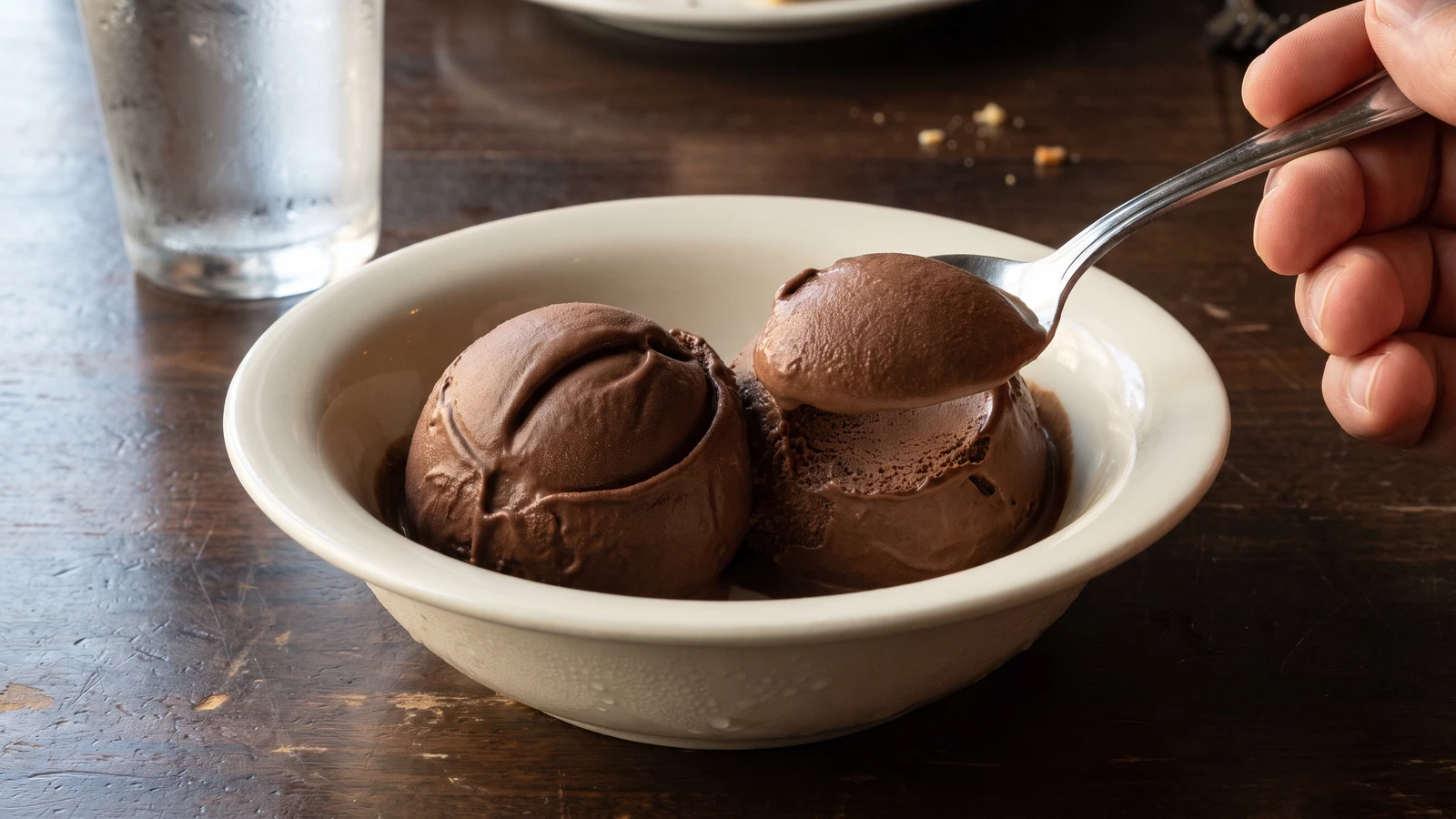
Glace au chocolat turns vanilla-scented milk custard and water-dissolved chocolate into a dark, satin-smooth scoop, proof that careful tempering and a cold base matter more than cream.
Glace au chocolat (French chocolate ice cream) teaches one true thing before you touch a pan: smooth frozen custard begins with heat controlled to the degree. Chocolate gives the base depth and body, but the yolks give it its fine texture, and once they enter the saucepan the mixture must thicken without boiling.
The original formula assumed a full quart of milk and an attendant turning a sorbetière packed with ice and salt. Here its quantities are halved exactly for a standard home ice-cream machine, including the unusual half yolk, because a one-quart batch freezes more evenly and leaves room for expansion. The brigade's hand-turning and elaborate moulding were scaffolding, so they can go. Dissolving the grated chocolate in water, infusing the milk with vanilla, cooking the yolk custard, and chilling it completely are the dish, so they stay. One cook, one stove, one evening.
The finished glace is dark, dense, and satiny rather than cream-heavy, with vanilla rounding the chocolate instead of announcing itself. The moment that decides it comes at the custard pan: cook à la nappe, until it coats the spoon, then stop before the first bubble.
Glace au chocolat belongs to the confectioners and café tables of Paris, where frozen creams moved from elaborate service into the broader bourgeois repertoire as the sorbetière became familiar household equipment. Classical French versions often relied on milk, egg yolks, sugar, and cacao butter rather than added cream, producing a clear chocolate flavour with a close, dense texture. The water is not dilution or error: it first disperses the grated chocolate into a smooth foundation before the vanilla-infused milk and custard are joined to it.
Quantity
1 cup (240 ml / 113 g)
finely grated
Quantity
1/2 cup (120 ml / 120 g)
Quantity
2 cups (480 ml / 495 g)
Quantity
1/2
split lengthwise
Quantity
1/2 cup plus 1 tablespoon (135 ml / 113 g)
Quantity
3 yolks plus half of a fourth (about 3 1/2 tablespoons / 52 ml / 63 g)
whisk the fourth yolk separately and use half, about 1 1/2 teaspoons or 9 g
| Ingredient | Quantity |
|---|---|
| sweet dark chocolate, 55 to 65% cacaofinely grated | 1 cup (240 ml / 113 g) |
| water | 1/2 cup (120 ml / 120 g) |
| whole milk | 2 cups (480 ml / 495 g) |
| large vanilla beansplit lengthwise | 1/2 |
| granulated sugar | 1/2 cup plus 1 tablespoon (135 ml / 113 g) |
| large egg yolkswhisk the fourth yolk separately and use half, about 1 1/2 teaspoons or 9 g | 3 yolks plus half of a fourth (about 3 1/2 tablespoons / 52 ml / 63 g) |
Freeze the bowl of your ice-cream machine according to its instructions, usually for at least 24 hours, unless you use a compressor machine. Set a clean bowl over a larger bowl of ice water and place a fine-mesh sieve nearby. Measure three whole yolks, then whisk the fourth separately and add half of it, about 1 1/2 teaspoons or 9 g, to the others. This preserves the source ratio without asking the home churn to hold a brigade batch.
Put the whole milk and split vanilla bean in a medium saucepan. Bring the milk just to the boil over medium heat, watching for the first rise around the edge, then remove it immediately, cover, and infuse for 20 minutes. Lift out the vanilla bean, scrape its seeds into the milk, and discard the pod or rinse and dry it for vanilla sugar.
While the milk infuses, bring the water to a bare simmer in a second saucepan. Add the grated chocolate by handfuls, whisking after each addition until it dissolves into a smooth, dark emulsion. Keep the heat low and continue whisking for 2 to 3 minutes, with no dry flecks remaining. If it tightens or looks grainy, take it off the heat and whisk in a spoonful of the warm infused milk; ça se rattrape. Do not proceed until the chocolate is perfectly smooth.
Blanchir, meaning whisk until pale, the yolks and sugar in a heatproof bowl for 2 to 3 minutes. The mixture should become thick enough to fall from the whisk in a slow ribbon. Whisk promptly once sugar touches yolk, because sugar left sitting on their surface draws out moisture and forms stubborn little grains.
Gradually whisk the hot vanilla milk into the dissolved chocolate, keeping the emulsion smooth. Pour one-third of this hot chocolate mixture into the yolks while whisking constantly, then return everything to the saucepan. Cook over low to medium-low heat, stirring continuously with a flexible spatula and sweeping the bottom and corners, until the crème anglaise, a stirred custard, reaches 82 to 84°C (180 to 183°F) and coats the spatula in an even film. This is à la nappe. Draw a finger through the coating; the line should remain clean. Never let it boil. At the first sign of tiny curds, remove the pan, set it in the ice bath, and blend briefly before straining. Ça se rattrape if you act at once; a custard allowed to boil into firm curds cannot be restored by a sieve.
Immediately strain the custard into the bowl set over ice water, stirring until it loses its warmth and falls below 10°C (50°F). Press reusable wrap or baking parchment directly onto the surface and refrigerate for at least 2 hours, or overnight, until thoroughly cold at 4°C (40°F) or below. A lukewarm base freezes slowly and grows coarse crystals; chilling is not waiting-room business, it is part of the technique.
Whisk the cold base briefly to restore an even texture, then churn according to your machine's instructions until it has the body of thick soft ice cream, usually 20 to 30 minutes. Transfer it promptly to a chilled one-quart container, press parchment directly against the surface, cover, and freeze for about 3 hours for firm scoops. If it becomes very hard after longer storage, leave it at room temperature for 8 to 12 minutes before serving. Dense is correct; icy is not. À table!
1 serving (about 110g)
Culinary guides, cultural storytelling, and the editorial depth that makes cooking meaningful.
Discover Culinary ExplorerChef Juliette
Five almond preparations, one discipline: remove the skins cleanly, dry every kernel through, then cut, toast, or cloak it in pale caramel without letting its fragrant oils escape.

Chef Juliette
A pastry pantry lesson in one tray: filberts warmed only until their red skins release, rubbed clean, cooled, and chopped into a fragrant mise-en-place for cakes, creams, pralines, and petits fours.

Chef Juliette
The smallest pâtisserie discipline decides whether a cake leaves its mould intact: clarified butter in every corner, followed by the lightest veil of dry flour or fécule.

Chef Juliette
Four whites, one spotless bowl, and a patient change of speed: whisk gently until loosened, then briskly to glossy stiffness, with powdered sugar waiting if the foam begins to granulate.