Chef Juliette
The Making of Ices
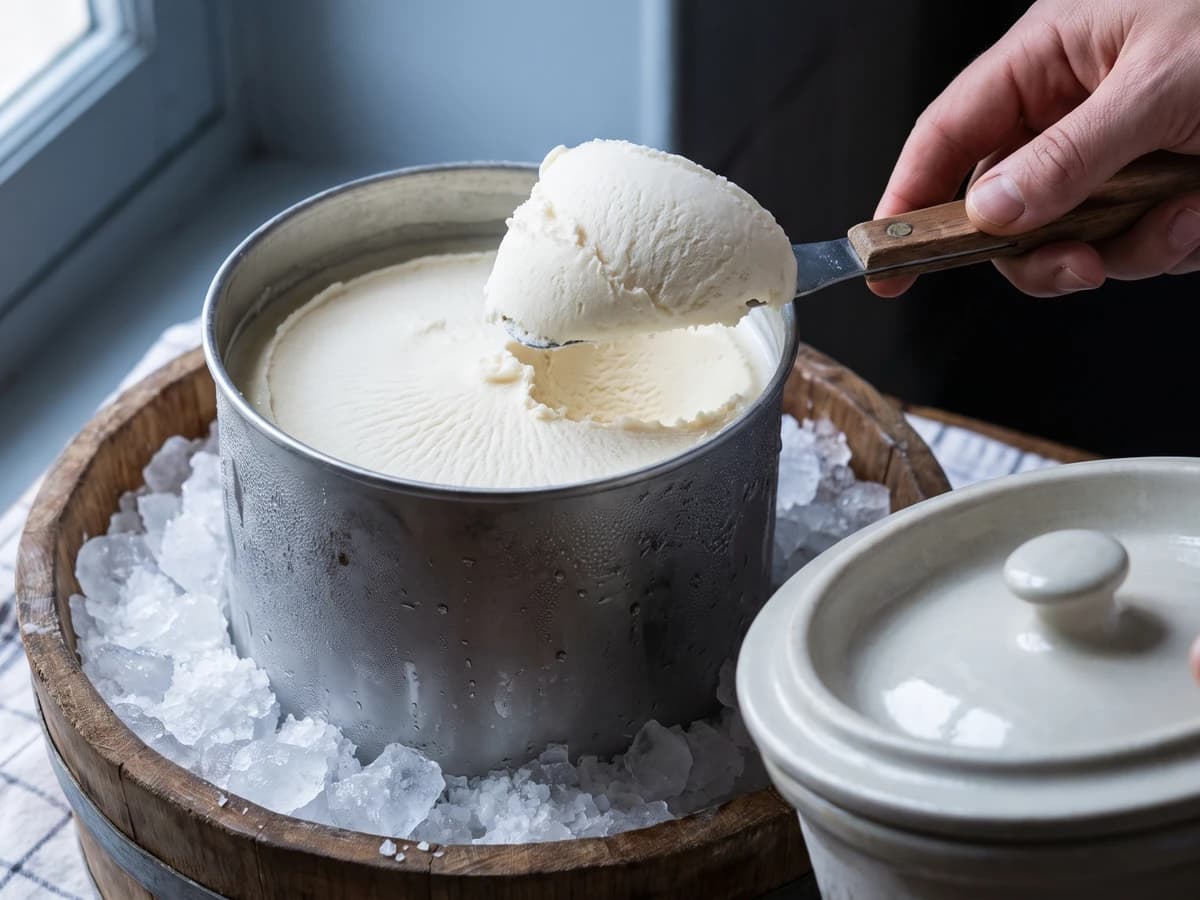
Freezing is the recipe: pack ice hard with salt, keep the canister moving, and scrape each frozen film into the base until the Glaces turn smooth, fine, and homogeneous.
A cooking platform built around craft, culture, and the stories behind what we eat.

Created by Chef Juliette
Based on No. 2746, Preparations for Simple Ices, from Le Guide Culinaire (1907) by Auguste Escoffier
One cream base, one fruit-syrup base, and the classical rule beneath both: sugar and yolks set the texture before the freezer does, so measure first and churn only when the balance is right.
Préparations pour glaces simples (bases for simple ices) teach the rule beneath the whole frozen repertoire: sugar is structure, not merely sweetness. In a glace à la crème, yolks and sugar keep the frozen milk supple and give it body. In a fruit ice, syrup performs the same work while letting the fruit remain clear and direct. Reduce the sugar and the ice freezes harder and cleaner; raise it, with the yolks in the cream family, and the texture grows softer and creamier.
The original kitchen assumed a pâtissier tending several mixtures, a saccharometer for reading syrup density, and a sorbetière packed with salt and ice. At home, a digital scale, a cold-saucer test, and one countertop churn give us the same control. I have set the cream preparation at a working average within the source's wide range and reduced both families to a single one-quart batch. The dedicated station and constant instrument readings were brigade scaffolding and can go; the measured proportions, the gentle custard, and the complete chilling before churning are the dish and must stay. One cook, one stove, one evening.
Choose one family for each batch and do not combine the ingredient groups. The step that matters most is the freezer test before churning: it tells you whether the balance will produce a soft scoop or a frozen brick while there is still time to correct it. If the balance is wrong, ça se rattrape.
In the French classical kitchen, simple ices were codified most clearly in Parisian confectionery and the pastry rooms of grand households, where dozens of flavors were organized around two working families: egg-enriched milk and fruit mixed with syrup. That system passed naturally to the bourgeois home table because changing the flavor did not require learning a new method each time. The saccharometer readings described concentration rather than a single ideal sweetness, since ripe fruit, tart fruit, and custard bases each freeze differently.
Quantity
2 cups (480 ml / 495 g)
Quantity
3/4 cup (180 ml / 150 g)
Quantity
5 (about 1/3 cup / 90 g)
Quantity
2 cups (480 ml / about 500 g)
strained smooth
Quantity
1 cup (240 ml / 240 g)
Quantity
1 cup (240 ml / 200 g)
| Ingredient | Quantity |
|---|---|
| whole milk, for the cream base | 2 cups (480 ml / 495 g) |
| granulated sugar, for the cream base | 3/4 cup (180 ml / 150 g) |
| large egg yolks, for the cream base | 5 (about 1/3 cup / 90 g) |
| strained unsweetened ripe fruit purée, for the fruit-syrup basestrained smooth | 2 cups (480 ml / about 500 g) |
| water, for the fruit-syrup base | 1 cup (240 ml / 240 g) |
| granulated sugar, for the fruit-syrup base | 1 cup (240 ml / 200 g) |
Make either the cream base or the fruit-syrup base. Do not combine the two ingredient groups. Freeze the ice-cream machine canister fully before beginning, or set a shallow stainless-steel pan in the freezer if you will work by hand. Put a small metal saucer in the freezer as well; it will become your home equivalent of the pastry kitchen's density test.
For the cream base, whisk the yolks with half the sugar until smooth and slightly lightened. Heat the milk with the remaining sugar until small bubbles gather around the edge, about 175°F (80°C), then pour one-third of it into the yolks in a thin stream while whisking. Return everything to the saucepan and cook over low heat, stirring constantly across the floor and corners, until the crème anglaise reaches à la nappe, thick enough to coat a spoon, at 175 to 180°F (80 to 82°C). Never let it boil. If fine curds appear, pull the pan from the heat, stand its base in cold water, whisk hard, and strain immediately. Ça se rattrape, provided you stop the cooking at once.
For the fruit-syrup base, combine the water and sugar in a clean saucepan. Warm gently, stirring only until every crystal dissolves, then bring the syrup to a quiet simmer for one minute. If sugar crystals form around the sides, cover the pan for one minute so condensation washes them down. If the syrup grains despite this, add 2 tablespoons (30 ml / 30 g) water and dissolve it again over gentle heat rather than throwing it away. Cool the syrup completely, then whisk it into the strained fruit purée until uniform.
Strain the chosen base into a stainless-steel bowl set over ice and stir until thoroughly cold. Cover and refrigerate for at least 1 hour, until no warmer than 40°F (4°C). Spoon 1 tablespoon onto the frozen saucer and return it to the freezer for 10 minutes. It should scrape into soft curls while holding a clear groove. If it freezes hard, dissolve 1 tablespoon (15 ml / 13 g) sugar in 1 tablespoon (15 ml / 15 g) hot water, cool it, stir it into the base, and test again. If the sample remains loose and syrupy, stir 1 tablespoon (15 ml / 15 g) cold milk into the cream base, or the same amount of cold water into the fruit base, then retest. This adjustment is the work once done by the saccharometer, translated for the home freezer.
Pour the cold base into the running ice-cream machine and churn until it swells slightly, holds ridges, and resembles very soft ice cream, usually 20 to 30 minutes. Stop when the paddle begins leaving a firm channel; continuing beyond that point warms the mixture without improving it. Without a machine, pour the base into the frozen shallow pan, freeze for about 40 minutes, and beat the firm edges into the softer center with a sturdy whisk. Repeat every 30 minutes three or four times. The hand-frozen ice will have a slightly coarser grain, but the balance and flavor remain honest.
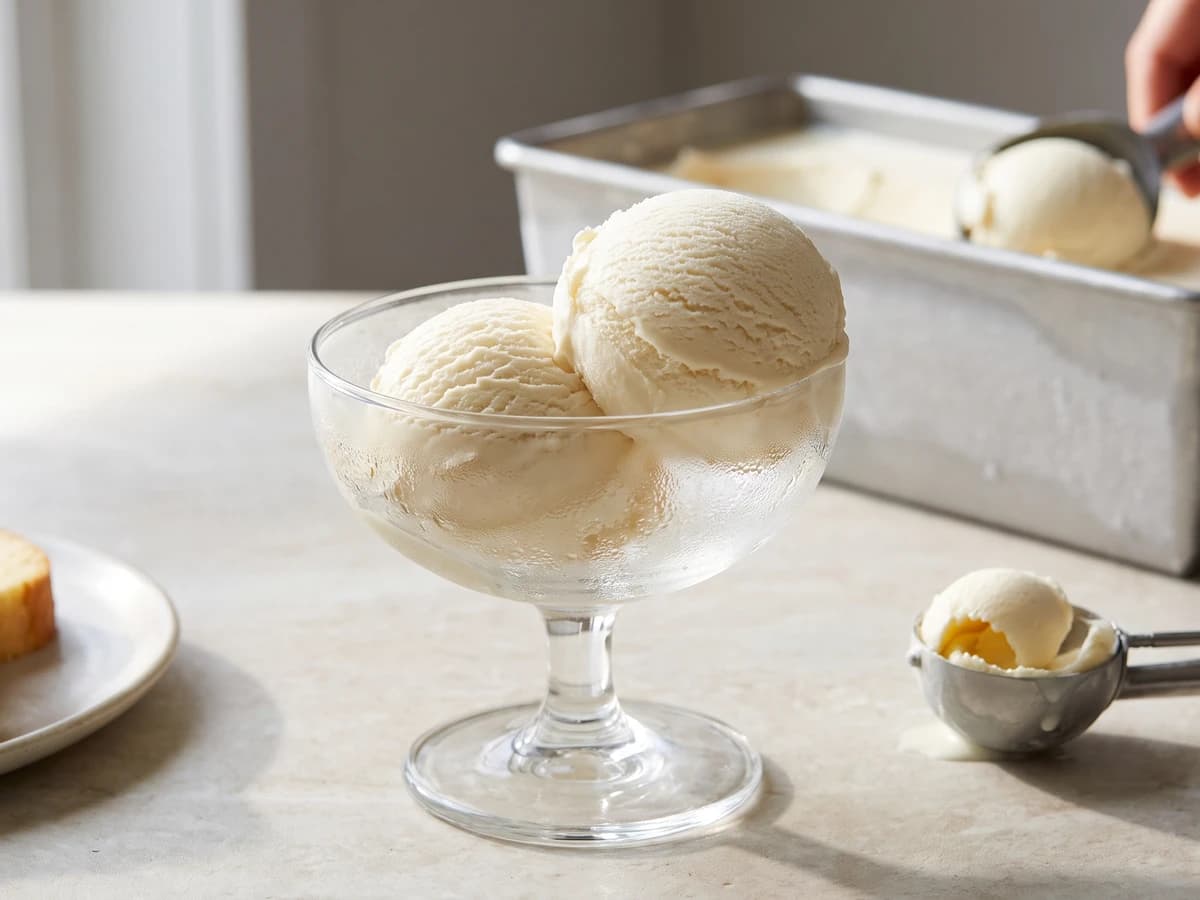
Pack the churned ice into a chilled 1-quart container, press parchment directly against the surface, cover, and freeze for about 3 hours, until firm enough to scoop. Let it stand in the refrigerator for 15 to 20 minutes before serving. If it has frozen harder than intended, do not attack it with a hot spoon; give it another 10 minutes in the refrigerator and scrape the softened edges toward the center. Serve the cream ice smooth and ivory, or the fruit ice bright and clean. À table!
1 serving (about 90g)
Culinary guides, cultural storytelling, and the editorial depth that makes cooking meaningful.
Discover Culinary ExplorerChef Juliette
Freezing is the recipe: pack ice hard with salt, keep the canister moving, and scrape each frozen film into the base until the Glaces turn smooth, fine, and homogeneous.

Chef Juliette
Pack a prepared glace until no air remains, harden it under salted ice, and turn it out with one quick tepid dip: clean fluting, a close surface, and no hollow pockets.
Chef Juliette
The custard beneath every French cream ice: yolks and sugar drawn to the ribbon, hot milk added slowly, then gentle heat until the spoon wears a satin veil and never a bubble.

Chef Juliette
Sweet almonds give body and five bitter almonds give perfume in this milk custard, infused for twenty minutes, cooked to nappe, then churned pale and silken.