
Chef Juliette
Various Almond Preparations
Five almond preparations, one discipline: remove the skins cleanly, dry every kernel through, then cut, toast, or cloak it in pale caramel without letting its fragrant oils escape.
A cooking platform built around craft, culture, and the stories behind what we eat.
Created by Chef Juliette
Based on No. 2735, Œufs à la Neige, from Le Guide Culinaire (1907) by Auguste Escoffier
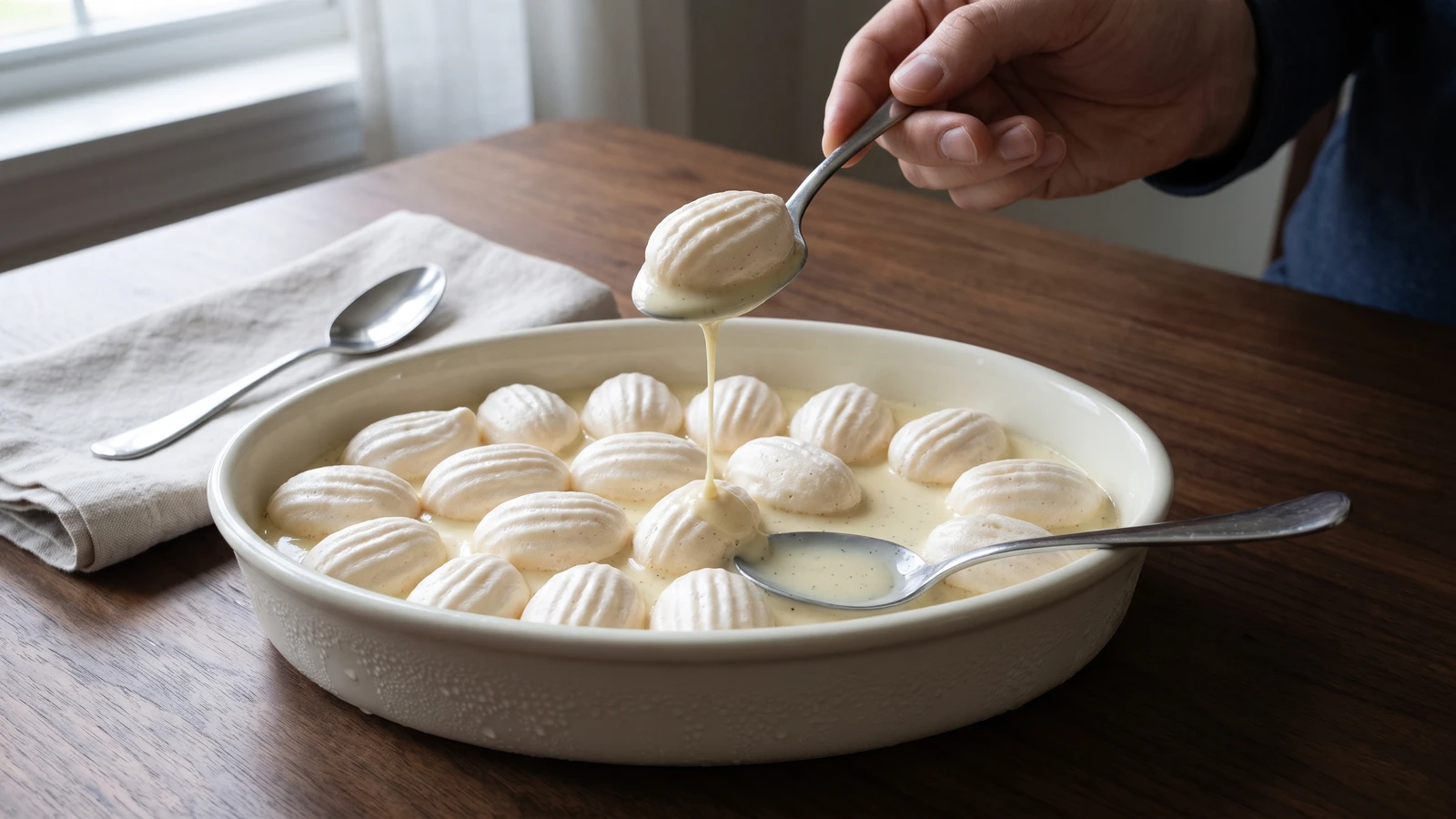
Pearly spoon-shaped meringues poached in vanilla milk, then covered with a very cold crème anglaise made from that same milk and six yolks. Gentle heat gives you both textures; a boil spoils them.
Œufs à la Neige (snow eggs) teaches the gentlest heat in the custard repertoire. The one true thing to know before you touch a pan is that the vanilla milk must shiver, never boil: at that tremble it sets the meringue without tearing it, then thickens around the yolks into crème anglaise, a pouring custard, without scrambling them. C'est la même grammaire in two textures, one fragrant milk, and six eggs used with good sense.
The original entry assumes Ordinary Meringue already waiting from the pastry section, a broad sauté pan watched without interruption, muslin for straining, and a tazza for presentation. For one cook, one stove, one evening, the eight-white reference is scaled to three quarters, matching six whites to the six yolks so nothing is wasted while its proportions remain intact. A fine-mesh sieve replaces the muslin, and a shallow chilled serving dish replaces the tazza. Those are service scaffolding and can go; the referenced meringue, two-spoon shaping, milk poach, and same-milk custard are the dish, and all stay.
When it is right, the meringues are pearly and softly resilient, with faint ridges left by the spoons, while the custard lies cold and satin-smooth beneath them. Keep the milk at a tremble during both the poach and the custard, because heat control is the step that decides the dish.
Œufs à la neige belongs to Parisian cuisine bourgeoise and the wider French family table, where generations of cooks made one economical dessert from separated eggs: whites poached in sweetened milk, then yolks used to thicken that same milk into crème anglaise. Grand kitchens refined the spoon shaping and service on a tazza, but the logic remained domestic and thrifty. The name is now often exchanged with île flottante, yet œufs à la neige precisely describes individual egg-shaped meringues poached in milk; that distinction carries the technique.
Quantity
3/4 batch Ordinary Meringue (No. 2382)
freshly prepared from 6 large egg whites and kept light
Quantity
3 cups plus 2 tablespoons (750 ml / 770 g)
Quantity
1/3 cup (80 ml / 70 g)
Quantity
1
split lengthwise and seeds scraped
Quantity
6
| Ingredient | Quantity |
|---|---|
| Ordinary Meringuefreshly prepared from 6 large egg whites and kept light | 3/4 batch Ordinary Meringue (No. 2382) |
| whole milk | 3 cups plus 2 tablespoons (750 ml / 770 g) |
| caster sugar | 1/3 cup (80 ml / 70 g) |
| vanilla beansplit lengthwise and seeds scraped | 1 |
| large egg yolks | 6 |
Put the milk, sugar, vanilla seeds, and pod into a wide sauté pan. Warm them gently until the sugar dissolves and the surface gives a quiet shiver, with tiny bubbles gathering at the rim but no rolling boil. Take the pan off the heat, cover it, and leave the vanilla to infuse for 10 minutes. Remove the pod, then return the milk to the gentlest heat.
Set the Ordinary Meringue (No. 2382) beside the stove and place a fine-mesh sieve over a tray. Dip two soup spoons in hot water and shake them nearly dry. Scoop up a rounded spoonful of meringue and pass it between the spoons three times to form an egg-shaped oval, then lower it directly into the milk. Shape five or six per batch, leaving room for them to swell. Hold the milk between 80 and 85°C, still shivering rather than boiling, and poach for about 90 seconds. Turn each meringue gently, poach the second side for another 60 to 90 seconds, then lift it into the sieve without pressing. Continue until you have about 18 meringues. If the milk boils and their edges begin to fray, pull the pan off the heat at once, skim away the loose fragments, and lower the flame before continuing. Ça se rattrape: the ragged ones will still drain, chill, and eat beautifully.
After the final batch, take the pan off the heat and strain the poaching milk through the fine-mesh sieve into a jug, removing every meringue fragment. This sieve is the honest home equivalent of muslin. Rinse the pan. Whisk the six yolks in a heatproof bowl just until smooth, then pour in about one third of the hot vanilla milk in a thin stream while whisking continuously. Return this tempered mixture to the remaining milk and pour everything back into the clean pan.
Set the pan over low heat and stir constantly with a flat-edged spoon or flexible spatula, sweeping the floor and corners so no yolk can settle there. Cook until the crème anglaise reaches 82 to 84°C and coats the back of the spoon; draw a finger through it, and the line should remain clean. Never let it boil. If the first fine grains appear, lift the pan straight into an ice bath and whisk firmly until smooth, then strain at once. Ça se rattrape when caught early. Firm scrambled curds mean the heat went too far.
Strain the crème anglaise into a clean bowl set over ice and stir until cool. Press reusable wrap or parchment directly against its surface and refrigerate for at least 4 hours, until very cold. Let the drained meringues cool uncovered in a single layer, then cover them loosely and chill separately. Keeping the two parts apart prevents the meringues from drinking the custard and losing their shape.
Whisk the cold crème anglaise briefly to restore its satin texture. Arrange the chilled meringues in a shallow porcelain serving dish, three per person, then pour the custard generously around and over them as the original entry directs. Serve at once, with no caramel or decorative business to distract from the vanilla, milk, and eggs. À table!
1 serving (about 245g)
Culinary guides, cultural storytelling, and the editorial depth that makes cooking meaningful.
Discover Culinary ExplorerChef Juliette
Five almond preparations, one discipline: remove the skins cleanly, dry every kernel through, then cut, toast, or cloak it in pale caramel without letting its fragrant oils escape.

Chef Juliette
A pastry pantry lesson in one tray: filberts warmed only until their red skins release, rubbed clean, cooled, and chopped into a fragrant mise-en-place for cakes, creams, pralines, and petits fours.

Chef Juliette
The smallest pâtisserie discipline decides whether a cake leaves its mould intact: clarified butter in every corner, followed by the lightest veil of dry flour or fécule.

Chef Juliette
Four whites, one spotless bowl, and a patient change of speed: whisk gently until loosened, then briskly to glossy stiffness, with powdered sugar waiting if the foam begins to granulate.