Culinary Explorer

A cooking platform built around craft, culture, and the stories behind what we eat.
Discover Culinary Explorer
Melon Frappe

Melon Frappe

Created by Chef Juliette

Based on No. 2729, Melon Frappe, from Le Guide Culinaire (1907) by Auguste Escoffier

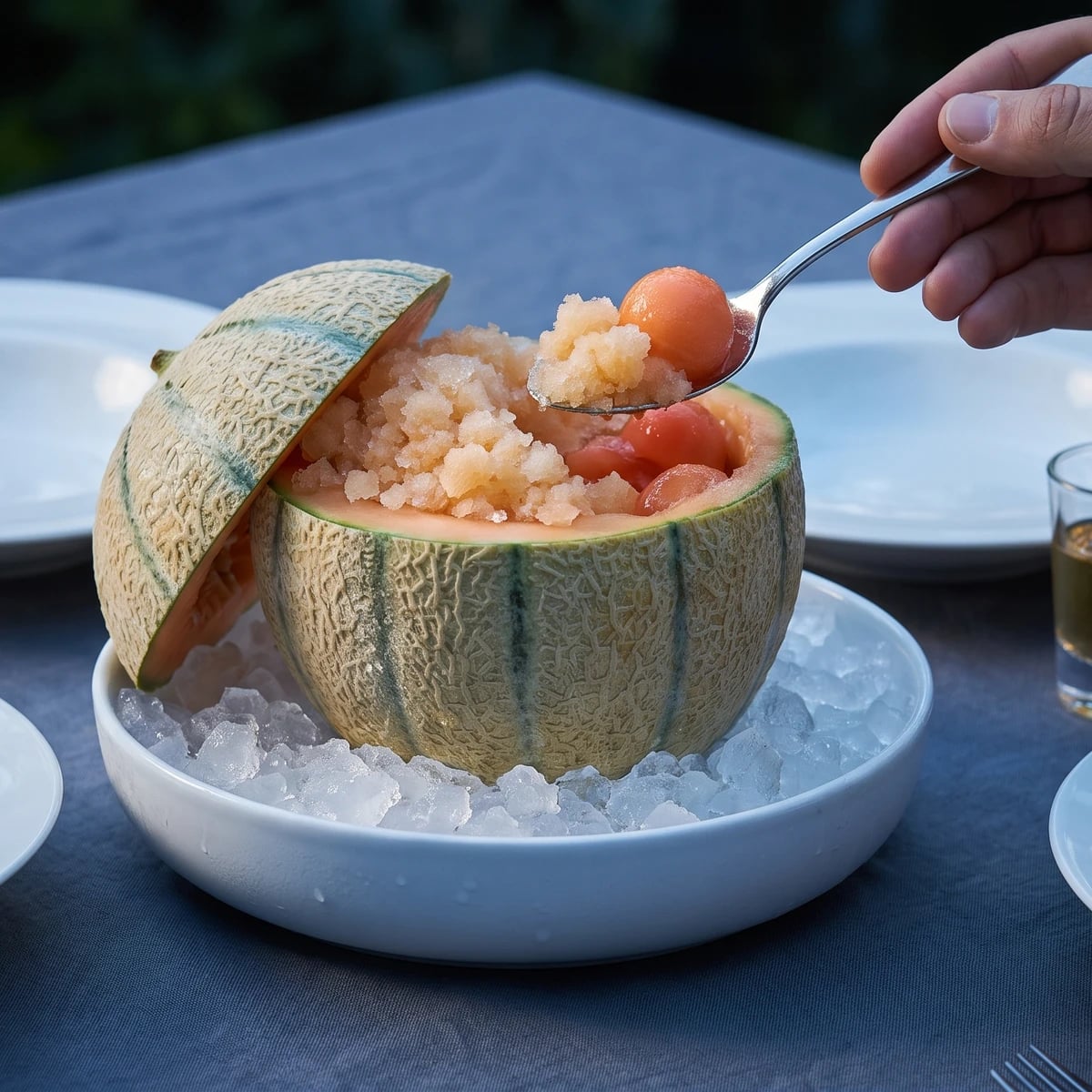
Melon frappé sets two textures of ripe fruit against each other: light melon granité and juicy maraschino-macerated pulp, layered inside the chilled rind and spooned onto cold plates.

Desserts
French
Outdoor Dining
Dinner Party
Special Occasion
20 min
Active Time
0 min cook50 min total
Yield4 servings

Melon frappé (layered frozen melon) teaches the discipline of leaving cold fruit alone. The one true thing is this: never stir a granité as it freezes, because it turns dense and smooth instead of setting into a light, granulated mass. One melon becomes that ice, the other stays juicy under a little sugar and maraschino, and the contrast is the dish.

The classical cold pantry assumed a tammy for sieving the fruit, ample freezing space, iced plates, and a spare pair of hands to carve an ornamental block of ice. At home, the finished Granités (No. 2930) comes from its separate preparation, a fine-mesh sieve replaces the tammy, and an ordinary bowl of crushed ice holds the melon securely. The carved block was service scaffolding, so it goes. The chilled shell, cold plates, maceration, and alternating layers are the dish, so they stay. One cook, one stove, one evening.

Layer only at the last moment, while the melon pieces are cold and glossy and the granité remains loose. If the ice is too hard, wait a few minutes and flake it gently rather than beating it. Ça se rattrape. The step that decides everything is still the same one: freeze the granité untouched, then handle it as little as possible.

Melon frappé belongs to the grand-service dining rooms of Paris, where fruit ices often closed the meal and the cold pantry sent them out in their own rinds over carved ice. Its defining combination is simpler than its presentation suggests: very ripe raw melon, lightly macerated in wine or liqueur, set against a thin granité with no meringue to blur the fruit. Home service exchanged carved blocks for bowls of crushed ice, but the cold shell, iced plates, and alternating textures kept the dish recognizably itself.

The technique, the tradition, and the story behind every dish.

Discover Culinary Explorer

Ingredients

Granités

Quantity

About 2 cups (480 ml / about 450 g) Granités (No. 2930)

prepared from the entire sieved pulp of 1 very ripe medium melon and fully frozen

very ripe medium cantaloupe or Charentais melon

Quantity

1

chilled

superfine sugar

Quantity

2 tablespoons (30 ml / 25 g)

maraschino liqueur, Port, clear Curaçao, rum, or kirsch

Quantity

3 tablespoons (45 ml / about 45 g)

crushed ice

Quantity

6 cups (1.4 L / about 800 g)

divided

Equipment Needed

  • Sharp paring knife
  • Stainless-steel dessert spoon
  • Two nesting bowls for the ice bath
  • Slotted spoon
  • Low serving bowl for the crushed ice
  • Four shallow dessert plates or bowls

Instructions

  1. 1

    Chill the service

    Put four shallow dessert plates or bowls in the refrigerator. Fill a large bowl with about one-third of the crushed ice and nest a smaller bowl inside it for the melon pulp. Reserve the remaining ice for supporting the finished shell. Cold service is not decoration here; it keeps the first spoonful as granular as the last.

  2. 2

    Open and hollow

    Cut a neat round cap around the stalk end of the chilled melon, angling the knife slightly inward so the cap will sit securely when replaced. Lift it away, scrape the seeds and loose fibres from both the cavity and cap, then use a stainless-steel dessert spoon to remove the flesh in irregular bite-sized pieces without piercing the rind. Set the emptied shell and cap in the refrigerator for 30 minutes.

  3. 3

    Macerate the pulp

    Place the melon pieces in the bowl nested over ice. Sprinkle over the sugar, add the maraschino or your chosen wine or liqueur, and fold gently until every piece is lightly glossed. Leave the pulp on ice for 20 to 30 minutes, folding only once. If the melon releases a puddle of juice, lift the pieces out with a slotted spoon and carry only enough syrup to coat them; excess liquid would melt the granité. Ça se rattrape.

    Maceration should perfume and gloss the fruit, not collapse it. Stop at 30 minutes if the melon is exceptionally soft.
  4. 4

    Ready the granité

    Bring the fully frozen Granités (No. 2930) from the freezer only when the shell has completed its chilling time. It should be a light, granulated mass. If it is too firm to lift, leave it at room temperature for 3 to 5 minutes, then loosen flakes gently from the edges with a fork. Never beat or stir it smooth. If it softens too far, return it to the freezer until the edges firm again.

    A churned sorbet is not an equivalent here. The loose granules are what distinguish the frozen melon from the juicy pieces.
  5. 5

    Layer without packing

    Nest the cold melon shell upright in a low serving bowl filled with the reserved crushed ice. Spoon in a loose layer of granité, then a layer of drained macerated melon. Continue alternating until the shell is full, finishing with granité. Work lightly and never press the layers down, because compacting crushes the granular texture you protected during freezing. Replace the melon cap.

  6. 6

    Spoon onto cold plates

    Carry the capped melon to the table over its bed of crushed ice. Remove the cap and spoon downward through several layers so each serving receives both granular ice and glossy melon pulp. Serve immediately on the chilled plates, with no added garnish to distract from the perfume of the fruit. À table!

Chef Tips

  • The melons must smell ripe before you cut them and yield slightly at the blossom end. This preparation has nowhere to hide a hard, watery fruit; if the market's melons are poor, wait for the season rather than increasing the sugar.
  • Choose one wine or liqueur, never a mixture. Maraschino keeps the flavor bright and floral, kirsch is drier, Curaçao brings orange, rum is rounder, and Port makes the fruit darker and more vinous.
  • Modern stainless steel replaces the silver spoon without changing the fruit. Use a spoon rather than a melon baller, because the original wants natural pieces that hold a little syrup between them.
  • Assemble immediately before serving. Once layered, the maceration syrup begins softening the granité, and no amount of theatrical carved ice can argue with that.

Advance Preparation

  • Prepare the Granités (No. 2930) separately earlier the same day and keep it fully frozen. The stated total time begins with that finished component already available.
  • The whole serving melon and dessert plates may be chilled several hours ahead. Hollow the melon and macerate its pulp no more than 30 minutes before assembly.
  • Do not assemble the layers ahead. The finished melon should move from crushed ice to the table as soon as its cap is replaced.

Frequently Asked Questions

Nutrition Information

1 serving (about 440g)

Calories
130 calories
Total Fat
0 g
Saturated Fat
0 g
Trans Fat
0 g
Unsaturated Fat
0 g
Cholesterol
0 mg
Sodium
35 mg
Total Carbohydrates
28 g
Dietary Fiber
2 g
Sugars
27 g
Protein
2 g

Note: Chef personas and recipes are created with AI assistance. Cook with care: follow safe food-handling practices, check doneness with a thermometer when needed, and adapt for allergies and your kitchen.

Where cooking meets culture.

Culinary guides, cultural storytelling, and the editorial depth that makes cooking meaningful.

Discover Culinary Explorer

More from Entremets (Sweets) - Cold Fruit Entremets

Browse the full collection