
Chef Juliette
Various Almond Preparations
Five almond preparations, one discipline: remove the skins cleanly, dry every kernel through, then cut, toast, or cloak it in pale caramel without letting its fragrant oils escape.
A cooking platform built around craft, culture, and the stories behind what we eat.
Created by Chef Juliette
Based on No. 2692, Oranges en Surprise, from Le Guide Culinaire (1907) by Auguste Escoffier
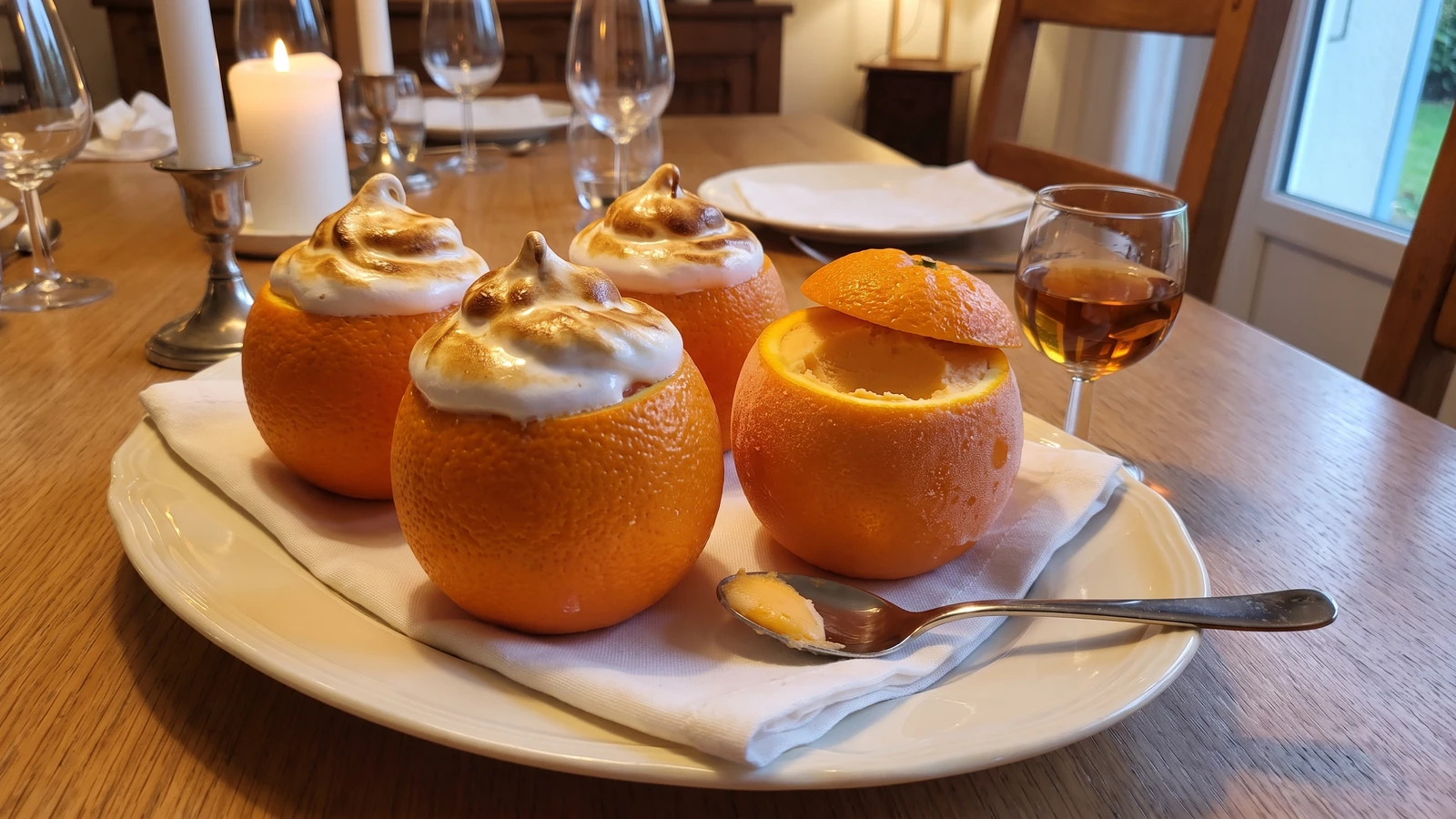
Orange ice hidden in its own shell, mantled with Meringue à l’Italienne (No. 2383) and bronzed under fierce heat in seconds: a frozen dessert whose elegance rests entirely on speed.
Oranges en Surprise (oranges with a hidden frozen centre) teaches one thing: hot colour, cold heart. The meringue must bronze before the heat finds the orange ice. Everything else is staging.
The original kitchen could reach for orange ice already churning, Meringue à l’Italienne (No. 2383), a cooked meringue stable enough for this blast of heat, a pulled-sugar hand, and a fierce oven with the speed of a salamander. At home, the broiler provides that concentrated heat, while a metal tray packed with crushed ice shields the frozen shells. The pulled-sugar leaves and stalks go because they are brigade decoration, not flavour. The orange shell, orange ice, meringue, crushed-ice protection, and last-second browning are the dish, so every one of those stays.
This is entirely manageable for one cook, one stove, one evening. Before you touch the saucepan, clear level freezer space and learn where your broiler runs hottest. The filled oranges must be frozen hard and the broiler fully blazing before the two meet.
Oranges en Surprise belongs to the Parisian grande cuisine repertoire of frozen entremets, where en surprise signalled a concealed centre revealed only when the guest broke through the outer form. Here the surprise is technical as well as visual: a natural orange shell hides orange ice beneath a browned mantle, while broken ice buys the kitchen the seconds needed to colour it. As the dish travelled from formal dining rooms to bourgeois celebration tables, the pulled-sugar foliage was often lost, but the brief encounter between fierce heat and a frozen centre remained its identity.
Quantity
4 large (about 2½ lb / 1.1 kg total), yielding about 1⅓ cups (320 ml / 320 g) strained juice
scrubbed and chilled
Quantity
1
insurance for a split shell
Quantity
½ cup (120 ml / 100 g)
Quantity
⅓ cup (80 ml / 80 g)
Quantity
¼ batch, about 2 cups (480 ml / 175 g), Meringue à l’Italienne (No. 2383)
cooled and ready to use
Quantity
8 cups (1.9 L / about 1.3 kg)
| Ingredient | Quantity |
|---|---|
| large orangesscrubbed and chilled | 4 large (about 2½ lb / 1.1 kg total), yielding about 1⅓ cups (320 ml / 320 g) strained juice |
| extra orange (optional)insurance for a split shell | 1 |
| granulated sugar | ½ cup (120 ml / 100 g) |
| water | ⅓ cup (80 ml / 80 g) |
| Meringue à l’Italiennecooled and ready to use | ¼ batch, about 2 cups (480 ml / 175 g), Meringue à l’Italienne (No. 2383) |
| coarsely crushed ice | 8 cups (1.9 L / about 1.3 kg) |
Cut a lateral slice from the top of each orange, taking off roughly one-quarter of its height, and reserve these lids intact. Run a small knife just inside the pith, then ease out the flesh with a grapefruit spoon without piercing the peel. Leave the white pith lining in place because it strengthens and insulates the shell. Squeeze the removed flesh gently, strain the juice, and measure 1⅓ cups (320 ml / 320 g). Set the empty shells and lids upright in the freezer.
Combine the sugar and water in a small saucepan and bring them just to a simmer, stirring only until the syrup turns completely clear. Simmer for one minute, then cool it fully. Stir the cold syrup into the strained orange juice. Taste it cold: it should seem slightly sweeter than you want at the table because freezing mutes sweetness and aroma.
Churn the orange mixture in an ice cream maker until thick and softly frozen, usually 20 to 25 minutes, then transfer it to a shallow container and freeze until firm. Without a machine, pour it into a shallow metal pan and freeze, beating it vigorously with a fork every 30 minutes until the crystals are fine and the mixture holds a scoop, about 3 to 4 hours. If it freezes into a hard, grainy slab, don't discard it. Ça se rattrape: soften it for 10 minutes, scrape or beat it thoroughly, and freeze it again.
Let the orange ice soften only until it can be packed, not until it runs. Spoon it firmly into the frozen orange shells, pressing out air pockets and levelling the surface at the cut rim. Return the filled shells and their lids to the freezer for at least 1 hour, until everything is hard at the centre. If the ice yields beneath a fingertip, wait. A soft centre cannot survive the broiler.
Working with one frozen orange at a time, spread the cooled Meringue à l’Italienne (No. 2383) over the exposed orange ice in a generous layer about ½ inch (1.25 cm) thick. Seal it cleanly against the cut edge and shape broad swirls with the back of a spoon. Return each orange to the freezer as soon as it is covered, then freeze all four for at least 20 minutes. If the covering slides or softens, stop and refreeze the orange before smoothing it again.
Set an oven rack about 3 inches (8 cm) below the broiler and preheat the broiler at its highest setting for a full 10 minutes. Fill a rimmed metal tray with the coarsely crushed ice, the home equivalent of the book's broken ice, and nestle the frozen oranges upright in it. Slide the tray beneath the heat and watch without looking away. The Meringue à l’Italienne (No. 2383) must brown before the heat finds the orange ice, usually within 30 to 60 seconds. Rotate the tray if one side colours first. If the crowns remain pale while their bases begin to soften, pull the tray immediately, refreeze the oranges for 20 minutes, and try again with a hotter broiler or a slightly closer rack.
Lift the oranges from the ice and close each one with its frozen reserved lid, resting it slightly askew so a little of the bronzed crown remains visible. Arrange them at once on a chilled platter lined with a clean folded napkin, which steadies the round shells just as the original service intended. Serve immediately, while the outside is newly coloured and the orange ice remains firm. À table!
1 serving (about 160g)
Culinary guides, cultural storytelling, and the editorial depth that makes cooking meaningful.
Discover Culinary ExplorerChef Juliette
Five almond preparations, one discipline: remove the skins cleanly, dry every kernel through, then cut, toast, or cloak it in pale caramel without letting its fragrant oils escape.

Chef Juliette
A pastry pantry lesson in one tray: filberts warmed only until their red skins release, rubbed clean, cooled, and chopped into a fragrant mise-en-place for cakes, creams, pralines, and petits fours.

Chef Juliette
The smallest pâtisserie discipline decides whether a cake leaves its mould intact: clarified butter in every corner, followed by the lightest veil of dry flour or fécule.

Chef Juliette
Four whites, one spotless bowl, and a patient change of speed: whisk gently until loosened, then briskly to glossy stiffness, with powdered sugar waiting if the foam begins to granulate.