
Chef Juliette
Various Almond Preparations
Five almond preparations, one discipline: remove the skins cleanly, dry every kernel through, then cut, toast, or cloak it in pale caramel without letting its fragrant oils escape.
A cooking platform built around craft, culture, and the stories behind what we eat.
Created by Chef Juliette
Based on No. 2665, Pudding Or “Crème Reine des Fées”, from Le Guide Culinaire (1907) by Auguste Escoffier
Quince-scented Meringue à l’Italienne (No. 2383) buttons, kirsch-soaked candied fruit, and alternating vanilla and pink Curaçao bavarois make a celebration pudding whose feather-light set depends on double cream, restrained gelatine, and calm chilling.
Crème Reine des Fées (Fairy Queen pudding) teaches restraint in a molded cream. Its bavarois, molded custard creams, contain twice the ordinary proportion of whipped cream and only half the usual gelatine. One true thing matters before you touch a pan: the two bases must be cool enough not to melt the cream, yet fluid enough to settle into even layers.
The original assumed a pâtissier tending several preparations, a broad pan holding four quarts of poaching syrup, and a scalloped Madeleine-mould buried in cracked ice. At home, one neutral custard is divided and flavored two ways, a wide sauté pan holds a smaller quantity of syrup at the original ratio, and a narrow chilled mold sits in a tray of ice. Making two separate custards was brigade scaffolding, so that goes. The quince Meringue à l’Italienne (No. 2383), its syrup poaching, and the unusually creamy, lightly gelled bavarois are the dish itself, so they stay. One cook, one stove, one evening.
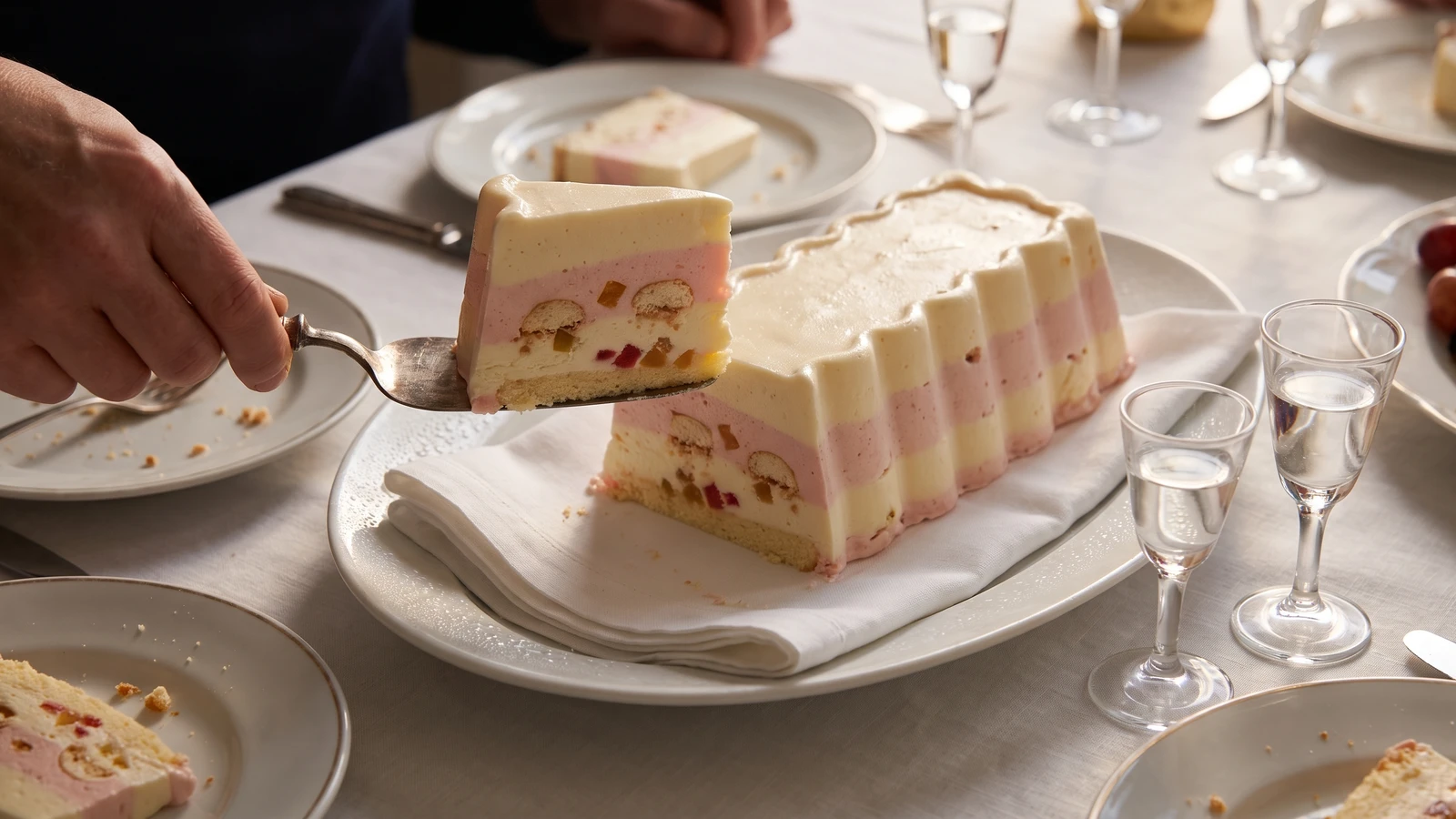
Cut through the finished pudding and you find ivory vanilla, shell-pink Curaçao, and soft quince-kirsch buttons carrying little flashes of candied fruit. The step that decides it is cooling both bavarois bases until they just begin to thicken before folding in the cream. Watch that moment and the layers will hold without becoming rubbery.
Crème Reine des Fées belongs to the Parisian grand-kitchen repertoire of named cold entremets, where bavarois were layered in ornamental molds for celebration tables. Its fanciful title and scalloped Madeleine-mould mark banquet practice rather than a regional farmhouse tradition, while quince jelly, Kirsch, candied fruit, vanilla, and Curaçao show the classical pantry using preserved fruit and liqueurs for contrast. The English label “pudding” can mislead: its construction is French, with poached Italian meringue held between unusually creamy, lightly gelled bavarois layers.
Quantity
¼ batch (about 1½ cups / 175 g) Meringue à l’Italienne (No. 2383)
prepared at the referenced quarter scale with 2 large egg whites
Quantity
½ cup (120 ml / 170 g)
Quantity
2 tablespoons (30 ml / 21 g)
cut into 5 mm dice
Quantity
1 tablespoon (15 ml / 14 g)
for macerating the candied fruit
Quantity
3 cups (720 ml / 720 g)
for the poaching syrup
Quantity
1 cup plus 1 tablespoon (255 ml / 215 g)
for the poaching syrup
Quantity
2 tablespoons (30 ml / 28 g)
for the poaching syrup
Quantity
1½ teaspoons (7.5 ml / 5 g)
Quantity
2 tablespoons (30 ml / 30 g)
for blooming the gelatine
Quantity
1 cup (240 ml / 245 g)
Quantity
4
Quantity
⅓ cup (80 ml / 65 g)
for the bavarois
Quantity
1 teaspoon (5 ml / 5 g)
Quantity
1 tablespoon (15 ml / 14 g)
Quantity
1 tiny drop
Quantity
2 cups (480 ml / 475 g)
at least 36% fat
Quantity
½ teaspoon (2.5 ml / 2 g)
for the mold
| Ingredient | Quantity |
|---|---|
| Meringue à l’Italienneprepared at the referenced quarter scale with 2 large egg whites | ¼ batch (about 1½ cups / 175 g) Meringue à l’Italienne (No. 2383) |
| firm quince jelly | ½ cup (120 ml / 170 g) |
| mixed candied fruitcut into 5 mm dice | 2 tablespoons (30 ml / 21 g) |
| Kirschfor macerating the candied fruit | 1 tablespoon (15 ml / 14 g) |
| waterfor the poaching syrup | 3 cups (720 ml / 720 g) |
| granulated sugarfor the poaching syrup | 1 cup plus 1 tablespoon (255 ml / 215 g) |
| Kirschfor the poaching syrup | 2 tablespoons (30 ml / 28 g) |
| powdered gelatine | 1½ teaspoons (7.5 ml / 5 g) |
| cold waterfor blooming the gelatine | 2 tablespoons (30 ml / 30 g) |
| whole milk | 1 cup (240 ml / 245 g) |
| large egg yolks | 4 |
| granulated sugarfor the bavarois | ⅓ cup (80 ml / 65 g) |
| vanilla bean paste | 1 teaspoon (5 ml / 5 g) |
| clear Curaçao | 1 tablespoon (15 ml / 14 g) |
| pink food coloring | 1 tiny drop |
| cold double cream or heavy whipping creamat least 36% fat | 2 cups (480 ml / 475 g) |
| neutral oilfor the mold | ½ teaspoon (2.5 ml / 2 g) |
Toss the diced candied fruit with the tablespoon of Kirsch and leave it for 30 minutes. Drain it with real care, then blot it on a clean cloth; loose liqueur would soften the meringue. Brush the inside of a 1.5-liter narrow scalloped mold or loaf pan with the thinnest film of neutral oil and chill it. You should see a sheen, not droplets.
Make the quarter batch of Meringue à l’Italienne (No. 2383) by its own method, with the adjustment belonging to this dish: add the quince jelly to that preparation’s sugar while the sugar cooks, matching the sugar’s bulk by volume. Do not alter the stage or pouring method given in the referenced preparation. At the last moment, fold in the carefully drained candied fruit. Pipe or spoon twelve broad buttons, about 5 cm across and 1.5 cm thick, onto a strip of baking parchment. If they spread instead of holding their shape, keep whisking until the meringue cools; if it remains loose, set the bowl over ice and whisk briefly. Ça se rattrape.
Combine the poaching water, sugar, and Kirsch in a wide 30 cm sauté pan and bring them to a full boil. Lower the parchment strip, meringue side up, onto the syrup, keeping your fingers well clear. As soon as the paper releases easily from the buttons, lift it away with tongs. Reduce the syrup to a lively simmer and poach the buttons for about 45 seconds, turn them gently, then give the second side another 30 seconds. If the syrup tears at their edges, pull the pan off the heat for 20 seconds before continuing. If a button clings to the paper, ladle hot syrup over its base and wait rather than pulling. Drain the poached meringues on a clean, lint-free linen cloth and let them cool completely.
Sprinkle the gelatine over the cold water and leave it to bloom for 5 minutes. Bring the milk just below a simmer. Whisk the yolks with the bavarois sugar until smooth, then pour in the hot milk gradually while whisking. Return everything to gentle heat and stir without pause until the custard reaches 82°C or 180°F and coats the spoon with a clear track when you draw a finger through it. Never let it boil. If it turns faintly grainy, remove it from the heat at once, blend briefly, and strain it into a clean bowl. Ça se rattrape before the eggs become firm curds. Stir in the bloomed gelatine until completely dissolved.
Divide the warm custard equally between two bowls. Stir the vanilla into one. Stir the Curaçao and the smallest drop of pink coloring into the other; it should be shell pink, not red. Cool both bowls, stirring occasionally, until the mixtures are no longer warm and have just begun to thicken. Whip the cold cream to soft, billowing peaks, divide it equally, and fold it into the two bases. The generous cream and restrained gelatine are deliberate: this pudding should hold softly, not bounce. If a base sets before the cream goes in, rest its bowl over lukewarm water and stir only until fluid again.
Spoon an even layer of vanilla bavarois into the chilled mold and set it over ice for 6 to 8 minutes, just until its surface can support the meringue without swallowing it. Arrange four cooled buttons over it, leaving a narrow margin at the sides. Add an equal layer of pink bavarois, chill until barely set, and repeat with four more buttons. Continue with vanilla, the remaining buttons, and a final pink layer, keeping the layers as even as you can. Each layer should be tacky when the next goes on; if it becomes firm, lightly roughen the surface with a fork so the layers bind rather than sliding apart.
Lay baking parchment directly over the mold and cover it with its lid or foil. Set it in a roasting pan, pack ice closely around the sides, and refrigerate for 2 hours. To serve, loosen the upper edge with a fingertip and invert the pudding onto a chilled platter covered with a clean, unscented white napkin. If it clings, wrap the mold for a few seconds in a cloth wrung out in warm water; prolonged heat will soften those delicate layers. Lift the mold straight upward, bring the pudding to the table immediately, and cut generous slices. À table!
1 serving (about 165g)
Culinary guides, cultural storytelling, and the editorial depth that makes cooking meaningful.
Discover Culinary ExplorerChef Juliette
Five almond preparations, one discipline: remove the skins cleanly, dry every kernel through, then cut, toast, or cloak it in pale caramel without letting its fragrant oils escape.

Chef Juliette
A pastry pantry lesson in one tray: filberts warmed only until their red skins release, rubbed clean, cooled, and chopped into a fragrant mise-en-place for cakes, creams, pralines, and petits fours.

Chef Juliette
The smallest pâtisserie discipline decides whether a cake leaves its mould intact: clarified butter in every corner, followed by the lightest veil of dry flour or fécule.

Chef Juliette
Four whites, one spotless bowl, and a patient change of speed: whisk gently until loosened, then briskly to glossy stiffness, with powdered sugar waiting if the foam begins to granulate.