Culinary Explorer

A cooking platform built around craft, culture, and the stories behind what we eat.
Discover Culinary Explorer
Pudding à la Richelieu

Pudding à la Richelieu

Created by Chef Juliette

Based on No. 2664, Pudding à la Richelieu, from Le Guide Culinaire (1907) by Auguste Escoffier

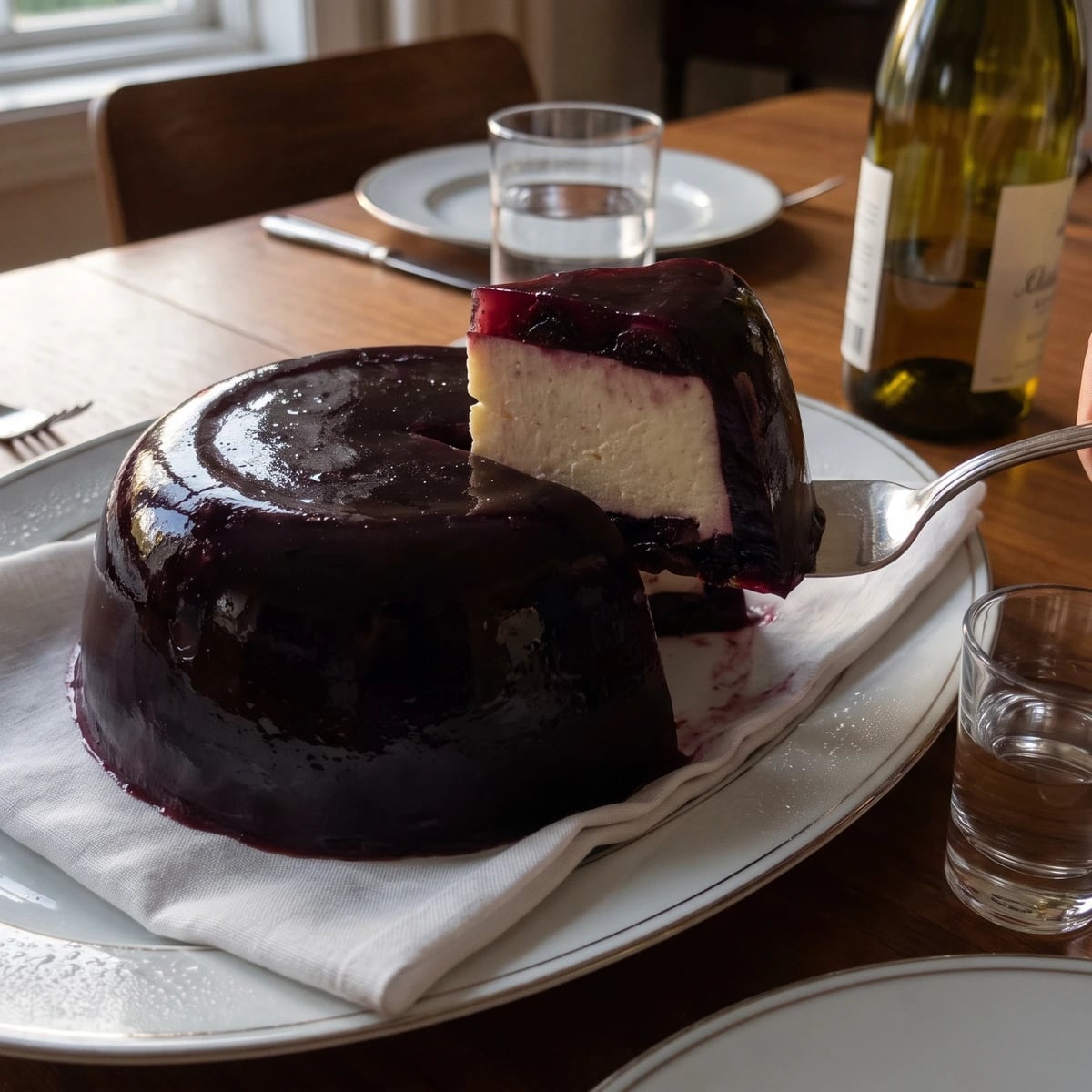
Dark prune and Kirsch jelly encloses a pale vanilla Bavarois in this composed cold pudding, where a second iced mould creates the hollow and a breath of warm water releases it.

Desserts
French
Special Occasion
Dinner Party
Make Ahead
1 hr
Active Time
40 min cook8 hr 30 min total
YieldOne 900 ml mould (6 servings)

Pudding à la Richelieu (a prune-and-Kirsch jelly shell around a vanilla cream custard) teaches that temperature, not force, controls a cold mould. The dark shell must set firmly around an iced inner mould, and that inner mould leaves only when tepid water loosens its skin. Pull at it and the shell tears. Warm it for a few seconds and it lifts cleanly. That is the one true thing to know before you touch a pan.

The grand pastry kitchen assumed very stiff clarified dessert jelly ready at hand, a matched Charlotte mould with a tinned insert and handles, and enough ice to keep every station cold. Your honest equivalent is powdered gelatin, a smooth 900 ml metal mould, and a tall stainless tumbler that leaves a 2 cm channel around itself. This version serves six, not a banquet. The brigade scaffolding goes, but the equal parts of prune purée, reduced prune juice, and Kirsch jelly stay, as do the iced insert and the vanilla Bavarois (custard lightened with whipped cream and set cold). Those are the dish. One cook, one stove, one evening.

The shell should taste of prune first, with Kirsch lifting it rather than shouting, while the center stays pale, soft, and vanilla-rich. Cool the Bavarois until it only begins to thicken before it enters the hollow. Warm filling melts the shell, while fully set filling leaves gaps. The decisive step is the release of the inner mould: tepid water, five seconds, then straight up.

Pudding à la Richelieu belongs to the formal Parisian entremets table, where the Richelieu name marked a composed presentation rather than the cooking of a particular region. Its gelée shell and Bavarois center passed from grand service into household dinner cookery as smooth metal moulds and reliable gelatin became familiar tools. Despite its name, this is neither a baked pudding nor prune jam in a mould: it is a cold, carefully cast dessert whose jelly is a firm Kirsch-scented preparation.

The technique, the tradition, and the story behind every dish.

Discover Culinary Explorer

Ingredients

pitted dried prunes

Quantity

1¼ packed cups (300 ml / 200 g)

cold water, for stewing the prunes

Quantity

3 cups (720 ml / 720 g)

cold water, for the Kirsch jelly

Quantity

⅓ cup plus 2 tablespoons (110 ml / 110 g)

unflavoured powdered gelatin, for the Kirsch jelly

Quantity

1 tablespoon plus 1 teaspoon (20 ml / 12 g)

caster sugar, for the Kirsch jelly

Quantity

¼ cup (60 ml / 50 g)

Kirsch

Quantity

2 tablespoons (30 ml / 28 g)

cold water, for the Bavarois

Quantity

1 tablespoon (15 ml / 15 g)

unflavoured powdered gelatin, for the Bavarois

Quantity

1¼ teaspoons (6 ml / 4 g)

whole milk

Quantity

½ cup (120 ml / 124 g)

vanilla bean

Quantity

½

split lengthwise

large egg yolks

Quantity

2

caster sugar, for the Bavarois

Quantity

3 tablespoons (45 ml / 38 g)

cold heavy cream

Quantity

½ cup (120 ml / 120 g)

crushed ice

Quantity

About 3 cups (720 ml / 500 g)

Equipment Needed

  • Smooth 900 ml metal Charlotte mould
  • Straight-sided stainless tumbler about 4 cm narrower than the outer mould and tall enough to project above its rim
  • Fine-mesh sieve and flexible scraper
  • Digital kitchen scale
  • Instant-read thermometer
  • Chilled serving platter and lint-free white napkin

Instructions

  1. 1

    Fit the moulds

    Choose a smooth 900 ml metal Charlotte mould and a tall, straight-sided stainless tumbler about 4 cm narrower in diameter. The tumbler must leave a channel close to 2 cm wide on every side and, once raised by the pudding's 2 cm base, must still project above the outer rim so you can grasp it. Chill both moulds. Stainless steel is the honest equivalent of the tinned insert because it conducts the brief warmth needed for release without holding it.

  2. 2

    Stew and sieve

    Put the prunes and their stewing water in a saucepan, bring them just to a simmer, and cook gently for 20 to 25 minutes, until the fruit yields completely when pressed. Drain through a fine sieve, reserving every drop of liquid. Rub the prunes through the cleaned sieve and weigh out exactly 200 g of smooth purée. Keep any surplus for breakfast. The sieving stays because skins would interrupt the clean, glossy shell.

    A blender leaves tiny fragments of skin and beats air into the purée. Pressing through the sieve takes a few minutes and gives the shell its proper smoothness.
  3. 3

    Reduce the prune juice

    Return the reserved prune liquid to the saucepan and boil steadily until only 200 ml, or 200 g by weight, remains. It should taste concentrated and coat the spoon lightly without becoming syrupy. If it reduces below the mark, add cold water a spoonful at a time until the weight is exact. Ça se rattrape. Cool the reduction until barely lukewarm.

  4. 4

    Make the Kirsch jelly

    Sprinkle the 12 g gelatin evenly over its 110 ml cold water and leave it for 5 minutes to swell. Add the 50 g sugar, then warm the mixture over low heat, stirring until the liquid is perfectly clear. Do not boil it. Remove from the heat and stir in the Kirsch, giving exactly 200 g of very stiff jelly preparation. Let it cool until lukewarm but still fluid. The professional kitchen set prepared jelly and melted it as required; making it only to remelt it tonight is scaffolding, so this version proceeds directly.

  5. 5

    Cast the prune base

    Mix exactly 200 g each of prune purée, reduced prune juice, and fluid Kirsch jelly until the color and texture are completely uniform. Pour enough into the cold outer mould to make a base 2 cm thick, then refrigerate for 25 to 35 minutes, until firm under a fingertip. Keep the remaining mixture fluid at cool room temperature. If it begins to gel in the bowl, stand the bowl in barely warm water and stir just until smooth again; do not heat it further.

  6. 6

    Build the outer shell

    Dry the outside of the chilled inner tumbler and stand it in the center of the set prune base. Fill it to the top with crushed ice so its weight holds it steady. Check that the surrounding channel is even, then pour the remaining prune mixture slowly into that space, stopping level with the top of the outer mould. If the tumbler drifts, hold it centered for a minute while the ice begins setting the nearest layer. Refrigerate for at least 2 hours, until the entire shell is firm.

  7. 7

    Release the inner mould

    Spoon out all the ice and melted water. Fill the empty tumbler with tepid water, count five seconds, empty it, and lift the tumbler straight upward. Never wrench or twist it. If it resists, repeat with fresh tepid water for another three seconds rather than pulling harder. If the exposed prune wall looks shiny or slightly softened, return the mould to the refrigerator for 10 minutes before filling. Force tears the shell; controlled warmth releases it cleanly.

  8. 8

    Make the crème anglaise

    Sprinkle the 4 g gelatin over its 15 ml cold water and leave it to swell. Scrape the vanilla seeds into the milk, add the pod, and heat until small bubbles appear at the edge. Remove the pod. Whisk the yolks with the 38 g sugar until smooth, pour in the hot milk gradually, then return everything to low heat. Stir constantly and cook it à la nappe (until it coats the back of a spoon and a finger drawn through it leaves a clean line), about 82 to 84°C. If tiny grains appear, remove the pan immediately, whisk in 1 tablespoon of the measured cold cream, and strain into a cold bowl. Stir in the bloomed gelatin until completely dissolved.

  9. 9

    Fold the Bavarois

    Set the crème anglaise over a bowl of ice and stir until cool and just beginning to thicken, about 24°C. Whip the remaining cream to soft folds, not stiff peaks, and fold it into the custard in three additions. If the custard sets too firmly before the cream is ready, hold its bowl over tepid water for a few seconds and whisk it smooth. If it remains warm and loose, return it to the ice bath. Pour the Bavarois into the prune-lined hollow in two additions, tapping the mould gently against a folded towel after each to release hidden gaps. Cover and refrigerate for at least 4 hours, preferably overnight.

  10. 10

    Unmould at service

    At the last moment, dip the outside of the mould in warm water for five seconds and dry it. Place a chilled serving platter lined with a clean, lint-free white napkin over the mould, invert both together, and lift the mould straight away. If the pudding does not release, repeat the warm-water dip for two seconds. Do not leave it soaking or the prune shell will slump. Slice with a thin knife dipped in hot water and wiped dry between cuts. À table!

Chef Tips

  • Test the two moulds before cooking. The inner tumbler should leave a channel close to 2 cm all around, stand above the outer rim, and have no rolled foot or texture that could catch in the jelly.
  • Use supple, unsmoked prunes with a deep wine-dark color. Pruneaux d'Agen are excellent, but careful stewing and sieving matter more than a grand label.
  • Kirsch means the clear, dry cherry eau-de-vie, not a sweet red cherry liqueur. Its perfume should brighten the prune without turning the shell sugary.
  • Standard unflavoured powdered gelatin gives the most predictable result here. Flavoured jelly crystals alter both the sweetness and the firm equal-part structure set down for the dish.
  • Keep the finished pudding covered and refrigerated, but never freeze it. Freezing damages both gels and leaves the Bavarois weeping when thawed.
  • Serve it alone, with coffee or a small glass of Kirsch. The cut shell and pale center provide all the decoration the pudding needs.

Advance Preparation

  • Complete the pudding 8 to 24 hours before serving and keep it covered in its mould. The longer final chill gives the Bavarois a clean slice and lets the Kirsch settle into the prune shell.
  • The prune purée and reduced juice may be prepared earlier in the day and refrigerated separately. Bring both to cool room temperature before combining them with the fluid jelly.
  • Unmould only when the table is ready. Once released, the pudding remains neat for about 30 minutes in a cool room, but its gloss and clean edges are finest straight from the mould.

Frequently Asked Questions

Nutrition Information

1 serving (about 150g)

Calories
260 calories
Total Fat
10 g
Saturated Fat
6 g
Trans Fat
0 g
Unsaturated Fat
4 g
Cholesterol
85 mg
Sodium
25 mg
Total Carbohydrates
38 g
Dietary Fiber
2 g
Sugars
29 g
Protein
5 g

Note: Chef personas and recipes are created with AI assistance. Cook with care: follow safe food-handling practices, check doneness with a thermometer when needed, and adapt for allergies and your kitchen.

Where cooking meets culture.

Culinary guides, cultural storytelling, and the editorial depth that makes cooking meaningful.

Discover Culinary Explorer

More from Entremets (Sweets) - Cold Sweets

Browse the full collection