
Chef Juliette
Various Almond Preparations
Five almond preparations, one discipline: remove the skins cleanly, dry every kernel through, then cut, toast, or cloak it in pale caramel without letting its fragrant oils escape.
A cooking platform built around craft, culture, and the stories behind what we eat.
Created by Chef Juliette
Based on No. 2651, Calf’s-foot Jelly, from Le Guide Culinaire (1907) by Auguste Escoffier
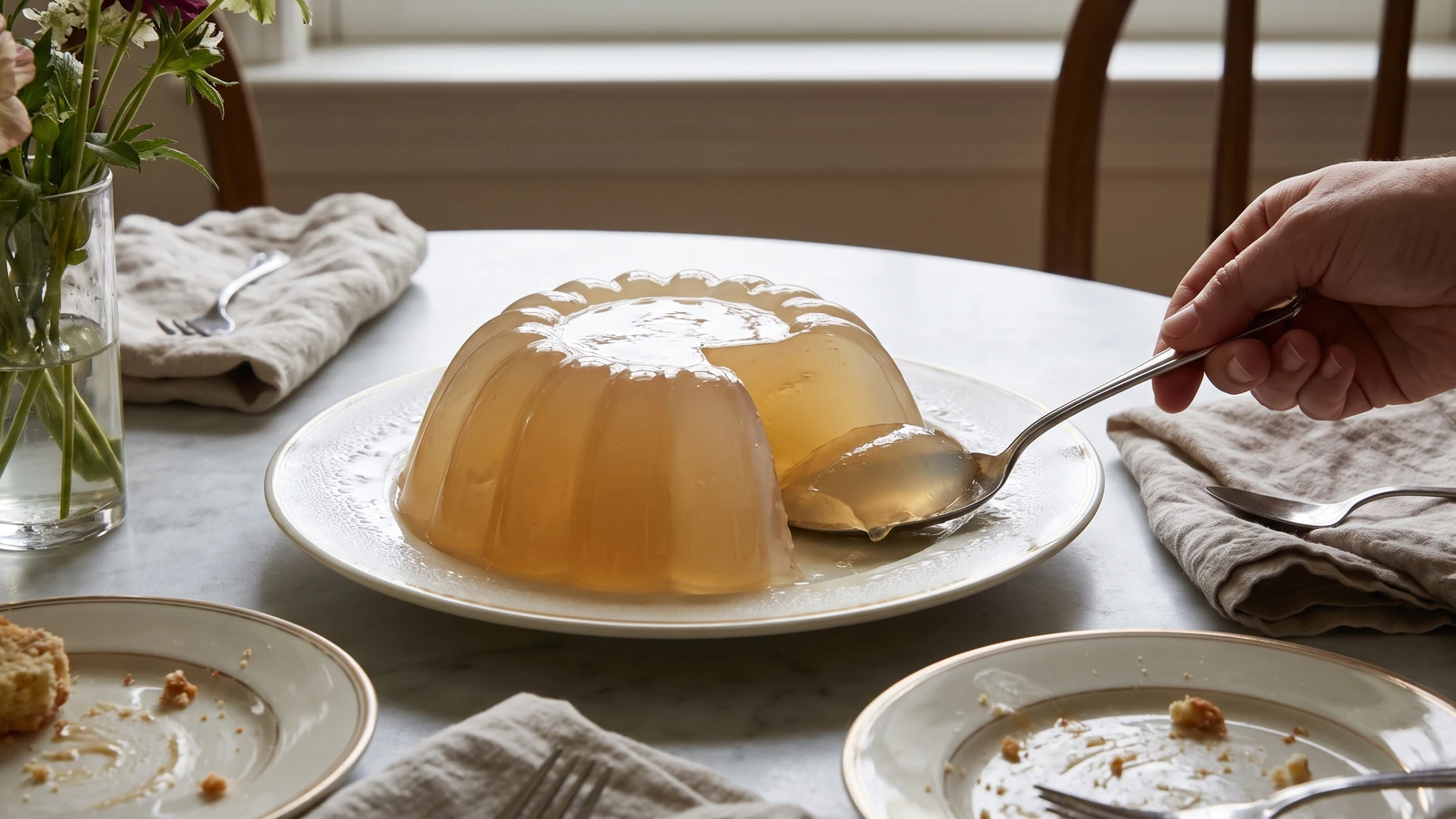
Gelée de pied de veau turns one humble foot, seven hours, and a bowl of ice into a clear citrus-scented dessert whose tender set proves that gelatin is a technique before it is an ingredient.
Gelée de pied de veau teaches the truth every jelly cook needs: strength is judged cold, never guessed from a hot spoon. The cooking liquor will look almost watery after seven hours, yet a teaspoon set over ice can reveal a gel far too firm for pleasure. Test first, correct with filtered water, and test again.
The source assumes a saucier on staff beside a stockpot never off the fire, ready ice, and a dedicated jelly bag. At home, one prepared foot, a heavy lidded pot, an ice bowl, the refrigerator, and clean damp linen do the same work at a five-cup scale. The constant second pair of hands and special bag are brigade scaffolding, so they go; seven hours of extraction, absolute degreasing, the ice test, the book’s sugar and citrus ratio, and egg-white clarification are the dish, so they stay.
Done properly, the gelée is pale amber and lucid, trembling rather than rubbery, with orange and lemon at the front and cinnamon no louder than a whisper. One cook, one stove, one evening gets it into the mold, and the cold finishes the work for tomorrow. Before you touch the pan, set aside the ice: the strength test is the step that decides everything.
Gelée de pied de veau belongs less to one province than to French cuisine bourgeoise and the Parisian classical entremets table, where the stockpot’s collagen could finish a sweet course as readily as a savory aspic. It traveled from household thrift into grand-kitchen clarification: calves’ feet supplied the natural set, while sugar, cinnamon, orange, and lemon turned the neutral liquor toward dessert. The common misconception is that it must taste meaty; careful blanching, skimming, degreasing, and clarification leave a translucent jelly whose flavor is citrus and spice, not broth.
Quantity
1 large (about 1½ to 2 lb / 700 to 900 g) (No. 273)
Quantity
4¼ cups (1 L / 1 kg)
Quantity
Up to 1 cup (240 ml / 240 g)
use only as required by the ice test
Quantity
1⅛ cups (265 ml / 227 g)
Quantity
1 small piece (½ inch / 1.5 cm, about 0.5 g)
Quantity
1 (about 7 oz / 200 g)
half its colored rind thinly pared and all its juice strained
Quantity
1 (about 4 oz / 115 g)
half its colored rind thinly pared and all its juice strained
Quantity
2
Quantity
1
reserve for reclarifying if necessary
Quantity
4 cups (950 ml / about 600 g)
divided, for chilling and strength tests
| Ingredient | Quantity |
|---|---|
| calf’s foot prepared according to Blanchings | 1 large (about 1½ to 2 lb / 700 to 900 g) (No. 273) |
| cold filtered water | 4¼ cups (1 L / 1 kg) |
| additional filtered water (optional)use only as required by the ice test | Up to 1 cup (240 ml / 240 g) |
| granulated sugar | 1⅛ cups (265 ml / 227 g) |
| cinnamon stick | 1 small piece (½ inch / 1.5 cm, about 0.5 g) |
| medium orangehalf its colored rind thinly pared and all its juice strained | 1 (about 7 oz / 200 g) |
| medium lemonhalf its colored rind thinly pared and all its juice strained | 1 (about 4 oz / 115 g) |
| large egg whites | 2 |
| large egg white (optional)reserve for reclarifying if necessary | 1 |
| ice cubesdivided, for chilling and strength tests | 4 cups (950 ml / about 600 g) |
Set the calf’s foot prepared according to Blanchings (No. 273) in a heavy lidded pot and add the 4¼ cups of cold filtered water. Bring it slowly toward a bare simmer, skimming every patch of gray froth and grease that rises during the first 20 to 30 minutes. When the surface remains clean, cover and cook at the gentlest tremble for seven full hours. Keep the lid close-fitting; if part of the foot becomes exposed, add only enough boiling water to cover it. At the finish, the foot should be collapsing and a cooled drop of liquor should feel distinctly tacky between two fingers.
Lift out the foot and strain the liquor through a fine sieve into a wide, heatproof bowl without pressing the solids. Set the bowl over half the ice until the liquor cools, then refrigerate it for 60 to 90 minutes, until the fat has hardened into an opaque cap. Lift off every trace, scrape the underside of the cap, and blot the surface with the corner of a clean paper towel. Remelt the gelled liquor gently in a clean pot. This cold degreasing replaces a saucier’s continual warm skimming, and it must be thorough: residual fat clouds the jelly and carries a savory taste into the dessert.
Set a small metal saucer over fresh ice and spoon on 1 tablespoon (15 ml / 15 g) of the warm liquor. Wait 3 minutes. It should form a tender gel that holds a furrow from the spoon yet trembles when the saucer moves. If it is rubbery or resists the spoon, stir ¼ cup (60 ml / 60 g) filtered water into the pot and test again, repeating only as needed. If the sample merely thickens without setting, simmer the liquor uncovered for 10 minutes and retest. Ça se rattrape. Never judge strength from the hot pot, and never commit the batch until the ice gives its verdict.
To the 4 cups of corrected liquor, add the sugar, cinnamon, half the thinly pared colored rind of the orange and lemon, and all the strained juice of both fruits. Warm gently, stirring until the sugar dissolves completely. Hold it just below a simmer for 2 minutes, then let it cool until merely lukewarm. Use colored rind only; white pith makes the clean citrus finish bitter.
Whisk the 2 egg whites only until loosened, not foamy. Blend them with a ladleful of the lukewarm liquor, return the mixture to the pot, and heat very slowly while stirring along the bottom. As the whites coagulate and rise into a raft, stop stirring. Make a small opening in the raft and hold the liquor at the barest simmer for 15 minutes; clear liquid should gather beneath it. If a hard boil tears the raft into the jelly, take the pot off the heat and cool it. Ça se rattrape: whisk in the reserved egg white and repeat over gentler heat.
Dampen clean muslin or lint-free linen with cold filtered water, wring it well, and use it to line a sieve over a clean bowl. Ladle the jelly slowly through the opening in the raft, allowing gravity to do the work. Return the first cloudy trickle to the cloth once its filtering bed has formed. Do not pour the raft into the sieve, press it, or squeeze the cloth; pressure drives captured particles straight back into the jelly. If necessary, pass the liquor through a freshly rinsed cloth once more.
Rinse a 5-cup mold with cold water and drain it without drying. Pour in the clarified jelly, then touch any surface bubbles with the edge of a paper towel to lift them away. Set the mold briefly over the remaining ice until no longer warm, cover, and refrigerate for at least 6 hours, preferably overnight. A properly judged gelée sets clear and tender, yielding to the spoon instead of behaving like rubber.
Dip the outside of the mold in warm water for 3 to 5 seconds, loosen the top edge with a damp fingertip, and invert it onto a chilled platter. If it clings, give the mold another 2 seconds in the water rather than forcing it. Serve the gelée cold in modest, generous spoonfuls, letting its orange, lemon, and quiet cinnamon stand alone. À table!
1 serving (about 160g)
Culinary guides, cultural storytelling, and the editorial depth that makes cooking meaningful.
Discover Culinary ExplorerChef Juliette
Five almond preparations, one discipline: remove the skins cleanly, dry every kernel through, then cut, toast, or cloak it in pale caramel without letting its fragrant oils escape.

Chef Juliette
A pastry pantry lesson in one tray: filberts warmed only until their red skins release, rubbed clean, cooled, and chopped into a fragrant mise-en-place for cakes, creams, pralines, and petits fours.

Chef Juliette
The smallest pâtisserie discipline decides whether a cake leaves its mould intact: clarified butter in every corner, followed by the lightest veil of dry flour or fécule.

Chef Juliette
Four whites, one spotless bowl, and a patient change of speed: whisk gently until loosened, then briskly to glossy stiffness, with powdered sugar waiting if the foam begins to granulate.