
Chef Juliette
Various Almond Preparations
Five almond preparations, one discipline: remove the skins cleanly, dry every kernel through, then cut, toast, or cloak it in pale caramel without letting its fragrant oils escape.
A cooking platform built around craft, culture, and the stories behind what we eat.
Created by Chef Juliette
Based on No. 2632, Baquet et Panier à la Chantilly, from Le Guide Culinaire (1907) by Auguste Escoffier
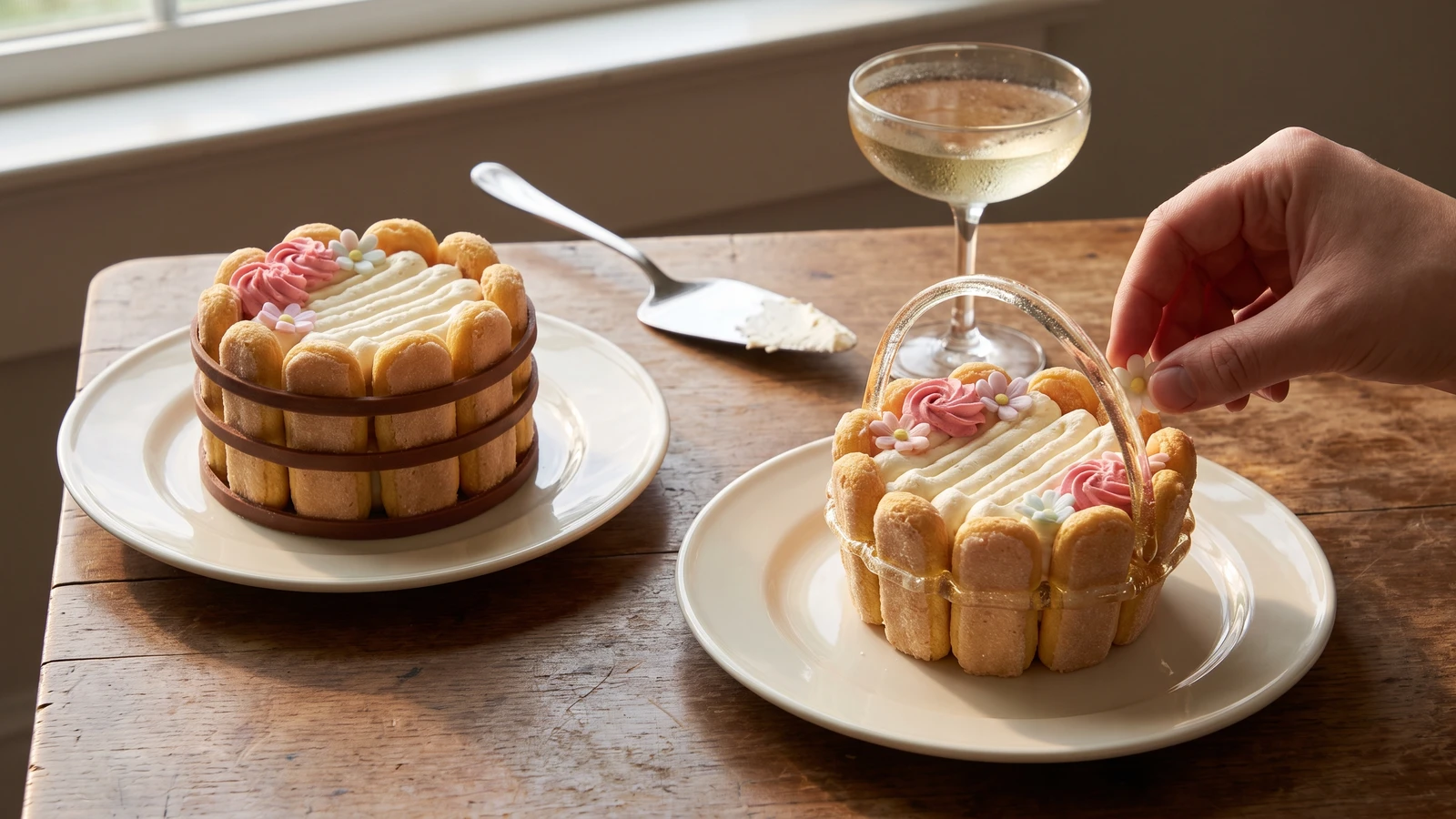
A ladyfinger baquet and panier, fixed with glass-clear cooked sugar, ringed in chocolate almond paste, and filled high with vanilla Chantilly: celebration pastry built by patience, not pastry-shop machinery.
Baquet et Panier à la Chantilly (a Chantilly-filled biscuit bucket and basket) teaches sugar as structure. The one true thing to know before touching a pan is this: large-crack sugar is not decoration here, it is the glue holding every biscuit upright. The golden walls, dark almond-paste hoops, ivory Chantilly, and pink rosettes all depend upon those small, clear joints.
The original assumed a pastry brigade with baked dry paste on hand, a copper sugar pan, a sugar lamp, pulling gloves, and someone free to pull a basket handle and its flowers while another cook assembled the walls. Your kitchen gets two thin pâte sucrée rounds, a digital thermometer, a cast sugar handle made on a silicone mat, and small ready-made sugar flowers. Those are changes to brigade scaffolding, not to the dish itself. The cooked-sugar construction, chocolate almond-paste hoops, pierced baquet uprights, biscuit panier, and real Chantilly all stay, scaled to two 12 cm centerpieces for one cook, one stove, one evening.
Once filled, the two forms should look cheerful and abundant, not architectural homework: crisp biscuits standing shoulder to shoulder, cream billowing above them, and the little basket handle catching the light. The decisive step comes before any sugar is cooked. Trim and dry-fit every biscuit around its base first, because large-crack sugar waits for no committee.
Baquet et Panier à la Chantilly belongs to Parisian grand-kitchen pâtisserie, where edible architecture traveled from the pastry bench to celebration tables as a pièce montée, an edible centerpiece. Its bucket and basket forms turned familiar biscuits, almond paste, cooked sugar, and cream into playful service pieces, with the sugar performing real structural work. Although Chantilly names the town and château north of Paris, this is not a local Chantilly specialty; here the word identifies the sweetened whipped cream filling, while the familiar invention story attached to the château remains debated.
Quantity
1 cup (240 ml / 125 g)
Quantity
5 tablespoons (75 ml / 70 g)
cubed
Quantity
¼ cup (60 ml / 30 g)
Quantity
1
Quantity
1 tablespoon (15 ml / 15 g), plus a few drops if needed
Quantity
⅛ teaspoon (0.6 ml / 0.8 g)
Quantity
36, including 4 spares
Quantity
⅓ cup packed (80 ml / 75 g)
Quantity
1 teaspoon (5 ml / 2 g)
Quantity
½ teaspoon (2.5 ml / 2.5 g)
Quantity
1 batch, about ⅔ cup (160 ml / 200 g), The Cooking of Sugar (No. 2344)
Quantity
1 batch, about ⅔ cup (160 ml / 200 g), The Cooking of Sugar (No. 2344)
Quantity
8
Quantity
2½ cups (600 ml / 600 g)
2 tablespoons reserved
Quantity
½ cup (120 ml / 60 g)
sifted
Quantity
2 teaspoons (10 ml / 10 g)
Quantity
1 small dab
| Ingredient | Quantity |
|---|---|
| plain flour | 1 cup (240 ml / 125 g) |
| cold unsalted buttercubed | 5 tablespoons (75 ml / 70 g) |
| confectioners' sugar for the bases | ¼ cup (60 ml / 30 g) |
| large egg yolk | 1 |
| cold water | 1 tablespoon (15 ml / 15 g), plus a few drops if needed |
| fine sea salt | ⅛ teaspoon (0.6 ml / 0.8 g) |
| firm, dry ladyfinger biscuits | 36, including 4 spares |
| almond paste | ⅓ cup packed (80 ml / 75 g) |
| unsweetened cocoa powder | 1 teaspoon (5 ml / 2 g) |
| warm water for the almond paste | ½ teaspoon (2.5 ml / 2.5 g) |
| large-crack sugar for biscuit assembly | 1 batch, about ⅔ cup (160 ml / 200 g), The Cooking of Sugar (No. 2344) |
| large-crack sugar for the basket handle and flowers | 1 batch, about ⅔ cup (160 ml / 200 g), The Cooking of Sugar (No. 2344) |
| small edible sugar flowers | 8 |
| cold heavy cream2 tablespoons reserved | 2½ cups (600 ml / 600 g) |
| confectioners' sugar for the Chantillysifted | ½ cup (120 ml / 60 g) |
| pure vanilla extract | 2 teaspoons (10 ml / 10 g) |
| rose-pink gel food coloring | 1 small dab |
Rub the cold butter into the flour, confectioners' sugar, and salt until the mixture resembles coarse crumbs. Add the yolk and cold water, then press the dough together without kneading; if dry flour remains, add water a few drops at a time. This pâte sucrée, a sweet shortcrust, is the home equivalent of the book's prepared dry paste. Flatten it, wrap it, and chill for 30 minutes.
Heat the oven to 350°F (175°C). Roll the chilled dough ⅛ inch (3 mm) thick and cut two 4¾-inch (12 cm) rounds. Set them on a lined baking sheet, prick them all over, and chill for 15 minutes. Bake for 16 to 20 minutes, until evenly golden and dry through the center. If an edge spreads, trim it with the cutter while the pastry is still warm. Cool completely before assembly, because warm pastry softens the sugar joints.
Stand ladyfingers around each cold base to determine the exact number required, usually 14 to 16 per form. Trim their bottoms flat so every biscuit stands upright. For the panier, cut all the biscuits to an even 3½ inches (9 cm). For the baquet, use the same height except for two opposite biscuits cut to 4¼ inches (11 cm); support each tall biscuit on a folded towel and gently twist a ¼-inch (6 mm) round piping tip through both faces near its top to form the characteristic holes. Knead the almond paste with the cocoa and warm water, then roll it into three slender cords, each about 16½ inches (42 cm) long. Dry-fit everything now. Once the sugar is ready, there is no time to discover a gap.
Draw a U-shaped handle with endpoints 3½ inches (9 cm) apart and a height of about 5½ inches (14 cm) on paper, then place the drawing beneath a translucent silicone mat. Prepare the handle batch of The Cooking of Sugar (No. 2344) to the large-crack stage according to its own entry, using a thermometer rather than testing hot sugar with your fingers. Let the bubbles settle briefly, then use a long-handled metal spoon to trace the U with three close, overlapping lines of sugar. Add a second layer for strength and leave it untouched until cold and rigid, about 20 minutes. If the first line spreads too thinly, wait until the sugar thickens slightly and trace over it; if it sets clear in the pan, warm it gently again. Reserve the remaining sugar for attaching the handle and flowers.
Set each pastry base on its final heatproof serving card or plate. Prepare the assembly batch of The Cooking of Sugar (No. 2344) to the large-crack stage according to its own entry. Working with one biscuit at a time, place a small drop of hot sugar on its bottom edge and another along one side, then stand it at the edge of the base and press it against its neighbor using the cool upper end. Complete the panier with biscuits of equal height. Build the baquet in the same way, placing its two taller, pierced biscuits directly opposite one another. Cooked sugar is the only glue that sets quickly and firmly enough here. If it hardens clear before the walls are finished, do not panic. Ça se rattrape: return it to the lowest heat until fluid, without stirring, then continue. Sugar that has turned dark and bitter has gone too far and must be replaced.
Let the biscuit walls stand until every joint is cold and rigid. Wrap the three chocolate almond-paste cords around the baquet at low, middle, and upper levels, joining each cord at the back with a tiny drop of the assembly batch of The Cooking of Sugar (No. 2344). Release the cast handle from its mat. Rewarm a spoonful of the handle batch of The Cooking of Sugar (No. 2344), use it to fix the handle ends securely inside two opposite sides of the panier, then attach the sugar flowers along the handle with minute drops. Hold each joint still until set. The handle is decoration, not a carrying handle, so move the panier by its base.
Chill a mixing bowl and whisk, then add all but the reserved 2 tablespoons of cream. Whip until the cream begins to hold trails, sift in the confectioners' sugar, add the vanilla, and continue only until the crème Chantilly, sweetened vanilla whipped cream, holds full soft peaks. It should mound generously while remaining smooth and supple. If it turns slightly grainy, stop immediately and fold in the reserved cold cream a spoonful at a time until smooth. Remove about one quarter of the Chantilly and tint it a clear, delicate pink.
Spoon or pipe the white Chantilly into the baquet and panier, bringing it just above the biscuit rims in abundant folds. Fit a piping bag with a medium star tip and finish both forms with rosettes of pink Chantilly, keeping the decoration generous and legible rather than fussy. Serve within an hour, while the biscuits remain crisp and the sugar joints clear. At the table, lift away the panier handle, separate small groups of biscuits with a serrated knife, and spoon the cream beside them; do not saw through the hard sugar seams. À table!
1 serving (about 215g)
Culinary guides, cultural storytelling, and the editorial depth that makes cooking meaningful.
Discover Culinary ExplorerChef Juliette
Five almond preparations, one discipline: remove the skins cleanly, dry every kernel through, then cut, toast, or cloak it in pale caramel without letting its fragrant oils escape.

Chef Juliette
A pastry pantry lesson in one tray: filberts warmed only until their red skins release, rubbed clean, cooled, and chopped into a fragrant mise-en-place for cakes, creams, pralines, and petits fours.

Chef Juliette
The smallest pâtisserie discipline decides whether a cake leaves its mould intact: clarified butter in every corner, followed by the lightest veil of dry flour or fécule.

Chef Juliette
Four whites, one spotless bowl, and a patient change of speed: whisk gently until loosened, then briskly to glossy stiffness, with powdered sugar waiting if the foam begins to granulate.