
Chef Juliette
Various Almond Preparations
Five almond preparations, one discipline: remove the skins cleanly, dry every kernel through, then cut, toast, or cloak it in pale caramel without letting its fragrant oils escape.
A cooking platform built around craft, culture, and the stories behind what we eat.
Created by Chef Juliette
Based on No. 2631, Charlotte à la Chantilly, from Le Guide Culinaire (1907) by Auguste Escoffier
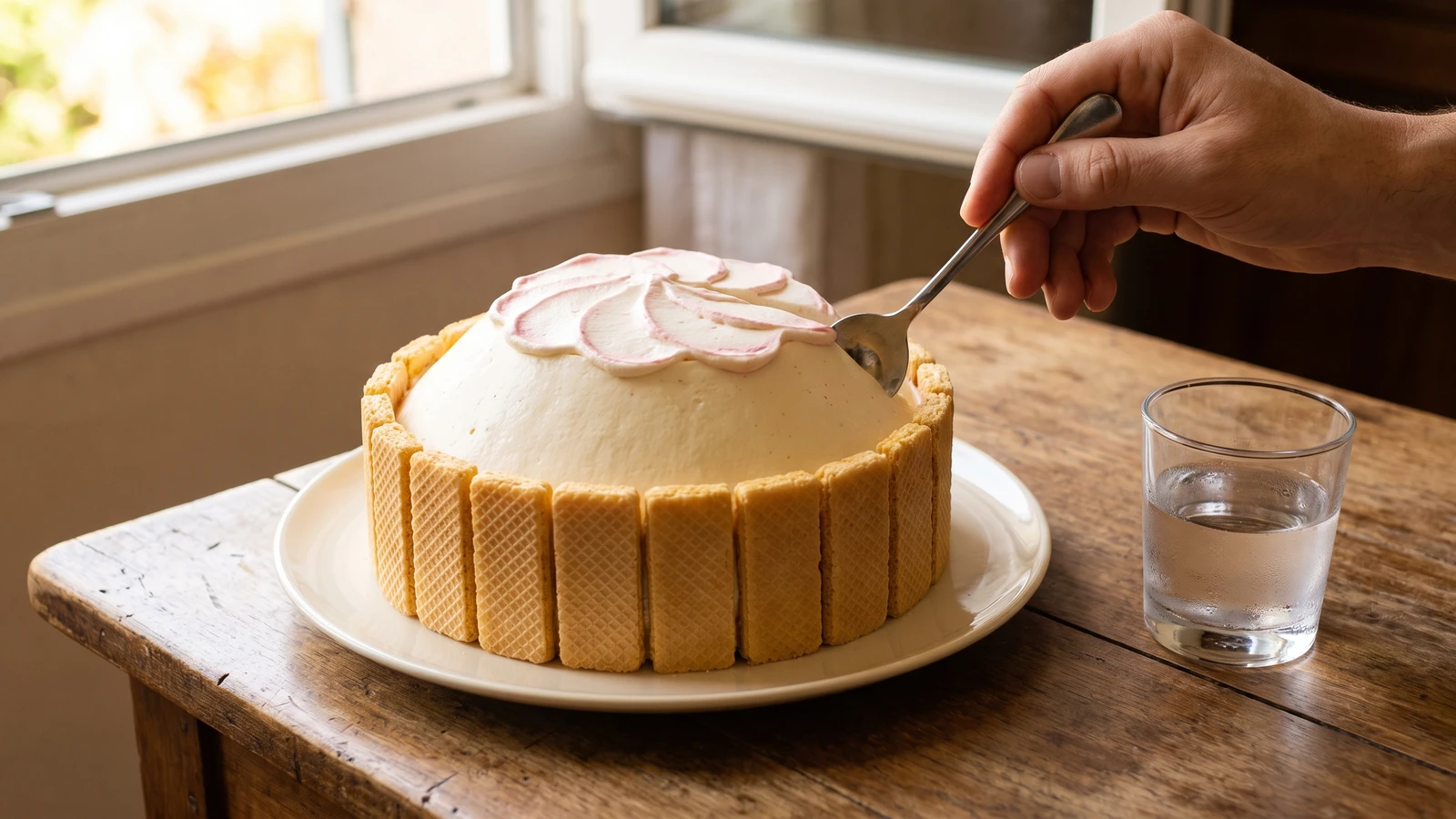
A crisp ring of upright gaufrettes holds a generous pyramid of vanilla Chantilly, with pale pink spoonwork over the top, a celebration charlotte built on timing, cold cream, and nerve.
Charlotte à la Chantilly (wafer charlotte crowned with vanilla whipped cream) teaches one true thing: delicate desserts are won by preparation, not haste. The pastry base and gaufrette wall must be finished before the cream is whipped, because crème Chantilly waits for no cook. Leave it standing and it weeps; whip it last and the pyramid reaches the table high, cold, and satin-soft.
The original recipe assumed a pastry station with dry-paste rounds, uniform gaufrettes, cooked sugar, and a charlotte mould ready to hand. Your honest equivalents are a small pâte sèche base baked on a sheet pan, crisp purchased wafer biscuits in place of a special wafer iron, and a six-inch cake ring used only as temporary support. The gaufrette iron and brigade quantities are scaffolding and can go. The dry base, cooked adhesive, upright wafers, vanilla cream, and pale pink spoonwork are the dish, so they stay. One cook, one stove, one evening.
This is edible architecture, but it isn't fussy theater. The wafers make the walls, the cream makes the feast, and the spoon leaves the decoration. Have the ring built, the serving plate ready, and the cream thoroughly cold before you begin whipping; that timing is the step that decides the dish.
Charlotte à la Chantilly belongs to the classical Paris pastry and grand-kitchen table, not to a single provincial larder. The charlotte form traveled from baked, fruit-filled bread molds into cold constructions of biscuits, wafers, and cream, and this gaufrette version made that architecture visible. The familiar tale that sweet whipped cream was invented at the Château de Chantilly is disputed; what defines this recipe is its service practice, a dry pastry floor, upright wafers, and vanilla cream whipped and mounded at the last moment.
Quantity
1 cup (240 ml / 125 g)
Quantity
1/4 cup (60 ml / 30 g)
Quantity
4 tablespoons (60 ml / 57 g)
diced
Quantity
1
Quantity
1/8 teaspoon (0.6 ml / 0.8 g)
Quantity
1 to 2 teaspoons (5 to 10 ml / 5 to 10 g)
use only if needed
Quantity
18 to 20 (about 3 ounces / 85 g total)
about 3 1/2 by 1 1/4 inches (9 by 3 cm) each
Quantity
1/3 cup (80 ml / 100 g) small-crack sugar prepared according to The Cooking of Sugar (No. 2344), or 1/3 cup (80 ml / 105 g) smooth apricot jam cooked to small-thread according to The Cooking of Sugar (No. 2344)
Quantity
2 cups (480 ml / 475 g)
at least 35 percent fat
Quantity
1/3 cup (80 ml / 40 g)
Quantity
1 1/2 teaspoons (7.5 ml / 7 g)
Quantity
1 drop
Quantity
2 tablespoons (30 ml / 30 g)
| Ingredient | Quantity |
|---|---|
| all-purpose flour | 1 cup (240 ml / 125 g) |
| confectioners' sugar for the pâte sèche | 1/4 cup (60 ml / 30 g) |
| cold unsalted butterdiced | 4 tablespoons (60 ml / 57 g) |
| large egg yolk | 1 |
| fine salt | 1/8 teaspoon (0.6 ml / 0.8 g) |
| ice water (optional)use only if needed | 1 to 2 teaspoons (5 to 10 ml / 5 to 10 g) |
| thin rectangular gaufrettesabout 3 1/2 by 1 1/4 inches (9 by 3 cm) each | 18 to 20 (about 3 ounces / 85 g total) |
| small-crack sugar or small-thread apricot jam | 1/3 cup (80 ml / 100 g) small-crack sugar prepared according to The Cooking of Sugar (No. 2344), or 1/3 cup (80 ml / 105 g) smooth apricot jam cooked to small-thread according to The Cooking of Sugar (No. 2344) |
| cold heavy whipping creamat least 35 percent fat | 2 cups (480 ml / 475 g) |
| confectioners' sugar for the crème Chantilly | 1/3 cup (80 ml / 40 g) |
| pure vanilla extract | 1 1/2 teaspoons (7.5 ml / 7 g) |
| liquid red food coloring | 1 drop |
| cold heavy whipping cream for rescue (optional) | 2 tablespoons (30 ml / 30 g) |
Mix the flour, confectioners' sugar, and salt. Rub in the cold butter with your fingertips until the mixture resembles fine crumbs, then work in the egg yolk. Press the crumbs together; if they remain dry, add ice water one teaspoon at a time, stopping as soon as a dough forms. Flatten it into a disc and chill for 30 minutes. Don't knead it smooth, because developed gluten makes a hard, shrinking base.
Heat the oven to 350°F (180°C). Roll the dough between sheets of parchment to a scant 1/8 inch (3 mm), then cut a 7-inch (18 cm) round. Transfer it on its lower parchment sheet to a baking tray, prick it closely with a fork, and chill for 10 minutes. Bake for 14 to 18 minutes, until evenly golden and dry through the center. Cool it completely on a rack. If the round cracks after baking, don't discard it; align the pieces and bridge the underside with a little cooked adhesive during assembly. Ça se rattrape.
Place the pastry round on its serving plate and center a 6-inch (15 cm) straight-sided cake ring or charlotte mould on top, leaving a narrow pastry rim around it. Stand the gaufrettes dry around the outside of the ring to check their fit and height, then lay them within reach in their proper order. Reserve two sound wafers for breakage. This rehearsal matters because the cooked adhesive sets quickly and offers no time for searching through a packet.
Prepare the chosen adhesive from its own entry immediately before assembly: small-crack sugar according to The Cooking of Sugar (No. 2344), or smooth apricot jam cooked to small-thread according to The Cooking of Sugar (No. 2344). Working with one gaufrette at a time, place a small bead of adhesive on the pastry just outside the guide, set the wafer upright in it, and support its inner face against the ring. Continue until the wafers form a close, even wall. Cooked sugar causes severe burns, so keep your fingers on the dry upper half of each wafer and use only dry utensils. If the sugar hardens in the pan, warm it briefly over the gentlest heat; if it crystallizes into an opaque mass, switch to the apricot option rather than fighting it. Let the joints set, loosen any stray adhesive with a thin knife, and lift the guide straight upward.
Chill a mixing bowl and the beaters for 15 minutes. Pour in the cold cream and vanilla, then whip at medium speed until the whisk leaves soft trails. Sift in the confectioners' sugar and continue only until the cream forms medium-firm peaks that stand but retain a smooth satin surface. This is the moment that decides the charlotte. If the cream stays loose, chill the bowl for 10 minutes and resume; if its edges turn grainy, stop and fold in the optional cold cream one tablespoon at a time until smooth. Ça se rattrape. Reserve a generous spoonful of Chantilly for the pink finish.
Spoon the white crème Chantilly into the wafer ring, filling the base completely so there are no hollow pockets. Continue mounding it upward in successively smaller spoonfuls, shaping a generous pyramid with the back of the spoon. Work lightly. Pressing and smoothing repeatedly knocks out the air that gives Chantilly its grace.
Fold one drop of red coloring into the reserved Chantilly until it is barely pink, not crimson. With the back of a teaspoon, place overlapping strokes of pink cream over the pyramid, leaving distinct soft ridges as the source directs. If this cream has softened, chill it for five minutes before decorating rather than whipping it harder. Serve within 30 minutes, cutting through the dry pastry base with a small serrated knife and giving each guest cream, base, and two or three gaufrettes. À table!
1 serving (about 150g)
Culinary guides, cultural storytelling, and the editorial depth that makes cooking meaningful.
Discover Culinary ExplorerChef Juliette
Five almond preparations, one discipline: remove the skins cleanly, dry every kernel through, then cut, toast, or cloak it in pale caramel without letting its fragrant oils escape.

Chef Juliette
A pastry pantry lesson in one tray: filberts warmed only until their red skins release, rubbed clean, cooled, and chopped into a fragrant mise-en-place for cakes, creams, pralines, and petits fours.

Chef Juliette
The smallest pâtisserie discipline decides whether a cake leaves its mould intact: clarified butter in every corner, followed by the lightest veil of dry flour or fécule.

Chef Juliette
Four whites, one spotless bowl, and a patient change of speed: whisk gently until loosened, then briskly to glossy stiffness, with powdered sugar waiting if the foam begins to granulate.