
Chef Juliette
Smelt (Éperlans)
Tiny éperlans, lightly floured and fried until their tails stand crisp, arrive in a generous heap on a napkin with fried parsley and grooved lemon, a weeknight lesson in heat and restraint.
A cooking platform built around craft, culture, and the stories behind what we eat.
Created by Chef Juliette
Based on No. 263, Frying Fat—its Preparation, from Le Guide Culinaire (1907) by Auguste Escoffier
Fresh beef kidney fat becomes a clean, resilient graisse de friture through water-assisted rendering, patient purification, and careful straining, ready to give croquettes, beignets, and fritters a crisp, dry finish.
Graisse de friture, sa préparation (preparation of frying fat) teaches the difference between melting fat and purifying it. Before you touch the pan, know this one thing: the water begins the rendering, but the cooking that makes the fat clean and durable begins only after every drop of water has gone. Listen for the broad bubbling to become a fine crackle, then watch the greaves and your thermometer.
The original formula assumed ten pounds of beef-kidney fat, a deep range pot, and a kitchen that kept its fryer in constant use. Your equivalent is five pounds in an eight-quart pot, enough to yield about two quarts without turning the stove into a works department. The water ratio stays exact, one cup for five pounds. The smaller charge and a ladle pressing the straining cloth replace brigade scale and the dangerous business of twisting a towel full of hot fat by hand. One cook, one stove, one evening.
Those changes are scaffolding. The preparation itself must stay: fresh raw fat, water-assisted melting, continued cooking until the membranes become crisp greaves and the first faint wisp announces purification, then ten minutes off the heat before a careful strain. Recognizing when the water has gone is the step that decides everything. Stop too soon and the fat foams during frying; carry it into acrid smoke and you've burned it.
This preparation belongs to the classical brigade kitchens of Paris and to household larders wherever frying fat had to remain useful through repeated batches. Fresh beef kidney fat became the standard because it could be thoroughly purified and worked longer than the finer but less resistant fat of veal; smaller household mixtures sometimes included veal or pork. Contrary to thrifty instinct, saved pot-au-feu fat and roast drippings were considered poor foundations for prolonged frying because they already carried moisture, seasoning, and cooked impurities.
Quantity
5 lb (2.27 kg)
well chilled, blood spots and heavy connective tissue trimmed, cut into ½-inch (1 cm) pieces
Quantity
1 cup (240 ml / 240 g)
| Ingredient | Quantity |
|---|---|
| fresh beef kidney fat (suet)well chilled, blood spots and heavy connective tissue trimmed, cut into ½-inch (1 cm) pieces | 5 lb (2.27 kg) |
| cold water | 1 cup (240 ml / 240 g) |
Chill the kidney fat until firm, then remove blood spots, bruised pieces, and the heaviest cords of connective tissue. Cut it into ½-inch (1 cm) pieces, or pulse it briefly in a food processor until coarsely chopped. Keep distinct pieces rather than making a paste; even cutting helps the fat render before the membranes scorch. Set a metal lid or baking sheet large enough to cover the pot beside the stove before lighting the burner.
Put the chopped fat and cold water in a completely dry, high-sided 8-quart pot. Heat over medium-low, uncovered, stirring from the bottom every five to ten minutes. The water works through the pieces, helping the fat melt evenly before the temperature can rise enough to brown them. Expect broad bubbling and some swelling, but the contents should remain below half the pot's height. If foam climbs toward the rim, turn off the burner and let it collapse before resuming at lower heat. Never add water once the fat is hot.
Continue cooking gently as the solid pieces shrink. While water remains, the temperature will hover near 212°F (100°C) and the bubbling will sound wet and busy. When the sound sharpens to a fine crackle and the temperature begins climbing above 230°F (110°C), the water has evaporated and purification has begun. Stir more frequently now so the greaves colour evenly. Cook until the greaves are small and deep golden, bubbling has nearly ceased, and the fat reaches about 390 to 400°F (199 to 204°C). At the first faint wisp and the distinct toasted smell of cooked fat, turn off the heat immediately. You want that first signal, never sustained smoke.
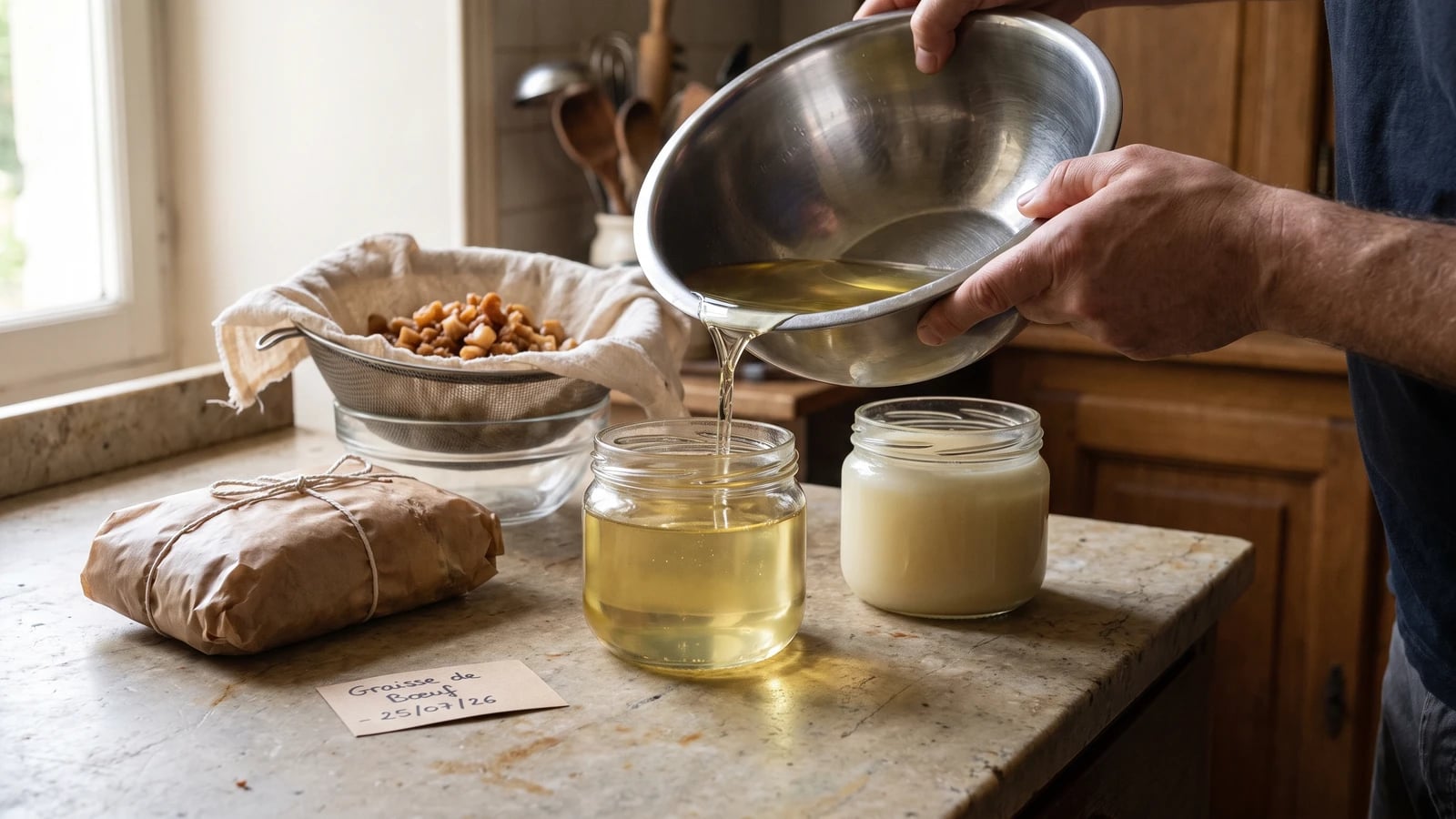
Leave the pot off the heat for ten minutes, exactly long enough for the fierce activity to settle while the fat remains fully liquid. Set a fine-mesh sieve lined with dry, coarse natural-fiber cheesecloth over a heatproof metal bowl. Pour the fat through slowly, away from your body, then press the greaves with the back of a long-handled ladle. Do not gather and twist the hot cloth in your hands; that was practical with a staffed brigade and is needless at home. Discard the spent greaves once they are cool.
Pour the strained fat into clean, completely dry, heatproof jars while it is still liquid, leaving 1 inch (2.5 cm) of headroom. Let it cool without sealing until it reaches room temperature, then inspect it. Properly purified graisse de friture sets smooth and ivory-pale, with no beads of water underneath. If liquid collects at the bottom or a spoonful spits sharply when reheated, ça se rattrape: return the whole batch to a dry pot and cook gently until the crackling stops and the temperature rises above 230°F (110°C), then strain it again into fresh, dry containers.
Seal the jars only when the fat is fully cool. Refrigerate for up to three months, or freeze in practical portions for up to one year. Melt only what you need for frying and heat it according to the food, usually between 350 and 375°F (175 and 190°C). After each use, let the fat cool until safe but still fluid, strain it into a separate clean container, and keep it cold. Discard it when it smells acrid, feels sticky, darkens heavily, or foams persistently.
1 serving (about 14g)
Culinary guides, cultural storytelling, and the editorial depth that makes cooking meaningful.
Discover Culinary ExplorerChef Juliette
Tiny éperlans, lightly floured and fried until their tails stand crisp, arrive in a generous heap on a napkin with fried parsley and grooved lemon, a weeknight lesson in heat and restraint.

Chef Juliette
Brandade de Morue turns salt cod, warm olive oil, and milk into a pale, silky emulsion: keep everything warm and add the oil slowly, then crown the generous dome with butter-fried bread.

Chef Juliette
Salt cod worked warm with cream, one patient spoonful at a time, until the rough flakes become a glossy Nîmes paste, domed generously and ringed with butter-fried croutons for the table.

Chef Juliette
Wine-poached char packed in its earthenware crock beneath butter gold: a make-ahead first course that turns careful cooling, thorough boning, and one unbroken seal into quiet abundance.