
Chef Juliette
Various Almond Preparations
Five almond preparations, one discipline: remove the skins cleanly, dry every kernel through, then cut, toast, or cloak it in pale caramel without letting its fragrant oils escape.
A cooking platform built around craft, culture, and the stories behind what we eat.
Created by Chef Juliette
Based on No. 2609, Fruit Suprême à la Gabrielle, from Le Guide Culinaire (1907) by Auguste Escoffier
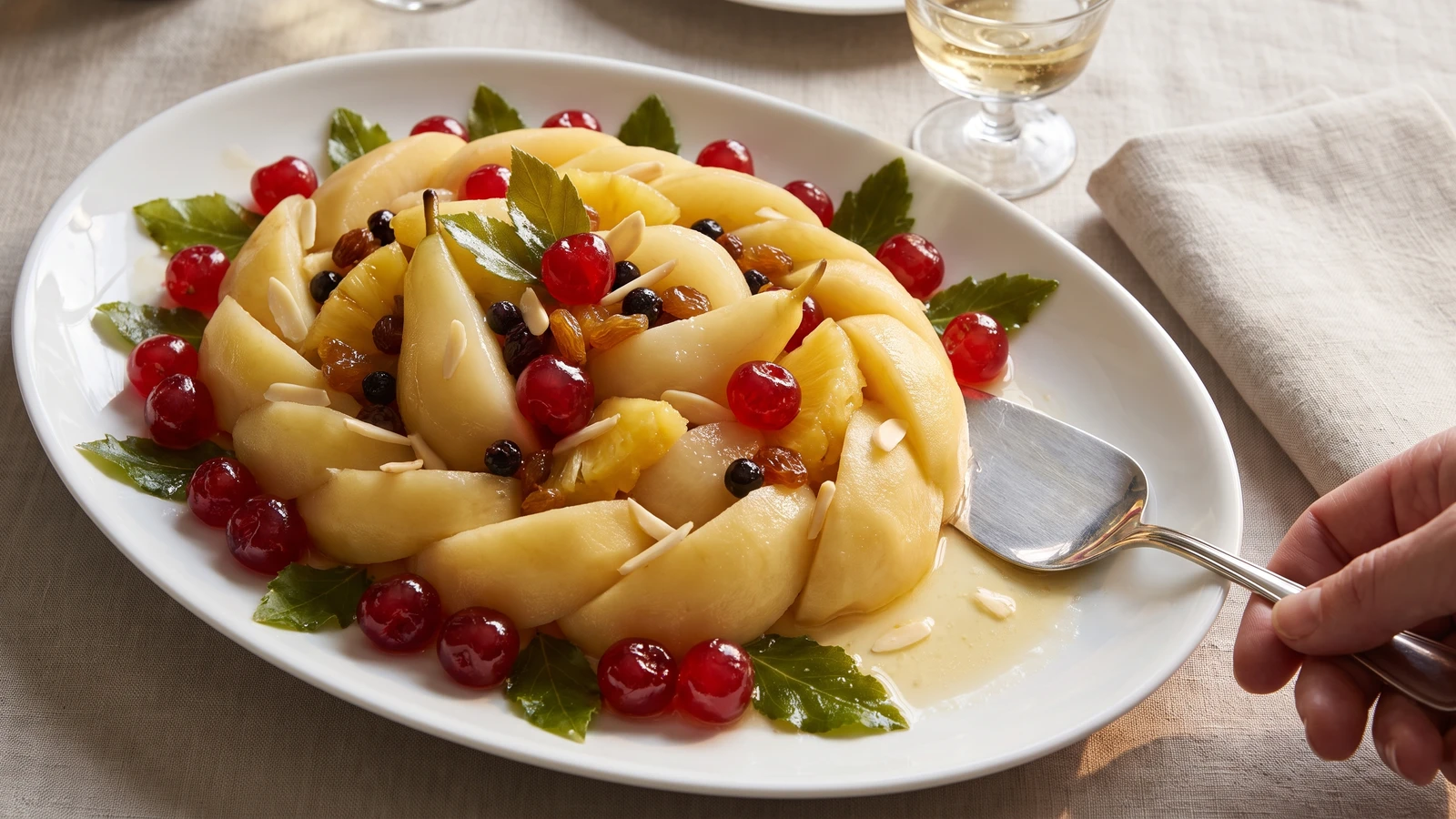
A poached apple border, tender enough to yield and firm enough to stand, cradles a jewel-bright macédoine of pears, pineapple, cherries, raisins, almond syrup, and butter.
Fruit Suprême à la Gabrielle (a poached apple border with almond-syrup mixed fruit) teaches concentration. That is the one true thing to know before touching the pan. The apples must lose enough water to hold their mould, and the pear syrup must reach the small-ball stage so the macédoine gleams rather than swims. C'est la même grammaire: remove water with attention, then restore richness at the finish.
The original assumed a pâtissier watching the sugar, an ornamented border mould, a fancy-cutter for the angelica, and portions intended for a formal service. Your honest equivalents are a one-liter ring mould, a roasting tin for the bain-marie, a paring knife, and a sugar thermometer. I have reduced the quantity to six servings and replaced the finger test for hot sugar with a thermometer because it is safer and more exact. That is brigade scaffolding. The apple border, the small-ball syrup, the ten-minute simmer, and the butter added away from the fire are the dish itself, and they stay.
Turned out, the apple stands tender and pale gold around a glossy macédoine, with candied cherries at its feet and splintered almonds across the fruit. The step to guard is the apple cooking: dry it until the spoon leaves a clean path across the pan before the eggs go anywhere near it.
Fruit Suprême à la Gabrielle belongs to the Parisian grand-kitchen repertory of moulded entremets, not to the larder of any one French region. Its architecture joins the bourgeois apple charlotte to the formal macédoine: homely stewed fruit made structural with eggs, then dressed with preserved fruit and controlled sugar work. The name Gabrielle marks the formula's presentation, while suprême here means a finished composition, not the poultry cut many cooks expect.
Quantity
1 tablespoon (15 ml / 14 g)
for the mould
Quantity
6 medium (about 2¼ pounds / 1 kg)
peeled, cored, and thinly sliced
Quantity
4 tablespoons (60 ml / 56 g)
Quantity
⅓ cup (80 ml / 65 g)
Quantity
3
Quantity
3 large (about 1¼ pounds / 570 g)
peeled, cored, and quartered
Quantity
2 cups (480 ml / 480 g)
Quantity
1 cup (240 ml / 200 g)
Quantity
1 cup (240 ml / 240 g) syrup plus scant 1 cup (230 ml / 192 g) sugar for The Cooking of Sugar (No. 2344)
Quantity
1 teaspoon (5 ml / 5 g)
reserved for crystallization rescue
Quantity
1 cup (240 ml / 180 g)
cut into large lozenges
Quantity
½ cup (120 ml / 100 g)
drained
Quantity
¼ cup (60 ml / 40 g)
cut into small leaf shapes
Quantity
¼ cup (60 ml / 40 g)
Quantity
¼ cup (60 ml / 40 g)
Quantity
⅙ cup (40 ml / 42 g)
made from 2 tablespoons smooth blanched almond butter and 2 teaspoons hot water
Quantity
2 tablespoons (30 ml / 28 g)
diced
Quantity
½ cup (120 ml / 100 g)
divided between the mould and serving platter
Quantity
⅓ cup (80 ml / 40 g)
cut into fine splinters
| Ingredient | Quantity |
|---|---|
| softened unsalted butterfor the mould | 1 tablespoon (15 ml / 14 g) |
| tart cooking applespeeled, cored, and thinly sliced | 6 medium (about 2¼ pounds / 1 kg) |
| unsalted butter | 4 tablespoons (60 ml / 56 g) |
| granulated sugar | ⅓ cup (80 ml / 65 g) |
| large eggs | 3 |
| firm pearspeeled, cored, and quartered | 3 large (about 1¼ pounds / 570 g) |
| water | 2 cups (480 ml / 480 g) |
| granulated sugar for pear syrup | 1 cup (240 ml / 200 g) |
| reserved pear syrup and granulated sugar | 1 cup (240 ml / 240 g) syrup plus scant 1 cup (230 ml / 192 g) sugar for The Cooking of Sugar (No. 2344) |
| lemon juice (optional)reserved for crystallization rescue | 1 teaspoon (5 ml / 5 g) |
| fresh pineapplecut into large lozenges | 1 cup (240 ml / 180 g) |
| semi-candied cherriesdrained | ½ cup (120 ml / 100 g) |
| candied angelicacut into small leaf shapes | ¼ cup (60 ml / 40 g) |
| dried currants | ¼ cup (60 ml / 40 g) |
| sultanas | ¼ cup (60 ml / 40 g) |
| very thick almond milkmade from 2 tablespoons smooth blanched almond butter and 2 teaspoons hot water | ⅙ cup (40 ml / 42 g) |
| cold unsalted butterdiced | 2 tablespoons (30 ml / 28 g) |
| candied cherriesdivided between the mould and serving platter | ½ cup (120 ml / 100 g) |
| blanched slivered almondscut into fine splinters | ⅓ cup (80 ml / 40 g) |
Heat the oven to 325°F (165°C). Butter a 1-quart (1-liter) ring or savarin mould thoroughly, reaching into every curve. Press six halved candied cherries, cut-side against the metal, around the bottom as a simple ornament, then chill the mould for 10 minutes so the butter fixes them in place. Keep the remaining candied cherries for the border on the serving platter.
Put the sliced apples, 4 tablespoons butter, and ⅓ cup sugar in a broad, heavy pan. Cover and cook over low heat for 8 to 10 minutes, stirring occasionally, until the fruit collapses. Uncover, raise the heat slightly, and cook while crushing the apples with a wooden spoon until you have a thick, nearly smooth paste that pulls from the pan and leaves a clean trail behind the spoon, about 15 minutes more. This drying is the structure of the border. If liquid still gathers in the trail, keep cooking; if the bottom catches, lower the heat and transfer the apples to a clean pan without scraping up the scorched patch. Ça se rattrape.
Let the apple paste cool until warm rather than hot, about 10 minutes. Beat the eggs together, then work them into the apples in three additions, mixing each completely before the next. If the apple is hot enough to scramble the egg, the border will be grainy, so wait until you can comfortably hold a fingertip against the mixture. Spoon it into the prepared mould, press firmly to remove air pockets, smooth the surface, and cover loosely with buttered parchment and foil.
Set the mould in a deep roasting tin and pour just-boiled water into the tin until it reaches halfway up the mould. This bain-marie, a hot-water bath, protects the egg-bound apples from harsh oven heat. Poach for 45 to 55 minutes, until the border feels firm at the inner and outer edges and the center registers about 175°F (80°C). Lift the mould from the water and rest it for 10 minutes, still covered.
While the apple border cooks, bring the 2 cups water and 1 cup sugar to a gentle simmer in a saucepan. Add the pear quarters and cover them with a small circle of parchment so they remain submerged. Poach at the barest tremble for 10 to 15 minutes, until a knife enters with slight resistance and the quarters still hold their shape. Lift out the pears. Measure exactly 1 cup of pear syrup for the sugar stage, then pour another ½ cup of the hot syrup over the currants and sultanas. Leave them to swell for 15 minutes and drain well, keeping any remaining syrup nearby.
Arrange the pear quarters, pineapple lozenges, semi-candied cherries, angelica leaves, drained currants, and drained sultanas in a wide sauté pan. This is the macédoine, the mixture of fruits. Handle it gently and keep the pieces distinct; it should look generous and varied, not stirred into compote.
Apply The Cooking of Sugar (No. 2344): combine the measured 1 cup pear syrup with the scant 1 cup, or 192 grams, of sugar in a clean saucepan with plenty of headroom. Stir over low heat only until the sugar dissolves, then stop stirring and boil until the syrup reaches the small-ball stage, 236°F (113°C). Brush crystals from the sides with a wet pastry brush. If the syrup begins to grain, remove it from the heat, add the lemon juice and 1 tablespoon of water, cover, and boil gently for 1 minute to dissolve the crystals; uncover and continue to temperature. Use the thermometer, not the old finger test. One cook has only ten fingers, and we need all of them.
Remove the small-ball syrup from the heat and carefully whisk in the very thick almond milk. Pour this over the prepared macédoine, bring it to the gentlest simmer, and cook for exactly 10 minutes, nudging the fruit rather than stirring it roughly. If the syrup tightens before the fruit is hot, loosen it with a spoonful of the remaining pear-poaching syrup. Take the pan completely off the fire, wait until the bubbling subsides, and swirl in the cold diced butter until the syrup becomes glossy. If the butter separates into yellow beads, lift out the fruit, whisk 1 teaspoon cold water into the syrup until it comes together, then return the fruit. Ça se rattrape.
Run a thin knife around the inner and outer edges of the apple border and invert it onto a warm serving platter. If it clings, wrap the mould in a hot damp towel for 30 seconds and try again without shaking. Arrange the remaining candied cherries around its base, spoon the warm macédoine generously into the center, and let a little almond syrup pool against the apple. Scatter the finely splintered almonds over the fruit and serve at once. À table!
1 serving (about 400g)
Culinary guides, cultural storytelling, and the editorial depth that makes cooking meaningful.
Discover Culinary ExplorerChef Juliette
Five almond preparations, one discipline: remove the skins cleanly, dry every kernel through, then cut, toast, or cloak it in pale caramel without letting its fragrant oils escape.

Chef Juliette
A pastry pantry lesson in one tray: filberts warmed only until their red skins release, rubbed clean, cooled, and chopped into a fragrant mise-en-place for cakes, creams, pralines, and petits fours.

Chef Juliette
The smallest pâtisserie discipline decides whether a cake leaves its mould intact: clarified butter in every corner, followed by the lightest veil of dry flour or fécule.

Chef Juliette
Four whites, one spotless bowl, and a patient change of speed: whisk gently until loosened, then briskly to glossy stiffness, with powdered sugar waiting if the foam begins to granulate.