
Chef Juliette
Various Almond Preparations
Five almond preparations, one discipline: remove the skins cleanly, dry every kernel through, then cut, toast, or cloak it in pale caramel without letting its fragrant oils escape.
A cooking platform built around craft, culture, and the stories behind what we eat.
Created by Chef Juliette
Based on No. 2594, Pommes à la Chevreuse, from Le Guide Culinaire (1907) by Auguste Escoffier
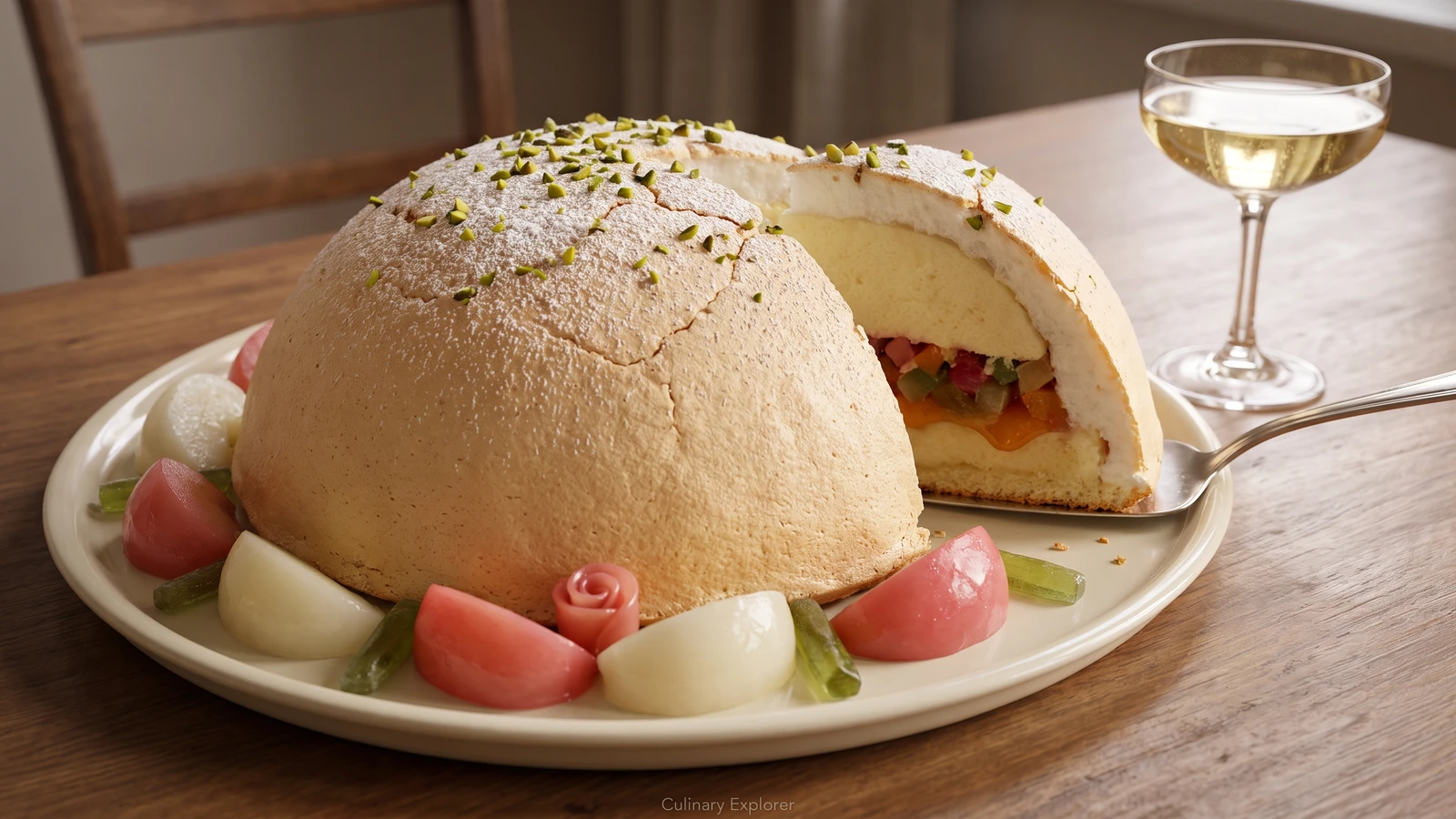
Firm vanilla-scented semolina, syruped apple quarters, and apricot-bound candied fruit disappear beneath a pale-gold meringue dome, finished with pistachio, angelica, and one rosy apple for a true celebration.
Pommes à la Chevreuse (meringue-domed apples with semolina) teaches control of moisture. That is the one true thing to know before touching a pan. The semolina must hold its shape, the syruped apples must be thoroughly drained, and the apricot purée must bind the salpicon rather than run from it. Get those three textures right and the dome stands proudly when cut.
The original entry assumed a pâtisserie station with semolina-croquette paste, two poaching syrups, apricot purée, and meringue already waiting, plus a platter large enough for brigade service. At home, one wide pan handles both syrups in sequence, the batch becomes a 30 cm platter for six, and your ordinary oven supplies the mild heat the source requires. No salamander belongs here. The holding pans and oversized quantities are scaffolding and go; the two apple colors, firm semolina cushion, apricot-bound salpicon, second semolina coat, and gentle bake are the dish and stay. One cook, one stove, one evening.
The bake decides it. Mild heat must set the meringue before its icing sugar takes too much color. If the crown races ahead, lower the oven and shield it loosely; ça se rattrape. Keep the dome pale gold and firm, because this is the step that matters most.
Pommes à la Chevreuse belongs to the Parisian classical repertoire of named entremets, while Chevreuse itself is the town and valley of Île-de-France southwest of Paris. It is better understood as a grand-kitchen composition carrying a place-name than as a documented village apple pudding: semolina, poached fruit, apricot-bound salpicon, and meringue reveal the organized work of the pâtisserie station. Cookery books carried that formal architecture into private dining rooms, where a smaller platter and a household oven preserve the same sequence.
Quantity
5 medium, about 2 lb / 900 g
peeled, cored, and quartered
Quantity
2 medium, about 13 oz / 370 g
peeled, cored, and quartered
Quantity
1, about 3 oz / 85 g
peeled with its stem left intact
Quantity
4 cups (960 ml / 960 g)
divided between the syrups
Quantity
2 cups (480 ml / 400 g)
divided
Quantity
1
split lengthwise
Quantity
2 to 3 drops
Quantity
2½ cups (600 ml / 620 g)
Quantity
¾ cup (180 ml / 125 g)
Quantity
⅓ cup (80 ml / 65 g)
Quantity
⅛ teaspoon (0.6 ml / 0.8 g)
Quantity
2 tablespoons (30 ml / 28 g)
Quantity
2
Quantity
1 teaspoon (5 ml / 5 g)
Quantity
¾ cup (180 ml / 120 g)
cut into 6 mm dice
Quantity
⅓ cup (80 ml / 50 g)
Quantity
½ cup (120 ml / 130 g)
Quantity
½ batch, about 4 cups (960 ml / 350 g) Ordinary Meringue (No. 2382)
Quantity
2 tablespoons (30 ml / 18 g)
finely chopped
Quantity
1 tablespoon (15 ml / 8 g)
Quantity
8 elongated lozenges, about 1 oz / 28 g
| Ingredient | Quantity |
|---|---|
| firm apples for the vanilla syruppeeled, cored, and quartered | 5 medium, about 2 lb / 900 g |
| firm apples for the pink syruppeeled, cored, and quartered | 2 medium, about 13 oz / 370 g |
| very small firm applepeeled with its stem left intact | 1, about 3 oz / 85 g |
| waterdivided between the syrups | 4 cups (960 ml / 960 g) |
| granulated sugar for the syrupsdivided | 2 cups (480 ml / 400 g) |
| vanilla beansplit lengthwise | 1 |
| rose-pink gel food coloring | 2 to 3 drops |
| whole milk | 2½ cups (600 ml / 620 g) |
| fine semolina | ¾ cup (180 ml / 125 g) |
| granulated sugar for the semolina | ⅓ cup (80 ml / 65 g) |
| fine sea salt | ⅛ teaspoon (0.6 ml / 0.8 g) |
| unsalted butter for the semolina | 2 tablespoons (30 ml / 28 g) |
| large egg yolks | 2 |
| unsalted butter for the dish | 1 teaspoon (5 ml / 5 g) |
| mixed candied fruitcut into 6 mm dice | ¾ cup (180 ml / 120 g) |
| seedless raisins | ⅓ cup (80 ml / 50 g) |
| smooth apricot purée | ½ cup (120 ml / 130 g) |
| Ordinary Meringue | ½ batch, about 4 cups (960 ml / 350 g) Ordinary Meringue (No. 2382) |
| shelled pistachiosfinely chopped | 2 tablespoons (30 ml / 18 g) |
| icing sugar | 1 tablespoon (15 ml / 8 g) |
| candied angelica | 8 elongated lozenges, about 1 oz / 28 g |
Combine 2½ cups (600 ml) of the water with 1¼ cups (250 g) of the syrup sugar and the split vanilla bean in a wide pan. Bring to a gentle simmer, stirring only until the sugar dissolves. Add the five apples in batches and poach at the barest tremble for 7 to 12 minutes, turning once, until a thin knife enters with slight resistance. A hard boil makes the quarters woolly and breaks their edges. Lift them carefully into a shallow dish, pour over enough syrup to cover, and leave them to cool in it.
Rinse the pan, then combine the remaining 1½ cups (360 ml) water and ¾ cup (150 g) syrup sugar. Tint it a clear pale rose with the food coloring. Lower in the small whole apple and simmer it gently for 5 minutes before adding the two quartered apples. Continue until the quarters are tender but intact and the small apple is cooked through, about 8 minutes for the quarters and 15 to 20 minutes in total for the whole apple. Cool them in the pink syrup. If a quarter splits, use it in the salpicon and overlap two neighboring quarters when decorating the base.
Bring the milk, ⅓ cup (65 g) sugar, and salt to a bare simmer in a heavy saucepan. Rain in the semolina slowly while whisking, then reduce the heat and stir with a firm spatula for 8 to 10 minutes. It is ready when it pulls cleanly from the pan and holds a mound rather than flowing back into place. Remove it from the heat, beat in the 2 tablespoons butter, wait 3 minutes, then beat in the yolks one at a time. If lumps appear, whisk hard while the mixture is still hot or press it through a coarse sieve. Do not thin it into porridge; the croquette-like firmness is what supports the dome.
Simmer the apricot purée in a small saucepan for 4 to 6 minutes, stirring, until a stroke of the spatula leaves the pan floor visible for two seconds. Let it cool until merely warm. If the raisins feel leathery, soak them for 10 minutes in a little hot vanilla syrup, then drain and dry them well. Fold the raisins and evenly diced candied fruit into the apricot purée. This is the salpicon, a mixture of small dice cohered by a sauce or purée, and it must sit in a spoon without leaking syrup around its edges.
Butter a 30 cm (12-inch) shallow ovenproof serving dish. Spread about two-thirds of the warm semolina into a round cushion 18 cm (7 inches) wide and roughly 2 cm (¾ inch) high, making a broad hollow in its center. Drain the vanilla apples thoroughly and blot their surfaces. Arrange 12 quarters in a close border around the cushion, rounded sides outward and tips pointing slightly inward. Spoon the salpicon into the center without raising it above the border, then spread the remaining semolina over it in a thin, even coat, joining it firmly to the cushion beneath.
Refrigerate the assembled cushion for 30 to 45 minutes, until the semolina feels firm and cold and no syrup collects around the apples. Keep the remaining white quarters, all the pink quarters, and the small pink apple in their syrups until needed. This pause is not brigade scaffolding. A warm or wet foundation makes the meringue slide, while a cold one gives it something solid to grip.
Heat the oven to 300°F (150°C) with a rack in the lower-middle position. Spread the Ordinary Meringue (No. 2382) over the chilled construction, pressing on a thin sealing coat first so every apple and seam is covered. Mound the remainder over it and shape a smooth dome about 20 cm (8 inches) wide and 10 cm (4 inches) high. Seal the meringue against the platter at the base so fruit syrup cannot escape. Sprinkle the chopped pistachios over the dome and dredge it evenly with the icing sugar.
Bake for 25 to 30 minutes, until the dome is set beneath its surface and colored a restrained biscuit-gold. Mild heat is the technique. If the top browns while the lower sides still look wet, reduce the oven to 275°F (140°C), shield the crown with a loose foil tent that does not touch it, and continue for 8 to 10 minutes. Ça se rattrape. Do not use the broiler. Rest the dish for 5 minutes, then drain the remaining apple quarters thoroughly and arrange them around the base in a close circle, alternating white and pink. Form a rosette of angelica lozenges on the crown and set the small pink apple, stem upright, in its center. Serve within 20 minutes. À table!
1 serving (about 480g)
Culinary guides, cultural storytelling, and the editorial depth that makes cooking meaningful.
Discover Culinary ExplorerChef Juliette
Five almond preparations, one discipline: remove the skins cleanly, dry every kernel through, then cut, toast, or cloak it in pale caramel without letting its fragrant oils escape.

Chef Juliette
A pastry pantry lesson in one tray: filberts warmed only until their red skins release, rubbed clean, cooled, and chopped into a fragrant mise-en-place for cakes, creams, pralines, and petits fours.

Chef Juliette
The smallest pâtisserie discipline decides whether a cake leaves its mould intact: clarified butter in every corner, followed by the lightest veil of dry flour or fécule.

Chef Juliette
Four whites, one spotless bowl, and a patient change of speed: whisk gently until loosened, then briskly to glossy stiffness, with powdered sugar waiting if the foam begins to granulate.