
Chef Juliette
Flan aux Carottes
A pale short-paste shell holds silken, lightly sweet carrot purée beneath neat glazed half-discs, their butter syrup catching the light: a classical tart poised between vegetable course and sweet.
A cooking platform built around craft, culture, and the stories behind what we eat.
Created by Chef Juliette
Based on No. 2586, Poires à la Régence, from Le Guide Culinaire (1907) by Auguste Escoffier
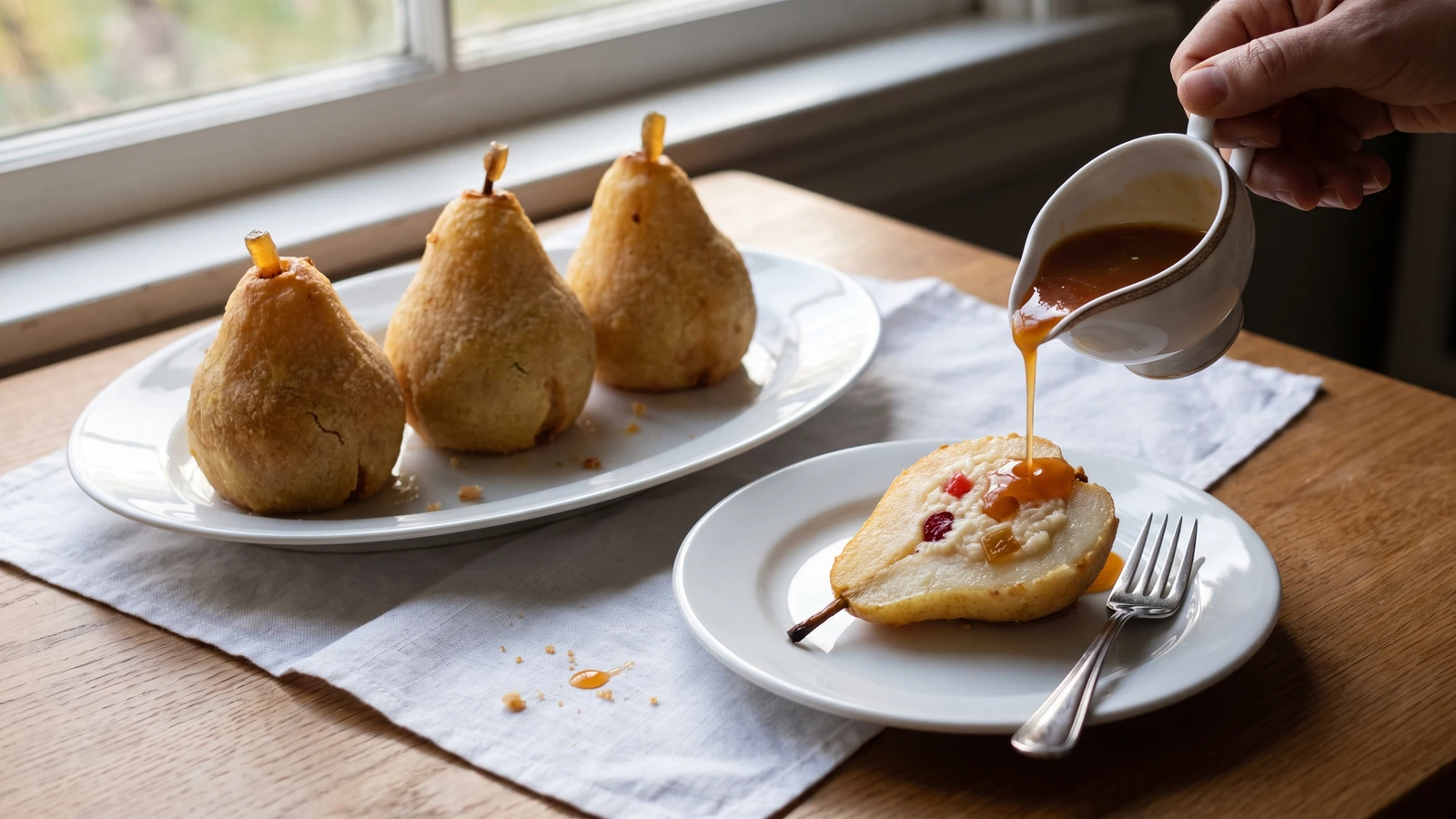
Poires à la Régence turn cold vanilla-poached pears into a crisp, improbable pleasure: kirsched rice and frangipane hidden inside, a fine crumb outside, and glossy apricot sauce alongside.
Poires à la Régence (fried, filled poached pears) teach a severe little truth: the cold structure must be settled before hot fat ever sees it. The pears are poached whole in vanilla syrup, cooled in that syrup, then opened and rebuilt around kirsched rice, frangipane, and candied-fruit salpicon. Cut them warm and they slump; cool them completely and the halves hold their shape as neatly as two cupped hands.
The classical formula assumed a pastry station with rice, frangipane, poaching syrup, apricot sauce, and frying fat already waiting. At home, a narrow saucepan replaces the syrup bath, a heavy pot and thermometer replace the fryer, and good apricot preserve gives the small quantity of sauce its honest fruit foundation. The brigade's separate production schedule is scaffolding and can go. The quarter-weight of frangipane, the Kirsch, the fine crumb coat, the candied angelica stem, and the last-minute frying are the dish itself, so they stay. One cook, one stove, one evening.
Cool the pears completely in their syrup before you cut them. If time presses, set the saucepan in an ice-water bath, but don't lift the pears from the syrup while they're warm. That chill is the step that decides the dish.
Poires à la Régence belong to the grand Parisian entremets table, where poached fruit was often rebuilt with rice, almond cream, candied fruit, and a fried crust for a formal sweet course. Régence is a courtly naming convention rather than a regional pear tradition, and the dish traveled into household manuals as a lesson in composed pastry work. Its surprise is structural: what appears to be a whole pear contains a kirsched center assembled from two carefully rejoined halves.
Quantity
4 medium pears
peeled and stems removed
Quantity
4 cups (960 ml / 960 g)
for the vanilla syrup
Quantity
2 cups (480 ml / 400 g)
for the vanilla syrup
Quantity
1
split lengthwise
Quantity
1 cup (240 ml / 245 g)
divided
Quantity
¼ cup (60 ml / 50 g)
Quantity
1½ tablespoons (22 ml / 19 g)
for the rice
Quantity
2 teaspoons (10 ml / 9 g)
for the rice
Quantity
2 teaspoons (10 ml / 10 g)
Quantity
2 teaspoons (10 ml / 8 g)
for the frangipane cream
Quantity
1 teaspoon (5 ml / 3 g)
for the frangipane cream
Quantity
1 tablespoon (15 ml / 7 g)
Quantity
1 teaspoon (5 ml / 5 g)
for the frangipane cream
Quantity
⅓ cup (80 ml / 50 g)
cut in a very fine dice
Quantity
2 tablespoons (30 ml / 28 g)
divided
Quantity
¾ cup (180 ml / 90 g)
for coating
Quantity
¾ cup (180 ml / 185 g) Anglaise (for Egg-and-bread-crumbing) (No. 174)
Quantity
2 cups (480 ml / 180 g)
Quantity
8 cups (1.9 L / 1.7 kg)
for deep-frying
Quantity
¾ cup (180 ml / 240 g)
Quantity
⅓ cup (80 ml / 80 g)
Quantity
4 pieces, each about 2 inches (5 cm) long
| Ingredient | Quantity |
|---|---|
| firm-ripe Bosc or Conference pearspeeled and stems removed | 4 medium pears |
| waterfor the vanilla syrup | 4 cups (960 ml / 960 g) |
| granulated sugarfor the vanilla syrup | 2 cups (480 ml / 400 g) |
| vanilla beansplit lengthwise | 1 |
| whole milkdivided | 1 cup (240 ml / 245 g) |
| short-grain dessert rice | ¼ cup (60 ml / 50 g) |
| granulated sugarfor the rice | 1½ tablespoons (22 ml / 19 g) |
| unsalted butterfor the rice | 2 teaspoons (10 ml / 9 g) |
| beaten egg yolk | 2 teaspoons (10 ml / 10 g) |
| granulated sugarfor the frangipane cream | 2 teaspoons (10 ml / 8 g) |
| all-purpose flourfor the frangipane cream | 1 teaspoon (5 ml / 3 g) |
| fine almond flour | 1 tablespoon (15 ml / 7 g) |
| unsalted butterfor the frangipane cream | 1 teaspoon (5 ml / 5 g) |
| candied-fruit salpiconcut in a very fine dice | ⅓ cup (80 ml / 50 g) |
| Kirschdivided | 2 tablespoons (30 ml / 28 g) |
| all-purpose flourfor coating | ¾ cup (180 ml / 90 g) |
| Anglaise (for Egg-and-bread-crumbing) | ¾ cup (180 ml / 185 g) Anglaise (for Egg-and-bread-crumbing) (No. 174) |
| very fine dry white breadcrumbs | 2 cups (480 ml / 180 g) |
| refined peanut or sunflower oilfor deep-frying | 8 cups (1.9 L / 1.7 kg) |
| apricot preserves | ¾ cup (180 ml / 240 g) |
| reserved pear-poaching syrup | ⅓ cup (80 ml / 80 g) |
| candied angelica stalk | 4 pieces, each about 2 inches (5 cm) long |
Combine the water, syrup sugar, and split vanilla bean in a narrow saucepan. Bring to a simmer, stirring only until the sugar dissolves. Peel each pear, remove its stem, and turn it lightly with a paring knife to smooth the shape without whittling away good fruit. Lower the pears into the syrup and cover them with a parchment cartouche so they remain submerged. Poach at the barest tremble for 15 to 25 minutes, turning them gently once or twice, until a fine knife enters with slight resistance. Stop before they become completely soft because they continue cooking as the syrup cools.
Remove the saucepan from the heat and leave the pears untouched in their vanilla syrup until the pan reaches room temperature. Refrigerate the whole pan for at least 2 hours, until the fruit is cold through. Don't move warm pears onto a tray. Their flesh is fragile immediately after poaching, while cooling in the syrup firms it enough to survive cutting, filling, coating, and frying. If time presses, set the saucepan in an ice-water bath and change the bath as it warms, keeping the pears submerged throughout.
Combine the rice with ¾ cup (180 ml) of the milk and the rice sugar in a small heavy saucepan. Bring it just to a simmer, then cook over very low heat for 22 to 28 minutes, stirring often, until the grains are tender and the mixture is thick enough for the spoon to leave a trail. Stir in the rice butter. If the milk disappears before the grains soften, add the reserved milk one spoonful at a time. If the rice catches, transfer the unburned portion immediately without scraping the pan floor. Spread it in a shallow bowl, cover its surface, and refrigerate promptly.
Heat 3 tablespoons (45 ml) of the remaining milk until it begins to quiver. In a small bowl, whisk the beaten yolk with the frangipane sugar, all-purpose flour, and almond flour. Whisk in the hot milk gradually, return everything to the saucepan, and cook over low heat until the cream thickens and gives one full bubble. Remove it from the heat and whisk in the butter. If it forms small lumps, press it through a fine sieve while warm. Ça se rattrape. Cover the surface and chill.
While the creams chill, combine the candied-fruit salpicon, the very fine even dice that lets the filling hold together, with 1 tablespoon (15 ml) of the Kirsch. Macerate for at least 20 minutes, then drain and reserve the Kirsch for the sauce. Weigh the cold cooked rice and fold in frangipane cream equal to exactly one-quarter of its weight, 25 g frangipane for every 100 g rice. Fold in the drained salpicon. Lift the cold pears from their syrup, reserve the syrup, and dry the fruit thoroughly. Cut each pear lengthwise, scoop away the core, and hollow each half only slightly, leaving at least ⅜ inch (1 cm) of flesh. Pack the hollows with filling, join the matching halves, and smooth the seam. If a pear slides apart, remove a little filling, wrap it snugly, and chill it for 15 minutes. Ça se rattrape.
Arrange the coating ingredients in three shallow dishes: the coating flour, the prepared Anglaise (for Egg-and-bread-crumbing) (No. 174), and the very fine breadcrumbs. Roll each pear lightly in flour and brush away the excess. Coat it completely in the Anglaise, let the excess drain, then press the breadcrumbs over every surface until the crust is continuous, especially along the seam. Patch any bare place with a touch more Anglaise and breadcrumbs. Chill the coated pears uncovered for 30 minutes so the crust settles firmly around them.
Combine the apricot preserves with ⅓ cup (80 ml) of the reserved pear syrup. Simmer for 4 to 6 minutes, stirring, until smooth and glossy, then press through a fine sieve. Remove from the heat and stir in the Kirsch drained from the salpicon and the remaining 1 tablespoon (15 ml) fresh Kirsch. If the sauce tightens too far, loosen it with another spoonful of syrup; if it runs like juice, simmer it briefly before adding the Kirsch. Hold it warm in a small sauceboat.
Set a wire rack over a tray. Pour the oil into a heavy 6-quart pot, keeping the pot no more than half full, and heat it to 350°F (175°C). Lower one pear at a time into the oil with a spider or slotted spoon, directing it away from you. Fry for 3 to 4 minutes, turning carefully, until the crust is evenly deep gold and firm. The pear and filling are already cooked; this last frying exists to set and color the crust. Let the oil return to 350°F before adding the next pear. If a crust comes out pale and oily, restore the heat and return that pear for 20 to 30 seconds. Drain each pear on the rack.
After each pear has drained for a minute, insert a piece of candied angelica into its neck to replace the stem. Arrange the pears upright on a clean folded napkin set over an oval platter, exactly as the dish intends, and carry them to the table at once. Pass the Kirsch-flavoured apricot sauce separately so each guest can spoon it around the pear without softening the crust before the first bite. À table!
1 serving (about 400g)
Culinary guides, cultural storytelling, and the editorial depth that makes cooking meaningful.
Discover Culinary ExplorerChef Juliette
A pale short-paste shell holds silken, lightly sweet carrot purée beneath neat glazed half-discs, their butter syrup catching the light: a classical tart poised between vegetable course and sweet.
Chef Juliette
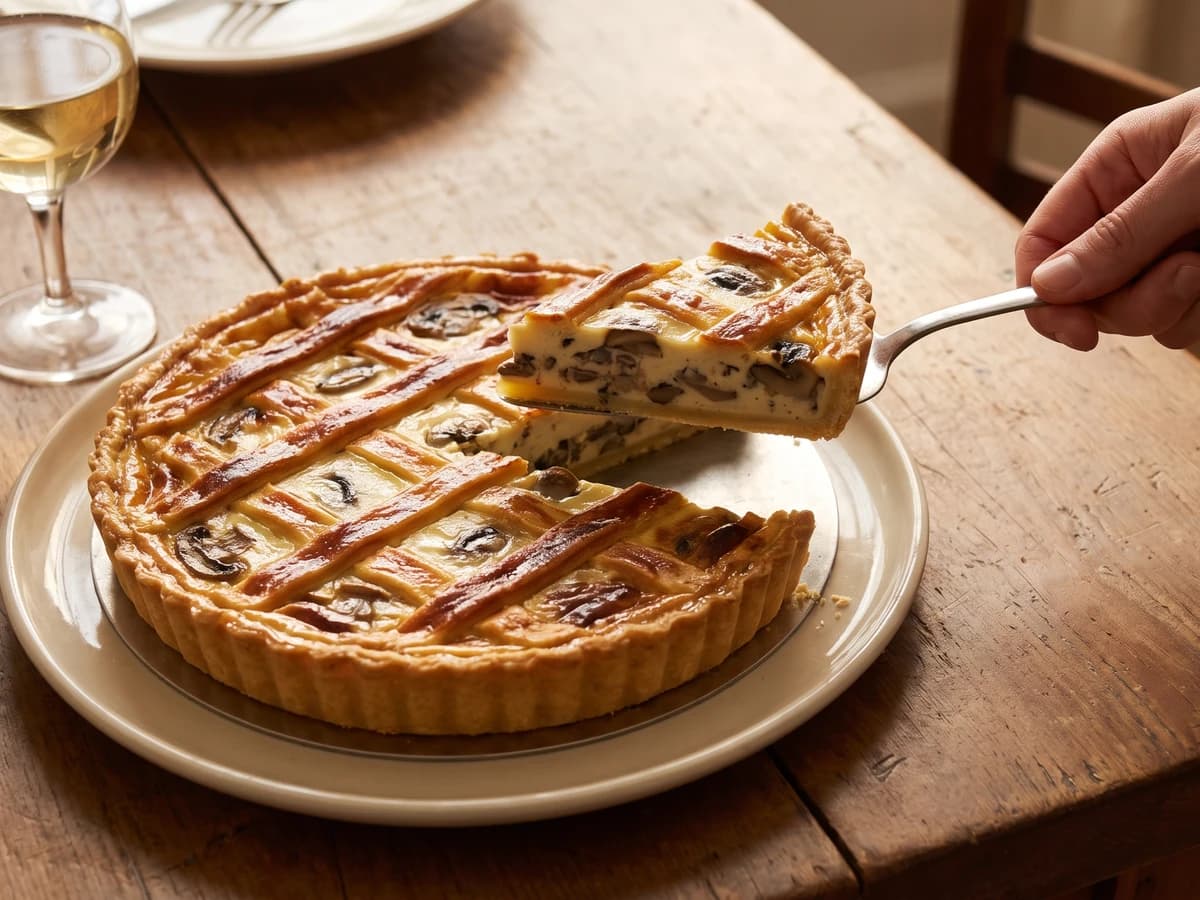
A hot mushroom flan under a butter-gold lattice, with cream reduced close around barely opened caps and a crisp short-paste base protected by one discipline: cool the filling completely.

Chef Juliette
Four little mushroom flans, latticed and gilded, baked hard and fast until butter-gold: a classical garnish scaled to the meat it accompanies and served before its crispness has time to fade.
Chef Juliette
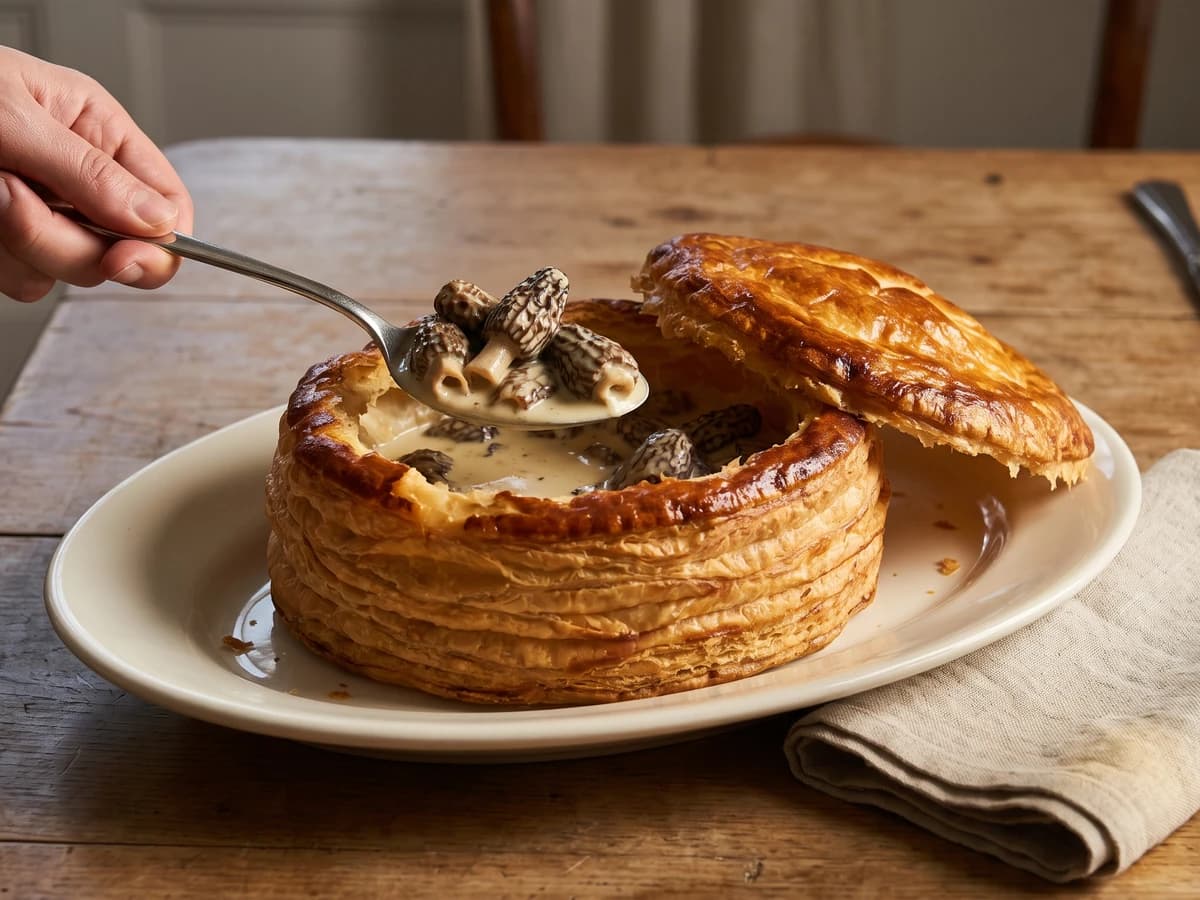
Morels surrender their liquor, then take it back as a glossy cream-and-butter sauce inside burnished puff pastry. The lesson is simple and absolute: reduce with patience, then heat gently and never boil.