
Chef Juliette
Flan aux Carottes
A pale short-paste shell holds silken, lightly sweet carrot purée beneath neat glazed half-discs, their butter syrup catching the light: a classical tart poised between vegetable course and sweet.
A cooking platform built around craft, culture, and the stories behind what we eat.

Created by Chef Juliette
Based on No. 2581, Poires à la Bourdaloue, from Le Guide Culinaire (1907) by Auguste Escoffier
Poires à la Bourdaloue turn careful trimming, vanilla poaching, and almond-rich assembly into one lesson: prepare the pear before it cooks, then let pale pastry and a fast glaze do the rest.
Poires à la Bourdaloue (vanilla-poached pear tart with frangipane and macaroon) teaches the discipline of preparing fruit before heat makes every cut clumsy. Halve medium pears, quarter large ones, core them, and trim every section while the flesh is raw. A cooked pear will not cut cleanly. Press a knife into one afterward and the fruit bruises, tears, and loses the neat shape this tart requires.
The original recipe assumed a pâtisserie bench where Apricots à la Bourdaloue (No. 2549) supplied the working formula, prepared pastry and cream stood ready, and a salamander could glaze the top in moments. At home, that formula scales to one 9-inch tart, while a saucepan, a parchment cartouche, and an ordinary oven broiler handle the pears and final colour. The brigade staging is scaffolding and can go. The pale flawn crust, two thin layers of macaroon-enriched frangipane, vanilla-poached fruit, real melted butter, and quick glaze are the dish and must stay. One cook, one stove, one evening.
When it is right, the tart has a pale, crisp rim and a mottled bronze surface with tender ivory pear held between slim layers of almond cream. Nothing should be sodden, scorched, or buried under decoration. Before you touch the pan, finish every cut on the raw pears. That is the step that decides the tart.
Poires à la Bourdaloue belongs to Parisian pâtisserie, and its name points to Rue Bourdaloue in the ninth arrondissement, not to a pear-growing province. The classical style joined poached fruit, frangipane, crushed almond macaroons, and a quickly glazed top, moving easily from the pastry-shop flawn to the home dessert table. Pear became its most familiar expression, but à la Bourdaloue was never limited to one fruit or one shell: the repertoire also set fruit and cream in timbales or within borders of rice, semolina, and Génoise.
Quantity
1 home-scale formula Apricots à la Bourdaloue (No. 2549), scaled for one 9-inch (23 cm) tart
prepare as its own entry directs, omitting only the apricots
Quantity
4 medium or 2 large (about 1 3/4 lb / 800 g total)
peeled
Quantity
4 cups (960 ml / 960 g)
Quantity
2 cups (480 ml / 400 g)
Quantity
1
split lengthwise and scraped
| Ingredient | Quantity |
|---|---|
| Apricots à la Bourdaloue preparationprepare as its own entry directs, omitting only the apricots | 1 home-scale formula Apricots à la Bourdaloue (No. 2549), scaled for one 9-inch (23 cm) tart |
| firm-ripe pearspeeled | 4 medium or 2 large (about 1 3/4 lb / 800 g total) |
| water | 4 cups (960 ml / 960 g) |
| granulated sugar | 2 cups (480 ml / 400 g) |
| vanilla beansplit lengthwise and scraped | 1 |
Prepare Apricots à la Bourdaloue (No. 2549) exactly as its own entry directs, scaling it to one 9-inch (23 cm) tart and omitting only its apricots. Stop when that formula calls for the poached fruit, keeping every prepared element in the condition its entry specifies. Do not replace its pale flawn crust or alter its cream treatment; the linked preparation carries the pastry architecture and remains whole.
Halve medium pears lengthwise or quarter large pears, just as the source directs. Scoop out the cores, remove the blossom ends, and pare each section into a clean, even shape without whittling away good fruit. Do all of this now. Once poached, a pear is too tender to trim neatly, and cutting it then crushes the flesh instead of shaping it.
Combine the water, sugar, vanilla seeds, and vanilla pod in a wide saucepan. Warm gently, stirring only until the sugar dissolves, then bring the syrup to a quiet simmer. Lower in the pear sections and cover their surface with a parchment cartouche so they remain submerged. Hold the syrup at the barest tremble, never a hard boil, and begin checking after 12 minutes. Depending on the variety and ripeness, they may need 12 to 25 minutes; they are ready when a fine skewer reaches the centre with slight resistance and the sections still hold their edges.
Remove each pear section as soon as it is tender, since different pieces rarely finish together. If the edges begin to feather or a section turns softer than intended, lift it immediately onto a cold tray and do not attempt to recut it. Chill it until firm, then move it later with a broad spatula and place any split cut side down beneath the cream. Ça se rattrape. Let sound sections cool in the syrup for 20 minutes, then drain them for at least 20 minutes and blot the cut surfaces dry. Wet fruit loosens the cream and softens the crust.
Resume Apricots à la Bourdaloue (No. 2549), replacing its half-apricots with the drained pear sections. Set the pears cut side down and space them evenly, close enough to fill the tart without pressing through the lower cream or crowding the rim. Complete every remaining cream, macaroon, and melted-butter operation exactly as the linked formula directs.
Heat the oven broiler or grill fully and place a rack about 6 inches (15 cm) beneath it. Set the tart on a rimmed baking sheet and glaze it quickly as Apricots à la Bourdaloue (No. 2549) directs, watching without leaving the oven. This is the honest home equivalent of the salamander: one to three minutes of fierce top heat, with the tart rotated as needed, until the buttered macaroon surface is mottled deep gold while the flawn edge remains pale. If one patch darkens too fast, shield it with a small piece of foil and finish the rest.
Let the tart settle for at least 45 minutes before releasing it from the tin. The cream firms as it stands, the pear juices stop running, and the crust becomes easier to slice cleanly. Serve slightly warm or at room temperature, cutting with a thin sharp knife and wiping the blade between portions. No extra decoration is needed. À table!
1 serving (about 180g)
Culinary guides, cultural storytelling, and the editorial depth that makes cooking meaningful.
Discover Culinary ExplorerChef Juliette
A pale short-paste shell holds silken, lightly sweet carrot purée beneath neat glazed half-discs, their butter syrup catching the light: a classical tart poised between vegetable course and sweet.
Chef Juliette
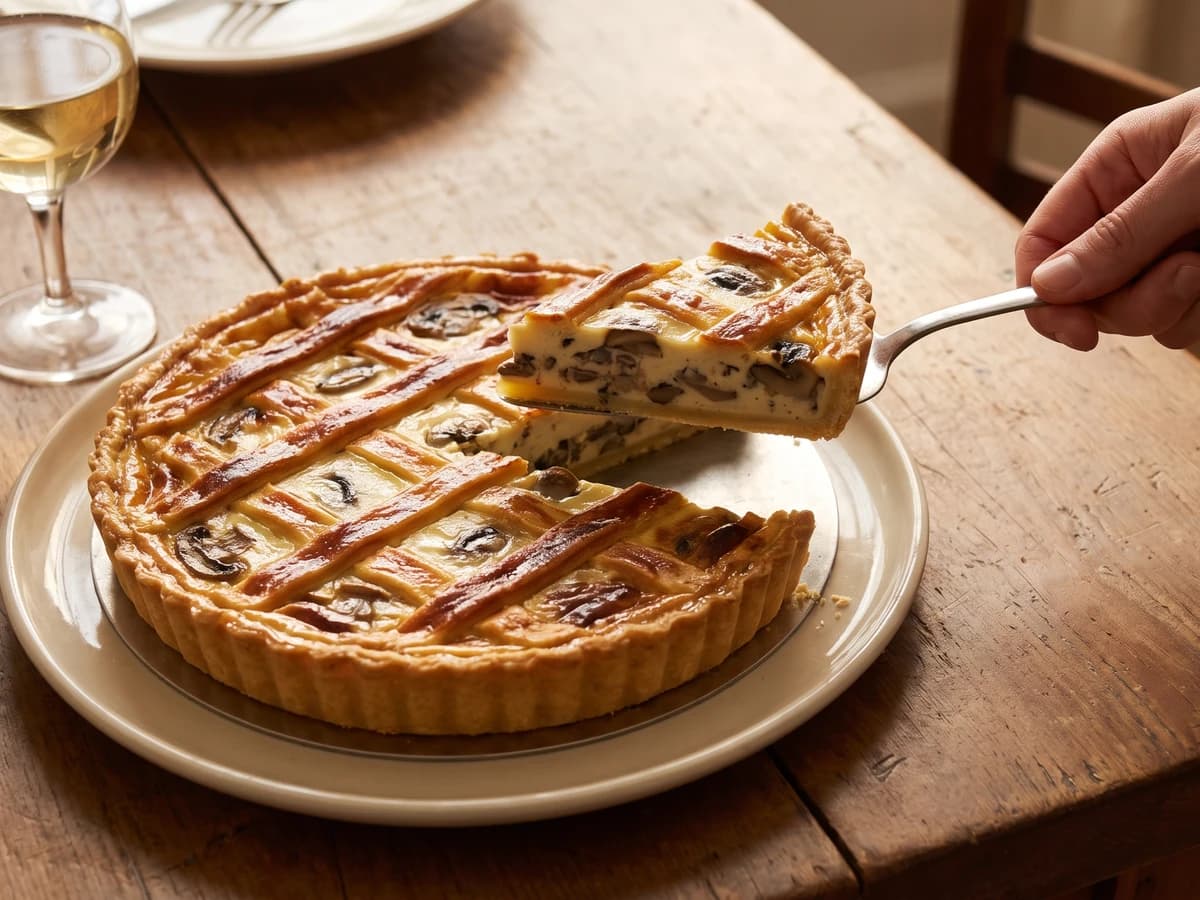
A hot mushroom flan under a butter-gold lattice, with cream reduced close around barely opened caps and a crisp short-paste base protected by one discipline: cool the filling completely.

Chef Juliette
Four little mushroom flans, latticed and gilded, baked hard and fast until butter-gold: a classical garnish scaled to the meat it accompanies and served before its crispness has time to fade.
Chef Juliette
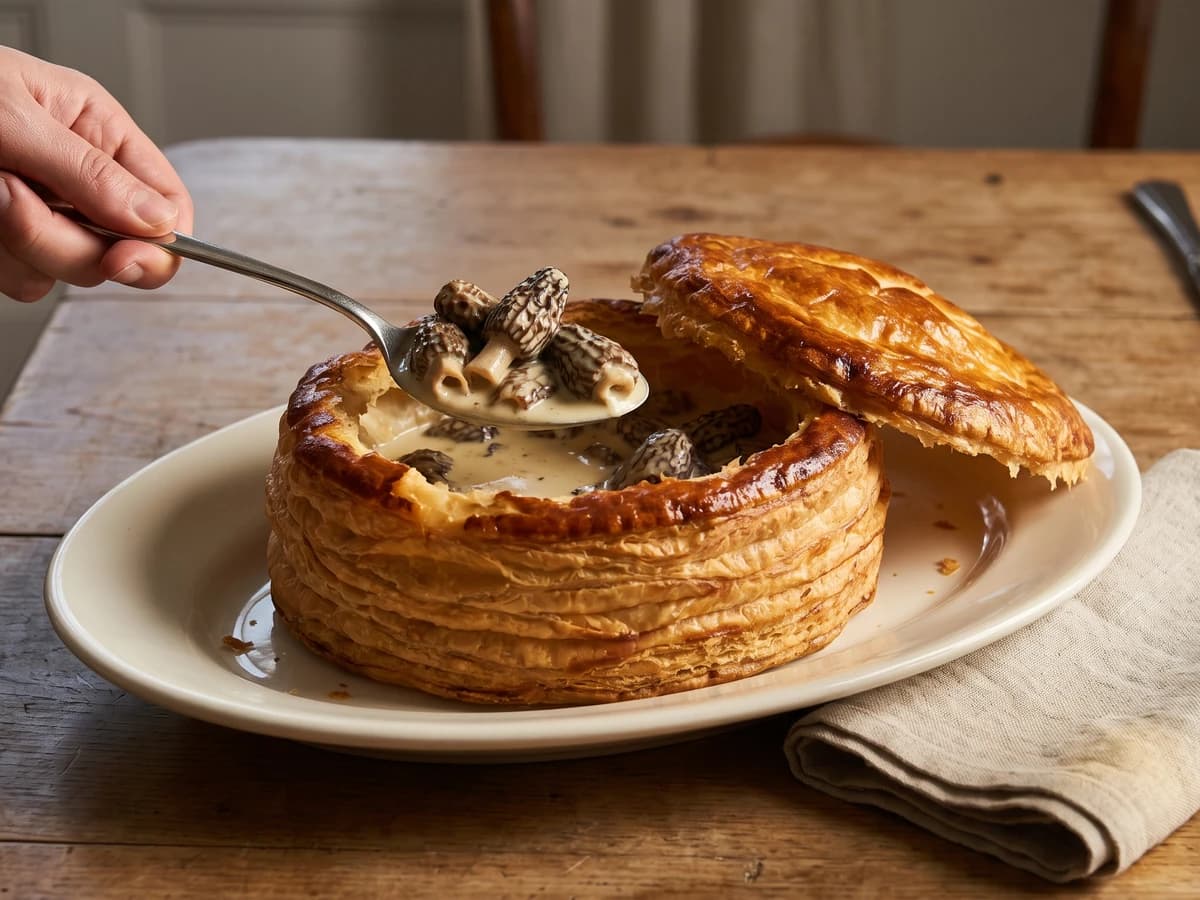
Morels surrender their liquor, then take it back as a glossy cream-and-butter sauce inside burnished puff pastry. The lesson is simple and absolute: reduce with patience, then heat gently and never boil.