Culinary Explorer

A cooking platform built around craft, culture, and the stories behind what we eat.
Discover Culinary Explorer
Pêches à la Cussy

Pêches à la Cussy

Created by Chef Juliette

Based on No. 2575, Pêches à la Cussy, from Le Guide Culinaire (1907) by Auguste Escoffier

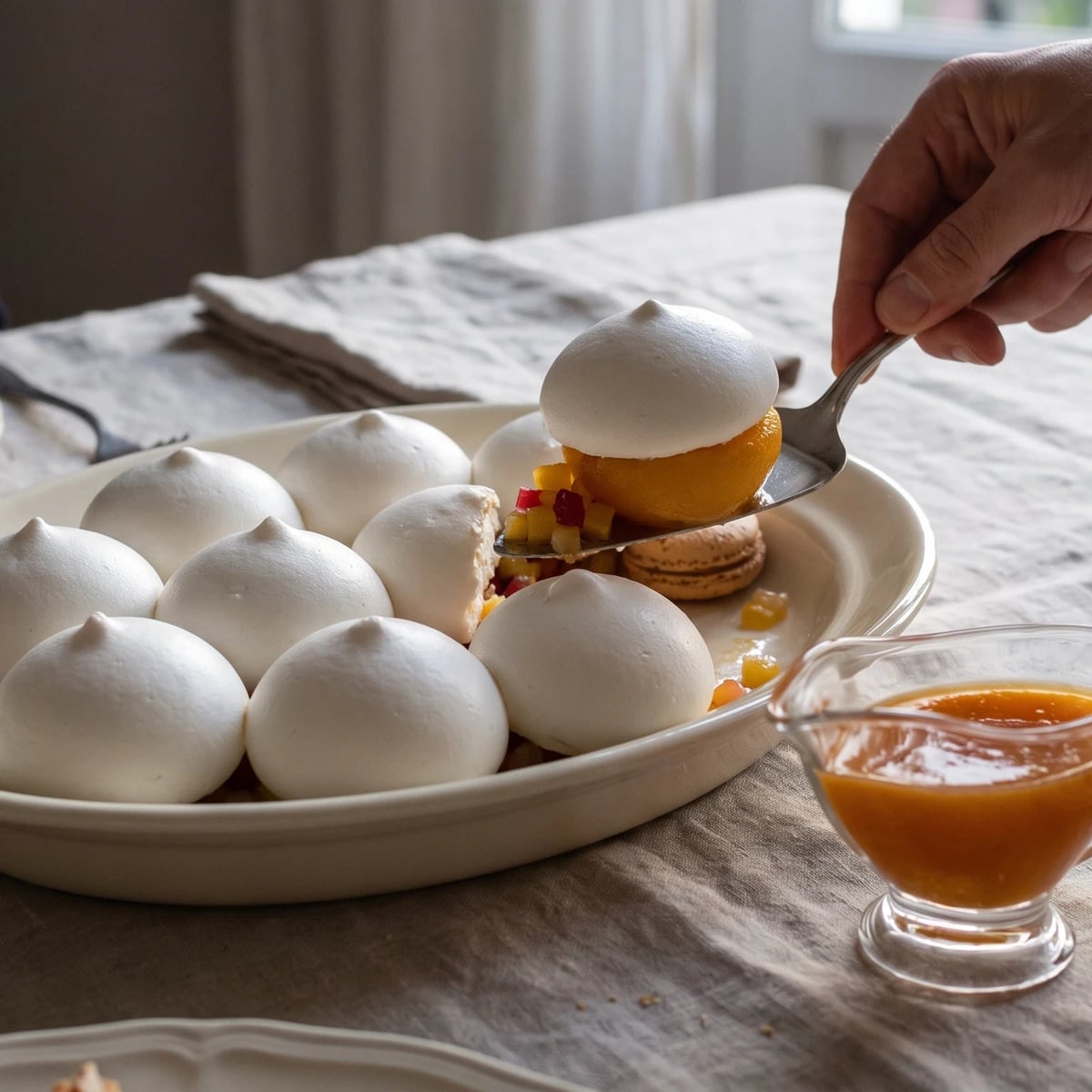
Poached peach halves rise over fruit-filled almond macaroons beneath a perfectly white coat of Italian meringue, dried just enough to set, with bright Kirsch apricot sauce passed at the table.

Desserts
French
Dinner Party
Special Occasion
Celebration
50 min
Active Time
30 min cook2 hr total
Yield4 servings (8 pieces)

Pêches à la Cussy (poached peaches under meringue) teaches a severe little lesson: drying and browning are not the same act. Its meringue italienne (Italian meringue) must set to a fine dry skin while remaining white. Colour counts as a fault, not because the plate wants fussiness, but because a toasted crust would drown the clean sequence of almond, peach, apricot, and Kirsch.

The entry sends the pastry cook to Apricots à la Cussy (No. 2553), which assumes a pastry station with poached fruit, apricot purée, fine salpicon, and meringue ready at hand. At home, make those components in sequence, use a small ovenproof platter in place of service equipment, and let a moderate oven do the drying. A salamander is too fierce for a finish that must not colour. I have scaled the crown to eight peach halves for four people. The brigade's holding and duplication are scaffolding and can go. The macaroon, bound salpicon, poached peach, meringue coat, and separate Kirsch sauce are the dish and must stay. One cook, one stove, one evening.

The finished meringue should be satin-smooth and thick enough to hide every contour, while the apricot sauce stays bright and loose in its own boat. The decisive moment comes at the oven: watch the white surface, not the clock, and pull the platter the instant the coating is dry to a light touch.

Pêches à la Cussy belongs to the Parisian grand-kitchen repertoire of named entremets, where fruit, almond pastry, meringue, and sauce were assembled as a composed dessert for formal service. Its formula traveled through the canon's family method: the peach version explicitly borrows Apricots à la Cussy (No. 2553), replacing only the poached fruit while preserving the macaroon, salpicon, meringue coat, and Kirsch-scented apricot sauce. The surprising discipline is its lack of colour: unlike a gratinéed meringue dessert, this coating is dried in a moderate oven and must remain white.

The technique, the tradition, and the story behind every dish.

Discover Culinary Explorer

Ingredients

Apricots à la Cussy

Quantity

1 home-scale governing preparation (No. 2553)

apply exactly, replacing only the apricot halves with peach halves

ripe but firm yellow peaches

Quantity

4 medium (about 1½ lb / 680 g)

water for poaching

Quantity

3⅓ cups (800 ml / 800 g)

granulated sugar for poaching

Quantity

1 cup (240 ml / 200 g)

plain almond macaroons

Quantity

8, about 2 inches / 5 cm across (about 3 oz / 85 g)

peeled peach, pear, and pineapple for the fine fruit salpicon

Quantity

½ cup total (120 ml / 90 g), equal parts

cut into even ⅛-inch / 3-mm dice

smooth unsweetened apricot purée

Quantity

1 cup (240 ml / 240 g)

divided; preferably made from drained canned apricots, blended and sieved

large egg whites

Quantity

3 (6 tablespoons / 90 ml / 90 g)

at room temperature

granulated sugar for the meringue italienne

Quantity

Scant 1 cup (210 ml / 180 g)

water for the meringue italienne

Quantity

3 tablespoons (45 ml / 45 g)

Kirsch

Quantity

1 tablespoon (15 ml / 14 g)

Equipment Needed

  • Wide 3-quart / 3-litre saucepan
  • Stand mixer or electric hand mixer
  • Digital sugar thermometer
  • Small heavy saucepan for sugar syrup
  • 11-inch / 28-cm ovenproof serving platter
  • Fine-mesh sieve
  • Small offset spatula

Instructions

  1. 1

    Honor the governing formula

    This entry reaches for Apricots à la Cussy (No. 2553) as its governing preparation. Keep that formula's exact sequence: almond macaroon, fruit salpicon bound with apricot purée, poached fruit half, meringue italienne, gentle oven drying, then Kirsch-flavoured apricot sauce served separately. Only the apricot half becomes a peach half; changing anything else would change the dish.

  2. 2

    Poach the peaches

    Bring the water and poaching sugar to a bare simmer in a wide saucepan. Halve the peaches along their seams, remove the stones, and lower the halves into the syrup skin-side down. Poach at the gentlest tremble for 3 to 7 minutes, turning once, until a small knife enters with light resistance. Lift them out as each becomes ready; a hard boil frays the edges and turns fine peach halves into compote. Cool them in the syrup for 15 minutes, slip off the skins, then drain cut-side down and blot every surface thoroughly.

    Firm-ripe peaches hold their curves after poaching. If the raw fruit already yields deeply under a finger, give it only enough time in the syrup to loosen the skin.
  3. 3

    Bind the salpicon

    Combine the evenly diced fruit with 2 tablespoons (30 ml / 30 g) of the apricot purée. This is the salpicon, a fine, regular dice held together just enough to sit neatly on the macaroon. It should cohere without releasing a puddle. If it runs, drain off the excess purée and add a little more diced fruit; if it falls apart, bind it with another teaspoon of purée. Spread about 2 teaspoons over the flat side of each macaroon, stopping just short of the edge.

  4. 4

    Build the apricot sauce

    Whisk the remaining apricot purée with ¼ cup (60 ml / 60 g) of the peach poaching syrup. Simmer for 2 to 3 minutes, just until the sauce flows in a glossy ribbon, then pass it through a fine sieve. Let it cool for 5 minutes before stirring in the Kirsch, which keeps the cherry perfume clear instead of boiling it away. If the sauce becomes too thick, loosen it with poaching syrup one spoonful at a time; if it is watery, reduce it before adding the Kirsch. Hold it at room temperature in a sauceboat.

  5. 5

    Whip the meringue italienne

    Heat the oven to 325°F / 160°C with a rack in the centre and convection switched off. Put the meringue sugar and water in a small clean saucepan, dissolve the sugar over low heat, then cook without stirring. When the syrup reaches 230°F / 110°C, begin whipping the egg whites in a grease-free mixer bowl. Bring them to soft peaks as the syrup reaches 244°F / 118°C. With the mixer running at medium speed, pour the syrup in a thin stream down the inside of the bowl, avoiding the moving whisk. Beat at high speed until the meringue italienne is dense, glossy, and barely warm, about 7 minutes. If the syrup crystallizes and turns sandy, remove it from the heat, add 1 tablespoon of reserved poaching syrup, and warm gently until clear before returning it to 244°F / 118°C. Ça se rattrape.

    A thermometer earns its place here. Undercooked syrup makes a slack coating; syrup cooked too far hardens into threads before it can join the whites.
  6. 6

    Build the crown

    Arrange the eight prepared macaroons in a close crown on an ovenproof serving platter. Set one peach half cut-side down on each mound of salpicon. Spoon the meringue italienne generously over every peach, then smooth it into an even ¼-inch / 6-mm coat that reaches the platter and seals the peach, fruit, and macaroon together. No peach should remain visible. If the coating slides, the fruit is still wet: scrape the meringue back into the bowl, blot the peach again, and recoat it. Never apologize at your own table; fix it and carry on.

  7. 7

    Dry without colour

    Place the platter in the moderate oven for 4 to 6 minutes, watching continuously after the third minute. The meringue is ready when its surface feels dry and no longer clings to a light fingertip, while remaining completely white. Colour counts as a fault here. If the surface threatens to turn ivory before it is dry, switch off the oven, open the door slightly, and let the residual warmth finish the coating for another minute or two. Never use the broiler.

  8. 8

    Pass the sauce

    Rest the crown for 3 minutes, then carry the whole platter to the table. Serve two pieces to each person and pass the Kirsch apricot sauce separately, so each diner spoons it beside the peaches without staining the white meringue. Almond first, then fine fruit, tender peach, and the bright sauce at the end. À table!

Chef Tips

  • Choose freestone yellow peaches that smell ripe but remain firm around the seam. Soft peaches collapse during poaching, while hard, scentless fruit never gains enough character from syrup alone.
  • Out of season, use 8 large canned peach halves packed in juice, about 1¼ lb / 560 g drained. They have already been gently cooked, so don't poach them again; drain, blot thoroughly, and proceed.
  • Use plain almond macaroons with a flat base, not filled Paris macarons. They must be dry enough to support the salpicon and peach without dissolving before the crown reaches the table.
  • Kirsch means dry cherry eau-de-vie, not sweet cherry liqueur. Add it away from the heat, where its perfume stays clear and gives the apricot sauce its necessary edge.
  • The moderate oven replaces the pastry kitchen's controlled drying cabinet. A broiler or salamander supplies fierce top heat and would colour the meringue, precisely the result this dish forbids.

Advance Preparation

  • Poach the peaches up to one day ahead and refrigerate them in their syrup. Drain and blot them immediately before assembly, because moisture prevents the meringue from holding.
  • Prepare the apricot purée and Kirsch sauce earlier in the day. Cover the sauce and hold it in the cold, then bring it back to room temperature before serving.
  • Cut the salpicon fruit up to 4 hours ahead, but bind it with apricot purée only shortly before spreading it over the macaroons.
  • Make the meringue, assemble the crown, and dry it shortly before serving. The completed dessert can stand for about 30 minutes, but longer holding softens the macaroons.

Frequently Asked Questions

Nutrition Information

1 serving (about 335g)

Calories
450 calories
Total Fat
5 g
Saturated Fat
1 g
Trans Fat
0 g
Unsaturated Fat
4 g
Cholesterol
0 mg
Sodium
55 mg
Total Carbohydrates
94 g
Dietary Fiber
5 g
Sugars
87 g
Protein
7 g

Note: Chef personas and recipes are created with AI assistance. Cook with care: follow safe food-handling practices, check doneness with a thermometer when needed, and adapt for allergies and your kitchen.

Where cooking meets culture.

Culinary guides, cultural storytelling, and the editorial depth that makes cooking meaningful.

Discover Culinary Explorer

More from Entremets (Sweets) - Hot Fruit Entremets

Browse the full collection