
Chef Juliette
Various Almond Preparations
Five almond preparations, one discipline: remove the skins cleanly, dry every kernel through, then cut, toast, or cloak it in pale caramel without letting its fragrant oils escape.
A cooking platform built around craft, culture, and the stories behind what we eat.
Created by Chef Juliette
Based on No. 2553, Apricots à la Cussy, from Le Guide Culinaire (1907) by Auguste Escoffier
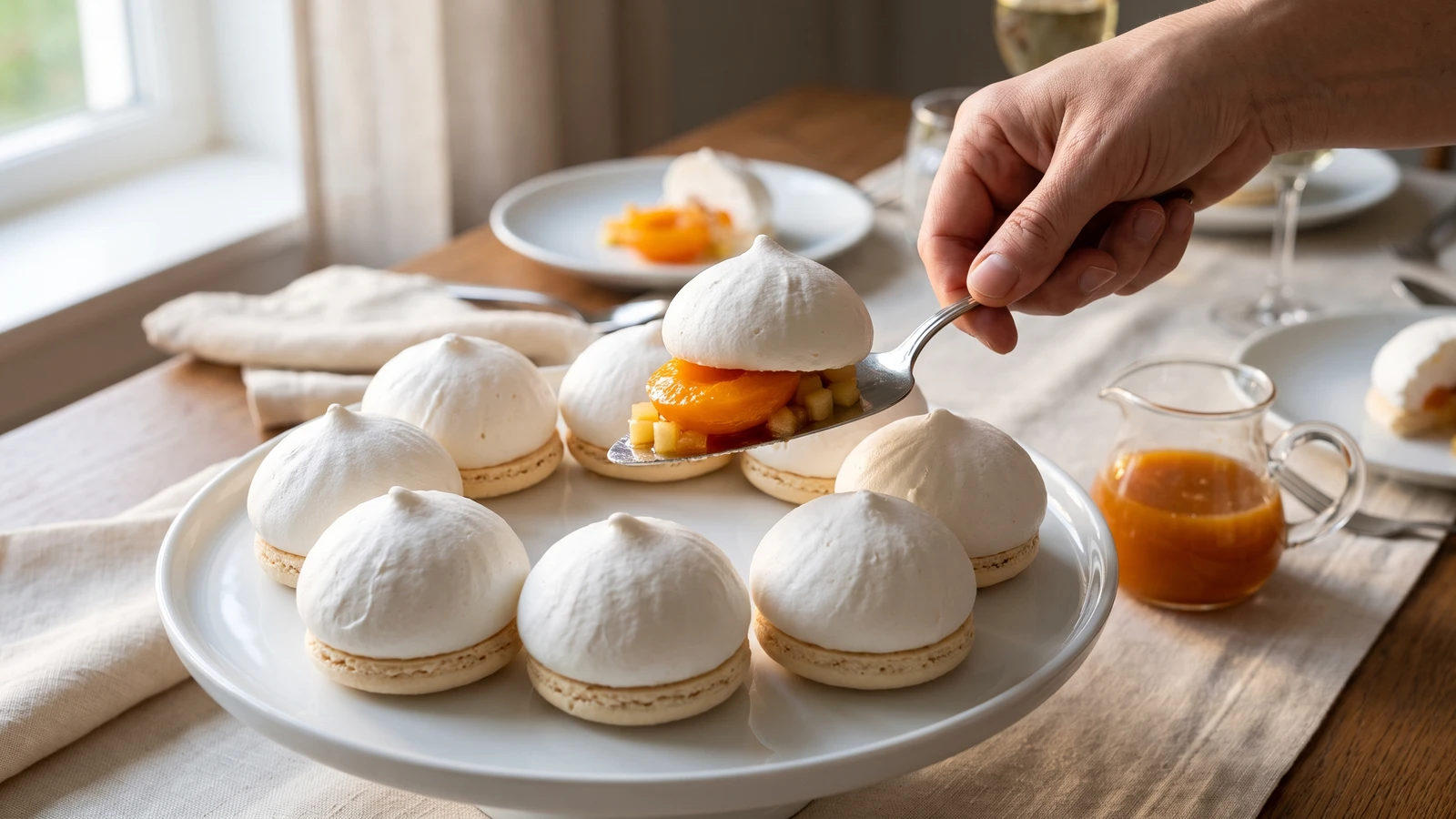
Apricot, almond, and Kirsch meet in a crown of macaroon-based sweets, each hidden beneath Italian meringue dried perfectly white and served with a bright apricot sauce at the table.
Apricots à la Cussy (macaroon crowns with poached apricots and white meringue) teaches restraint inside abundance. The one true thing is this: the meringue must dry through and remain white. Colour would make it handsome in the wrong way, burying the clear apricot and almond beneath a toasted flavour the dish never asked for.
The original assumed a pastry station with poached fruit, apricot purée, and meringue ready for assembly. There is no saucier or permanent stockpot to imitate in this sweet, and a salamander would be exactly the wrong tool. For the home table, one saucepan, an ovenproof platter, and a low-moderate oven replace that brigade of prepared components. The quantity becomes eight pieces, while the sequence and proportions remain intact. The brigade's standing supply of components is scaffolding and can go; the macaroon, bound salpicon, poached apricot, white meringue, and separate Kirsch sauce are the dish and all stay.
The salpicon is a fine dice of fruit cohered with apricot purée, not a loose fruit salad. The Meringue à l’Italienne (No. 2383), the Italian meringue, arrives as a finished preparation from its own entry, exactly as the original intends. Make the fruit and sauce first, then assemble without delay. Watch the meringue, not the clock. Its white, just-dry surface is the step that decides everything.
Apricots à la Cussy belongs to the named Parisian grand-kitchen repertoire, where composed sweets often honoured celebrated patrons and gourmands rather than claiming a province. The title recalls the Marquis de Cussy, a gastronome and writer, while the construction displays the pastry kitchen's precise grammar: macaroon, salpicon, poached fruit, Italian meringue, and a separately served Kirsch-flavoured sauce. Its pale finish corrects a common assumption about meringue desserts: the oven sets and dries this coating, but browning it changes the intended dish.
Quantity
5 (about 14 ounces / 400 g)
halved and pitted
Quantity
2 cups (475 ml / 475 g)
Quantity
3/4 cup (180 ml / 150 g)
Quantity
1/2 small (about 1/4 cup / 45 g)
peeled and cored
Quantity
2 tablespoons (30 ml / 32 g)
for the salpicon
Quantity
3/4 cup (180 ml / 190 g)
for the sauce
Quantity
8
about 2 inches (5 cm) wide
Quantity
1 3/4 cups (415 ml / 225 g) Meringue à l’Italienne (No. 2383)
Quantity
1 tablespoon (15 ml / 14 g)
| Ingredient | Quantity |
|---|---|
| firm-ripe fresh apricotshalved and pitted | 5 (about 14 ounces / 400 g) |
| water | 2 cups (475 ml / 475 g) |
| granulated sugar | 3/4 cup (180 ml / 150 g) |
| firm-ripe pearpeeled and cored | 1/2 small (about 1/4 cup / 45 g) |
| unsweetened apricot puréefor the salpicon | 2 tablespoons (30 ml / 32 g) |
| unsweetened apricot puréefor the sauce | 3/4 cup (180 ml / 190 g) |
| plain almond macaroonsabout 2 inches (5 cm) wide | 8 |
| Meringue à l’Italienne | 1 3/4 cups (415 ml / 225 g) Meringue à l’Italienne (No. 2383) |
| Kirsch | 1 tablespoon (15 ml / 14 g) |
Combine the water and sugar in a wide saucepan and warm gently until the syrup is completely clear. Add the apricot halves in one layer, cut sides down, and hold the syrup at the barest tremble for 2 to 5 minutes, turning once. Lift each half as soon as a small knife enters with slight resistance; the fruit must be tender but still able to carry its own weight. Cool the halves in a shallow dish with enough syrup to cover them. If one or two soften too far, don't discard them. Choose the eight finest halves for the crowns and reserve the softer ones for the salpicon. Ça se rattrape.
Drain the two remaining poached apricot halves well and cut them with the pear into an even 1/8-inch (3 mm) dice. This is the salpicon: distinct, fine pieces held together by sauce. Fold in the 2 tablespoons of apricot purée, using only enough to cohere the fruit into a spoonable layer. If it runs or sheds liquid, drain it briefly through a fine sieve and return only the fruit to the bowl. A wet salpicon dissolves the macaroons; a bound one softens them just enough.
Measure 1/4 cup (60 ml / 60 g) of the poaching syrup into a small saucepan and add the 3/4 cup of apricot purée reserved for the sauce. Simmer gently for 3 to 5 minutes, stirring, until the sauce flows in a glossy ribbon and lightly coats a spoon. Pass it through a fine sieve, let it cool until merely warm, then stir in the Kirsch so its clear cherry perfume remains. If the sauce is thin, reduce it before adding the Kirsch; if it tightens too far, loosen it with poaching syrup one teaspoon at a time. Set it aside in a small pitcher.
Heat the oven to 300°F (150°C), or 275°F (135°C) with convection. Arrange the eight macaroons flat sides up in a crown on a 12-inch (30 cm) ovenproof platter. Spoon a neat layer of salpicon onto each, leaving a narrow rim so the fruit cannot escape. Drain the eight reserved apricot halves thoroughly, blot their cut sides, and set one half cut side down on every macaroon. Press only enough to seat it; crushed fruit will leak beneath the meringue.
Bring the finished Meringue à l’Italienne (No. 2383) to the platter and spoon it generously over each apricot mound, coating the fruit and salpicon down to the edge of the macaroon. Smooth it into an even layer about 1/4 inch (6 mm) thick, with low, soft ridges rather than tall points, since points colour first. If the meringue drags or tears, dip the offset spatula in hot water, dry it completely, and smooth the surface again.
Place the platter on the centre rack and dry the meringue for 8 to 10 minutes, checking after 6. It is ready when the surface feels dry beneath a light fingertip and remains satin-white. If an edge begins to turn beige before the coating sets, remove the platter at once, switch off the oven, leave the door open for one minute, then return the dish to the falling heat for 3 to 5 minutes. Ça se rattrape. A moderate oven is part of the dish; a broiler would colour the meringue before its centre dried.
Let the crown settle for 5 minutes, then carry the platter to the table while the macaroons remain lightly crisp beneath their fruit. Pass the Kirsch-flavoured apricot sauce separately so each guest can spoon it around, not over, the white meringue. Serve two pieces per person. À table!
1 serving (about 245g)
Culinary guides, cultural storytelling, and the editorial depth that makes cooking meaningful.
Discover Culinary ExplorerChef Juliette
Five almond preparations, one discipline: remove the skins cleanly, dry every kernel through, then cut, toast, or cloak it in pale caramel without letting its fragrant oils escape.

Chef Juliette
A pastry pantry lesson in one tray: filberts warmed only until their red skins release, rubbed clean, cooled, and chopped into a fragrant mise-en-place for cakes, creams, pralines, and petits fours.

Chef Juliette
The smallest pâtisserie discipline decides whether a cake leaves its mould intact: clarified butter in every corner, followed by the lightest veil of dry flour or fécule.

Chef Juliette
Four whites, one spotless bowl, and a patient change of speed: whisk gently until loosened, then briskly to glossy stiffness, with powdered sugar waiting if the foam begins to granulate.