
Chef Juliette
Apricots (Abricots)
Apricots peeled clean and poached just to tenderness, their golden halves held in clear syrup for tarts and cold sweets: a small lesson in texture, restraint, and knowing when fruit is ready.
A cooking platform built around craft, culture, and the stories behind what we eat.
Created by Chef Juliette
Based on No. 2574, Pêches à la Condé, from Le Guide Culinaire (1907) by Auguste Escoffier
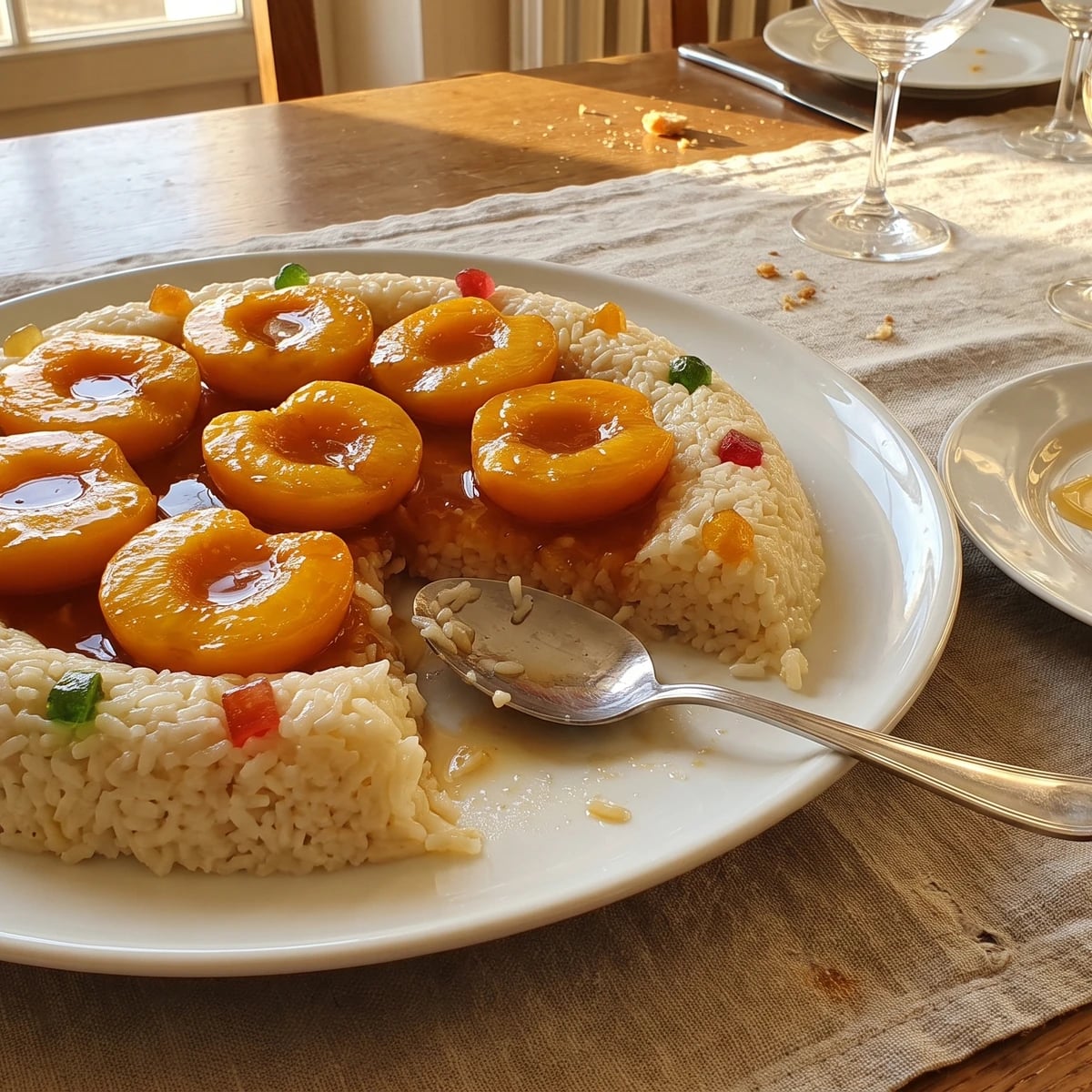
Poached peach halves keep their shape above vanilla-scented rice, candied fruit, and glossy apricot-Kirsch syrup, with a second Condé arrangement of Génoise sponge roundels and crisp rice croquettes.
Pêches à la Condé (poached peaches with vanilla rice and apricot-Kirsch sauce) teaches the discipline of ripeness. The fruit must be fragrant enough to perfume the syrup and firm enough to survive it; know that before you touch a pan. Rice and Génoise can be exact, but a collapsing peach makes either arrangement lose its shape.
The book assumes a pâtisserie bench where vanilla sweet rice, apricot glaze, Génoise sponge, sugared cherries, and rice croquettes wait in their own pans, plus a buttered border mould and enough hands to assemble a formal dessert. Your home equivalent is simpler and faithful: make either Apricots à la Condé (No. 2551) or Apricots à la Condé (2nd method) (No. 2552) at a four-serving scale, replace its apricots one for one with peaches, and use a buttered spoon instead of a border mould. The reduction and arrangement stay. The mould and extra hands are brigade scaffolding and can go.
Method 1, fruit on a rice border, is the calm one-cook path. Method 2, peach halves on Génoise with rice croquettes at the centre, keeps all its ceremony and asks you to prepare the components ahead. Neither needs invention. One cook, one stove, one evening. The poach is the step that matters most: hold the syrup at a tremble and lift the halves while their centres still resist the skewer.
Pêches à la Condé belongs to the Parisian grand-kitchen repertoire, where composed fruit and rice entremets formed a distinct dessert course. The name Condé became attached to sweet rice preparations and is traditionally linked to the princely House of Condé, although no single table owns a settled account of the naming. This entry's direct application of two apricot arrangements to peaches reveals the governing idea: the poached stone fruit may change, but the vanilla rice, formal crown, and apricot-Kirsch finish define the dish.
Quantity
4 medium (about 1½ pounds / 680 g)
preferably freestone
Quantity
4 cups (950 ml / 950 g)
for peeling and controlling the poach
Quantity
1 four-serving preparation Apricots à la Condé (No. 2551)
Make as directed, replacing its apricots with the peaches above
Quantity
1 four-serving preparation Apricots à la Condé (2nd method) (No. 2552)
Make as directed, replacing its apricots with the peaches above; use instead of Method 1
| Ingredient | Quantity |
|---|---|
| ripe but firm medium peachespreferably freestone | 4 medium (about 1½ pounds / 680 g) |
| ice water (optional)for peeling and controlling the poach | 4 cups (950 ml / 950 g) |
| Apricots à la Condé preparation for Method 1 (optional)Make as directed, replacing its apricots with the peaches above | 1 four-serving preparation Apricots à la Condé (No. 2551) |
| Apricots à la Condé (2nd method) preparation for Method 2 (optional)Make as directed, replacing its apricots with the peaches above; use instead of Method 1 | 1 four-serving preparation Apricots à la Condé (2nd method) (No. 2552) |
Choose one presentation, not both. For the rice-border presentation, reach for Apricots à la Condé (No. 2551) and prepare its complete formula at a four-serving scale, holding back the apricots. For the Génoise crown and rice-croquette presentation, reach for Apricots à la Condé (2nd method) (No. 2552) and do the same. Keep each referenced preparation whole and follow its own entry; this recipe changes only the fruit and the home-scale equipment.
Cut a shallow cross through the skin at the base of each peach. Lower the peaches into a saucepan of boiling water for 20 seconds, then move them into the ice water. Slip off the skins, halve the fruit cleanly along its seam, and remove the stones without pressing the flesh. If a skin resists, return that peach to the water for 10 seconds; scraping at it with a knife bruises the surface the syrup should leave smooth.
Bring the poaching syrup supplied by Apricots à la Condé (No. 2551), or by Apricots à la Condé (2nd method) (No. 2552), to the faintest simmer. Lay in the peach halves in one layer and poach for 3 to 7 minutes, turning once, until a fine skewer enters the thickest part with slight resistance. Lift each half as it reaches that point; they need not finish together. If the syrup boils and the fruit's edges begin to feather, pull the pan off the heat, add 2 tablespoons (30 ml / 30 g) of the ice water, and lift the peaches immediately. Ça se rattrape. Their own heat will finish the centres.
Set the peach halves in a single layer on a rack or shallow tray and let them drain without stacking. For Method 1, bring the Kirsch-flavoured apricot syrup from Apricots à la Condé (No. 2551) to the coating consistency its entry specifies. For Method 2, finish the Kirsch-flavoured apricot sauce from Apricots à la Condé (2nd method) (No. 2552) as directed and reserve it separately. If either finish tightens before serving, warm it gently and loosen it with a teaspoon of cooled peach-poaching syrup; if it runs watery, reduce it before the Kirsch goes in.
Complete Apricots à la Condé (No. 2551) exactly as directed, replacing each poached apricot half with a drained peach half. Shape the finished vanilla sweet rice into an even border on a round dish with a lightly buttered spoon or flexible spatula; the special border mould is useful, not necessary. Arrange the peach halves on the rice, decorate with the prescribed candied fruit, and coat evenly with the Kirsch-flavoured apricot syrup. A thin glaze should cling and gleam, not collect in a moat.
For the alternative, complete Apricots à la Condé (2nd method) (No. 2552) exactly as directed, substituting one drained peach half for each poached apricot half. Set the crown of small Génoise roundels around the dish, place a peach half on each with its convex side underneath, and put half a sugared cherry in every hollow. Build the prescribed pyramid of apricot-shaped rice croquettes in the centre and serve the Kirsch-flavoured apricot sauce separately. The Génoise and croquettes are the dish in this method, not decoration to be omitted.
Let Method 1 settle for 10 minutes so the rice border holds cleanly when served. Bring Method 2 to the table as soon as its freshly fried croquettes are arranged, with the sauce alongside. Give each person two peach halves and a generous share of rice or croquettes. Cooking well is not cooking fancy, even when the platter knows how to make an entrance. À table!
1 serving (about 320g)
Culinary guides, cultural storytelling, and the editorial depth that makes cooking meaningful.
Discover Culinary Explorer
Chef Juliette
Apricots peeled clean and poached just to tenderness, their golden halves held in clear syrup for tarts and cold sweets: a small lesson in texture, restraint, and knowing when fruit is ready.

Chef Juliette
Abricots à la Bourdaloue teaches the discipline of colour: an ivory flawn crust, macaroon-rich frangipane, and vanilla-poached fruit, finished with one fierce flash of buttered gratin.

Chef Juliette
Firm-poached apricots, sweet entremets rice, and a fine panure à l’anglaise meet the fryer for one golden minute, then arrive crisp with warm Kirsch apricot sauce alongside.

Chef Juliette
Apricots à la Condé sets tender poached fruit on a border of distinct vanilla rice grains, then coats the whole with glossy kirsch-scented apricot syrup and bright candied fruit.